


The Sisyphean Cycle of Technology Panics
- PMID: 32603635
- PMCID: PMC7477771
- DOI: 10.1177/1745691620919372
The Sisyphean Cycle of Technology Panics
Abstract
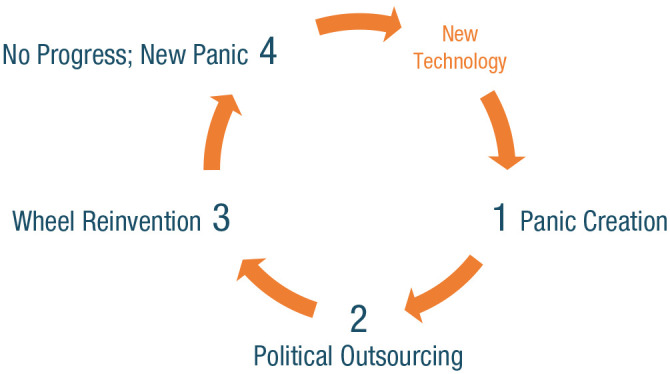
Widespread concerns about new technologies-whether they be novels, radios, or smartphones-are repeatedly found throughout history. Although tales of past panics are often met with amusement today, current concerns routinely engender large research investments and policy debate. What we learn from studying past technological panics, however, is that these investments are often inefficient and ineffective. What causes technological panics to repeatedly reincarnate? And why does research routinely fail to address them? To answer such questions, I examined the network of political, population, and academic factors driving the Sisyphean cycle of technology panics. In this cycle, psychologists are encouraged to spend time investigating new technologies, and how they affect children and young people, to calm a worried population. Their endeavor, however, is rendered ineffective because of the lack of a theoretical baseline; researchers cannot build on what has been learned researching past technologies of concern. Thus, academic study seemingly restarts for each new technology of interest, which slows down the policy interventions necessary to ensure technologies are benefiting society. In this article, I highlight how the Sisyphean cycle of technology panics stymies psychology's positive role in steering technological change and the pervasive need for improved research and policy approaches to new technologies.
Keywords: adolescents; digital-technology use; screen time; social media; well-being.
Conflict of interest statement
Figures
References
-
- Altman I., Taylor D. A. (1973). Social penetration: The development of interpersonal relationships. New York, NY: Holt, Rinehart and Winston.
-
- Anderson J. A. (2008). The production of media violence and aggression research: A cultural analysis. American Behavioral Scientist, 51, 1260–1279. doi: 10.1177/0002764207312019 - DOI
-
- Anderson M., Jiang J. (2018. May 31). Teens, social media & technology 2018. Pew Research Center. Retrieved from https://www.pewresearch.org/internet/2018/05/31/teens-social-media-techn...
Publication types
MeSH terms
LinkOut - more resources
Full Text Sources
Medical
Miscellaneous
