Review
. 2020 Jul;10(7):200085.
doi: 10.1098/rsob.200085. Epub 2020 Jul 1.

What do editors do? Understanding the physiological functions of A-to-I RNA editing by adenosine deaminase acting on RNAs

Affiliations
Review

What do editors do? Understanding the physiological functions of A-to-I RNA editing by adenosine deaminase acting on RNAs

Jacki E Heraud-Farlow et al. Open Biol. 2020 Jul.

Abstract

Adenosine-to-inosine (A-to-I) editing is a post-transcriptional modification of RNA which changes its sequence, coding potential and secondary structure. Catalysed by the adenosine deaminase acting on RNA (ADAR) proteins, ADAR1 and ADAR2, A-to-I editing occurs at approximately 50 000-150 000 sites in mice and into the millions of sites in humans. The vast majority of A-to-I editing occurs in repetitive elements, accounting for the discrepancy in total numbers of sites between species. The species-conserved primary role of editing by ADAR1 in mammals is to suppress innate immune activation by unedited cell-derived endogenous RNA. In the absence of editing, inverted paired sequences, such as Alu elements, are thought to form stable double-stranded RNA (dsRNA) structures which trigger activation of dsRNA sensors, such as MDA5. A small subset of editing sites are within coding sequences and are evolutionarily conserved across metazoans. Editing by ADAR2 has been demonstrated to be physiologically important for recoding of neurotransmitter receptors in the brain. Furthermore, changes in RNA editing are associated with various pathological states, from the severe autoimmune disease Aicardi-Goutières syndrome, to various neurodevelopmental and psychiatric conditions and cancer. However, does detection of an editing site imply functional importance? Genetic studies in humans and genetically modified mouse models together with evolutionary genomics have begun to clarify the roles of A-to-I editing in vivo. Furthermore, recent developments suggest there may be the potential for distinct functions of editing during pathological conditions such as cancer.

Keywords: ADAR; RNA editing; innate immune sensing; mouse models.


Conflict of interest statement

The authors declare that they have no competing interests.

Figures
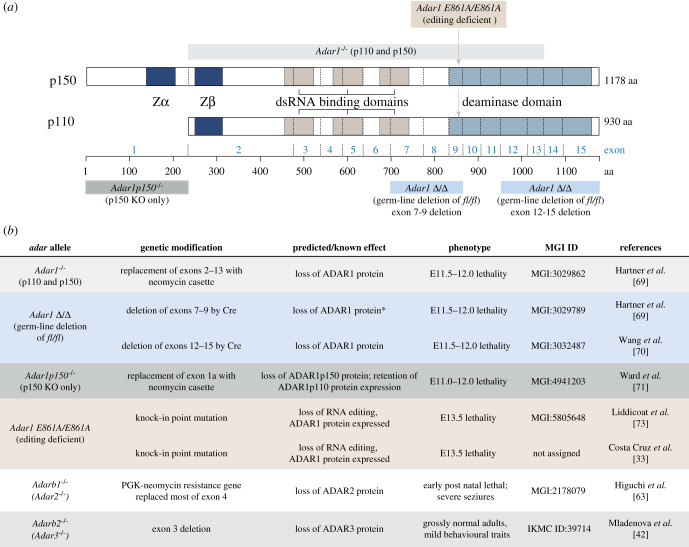
Figure 1.
Figure 1.
Summary of mouse alleles used to study functions of A-to-I editing. (a) Schematic representation of the two ADAR1 protein isoforms which are expressed from alternative promoters at the Adar locus and an indication of the various murine deletion alleles fall on the protein domain structure. (b) Summary of the different ADAR family mutant mouse models that have been described.
Figure 2.
Figure 2.
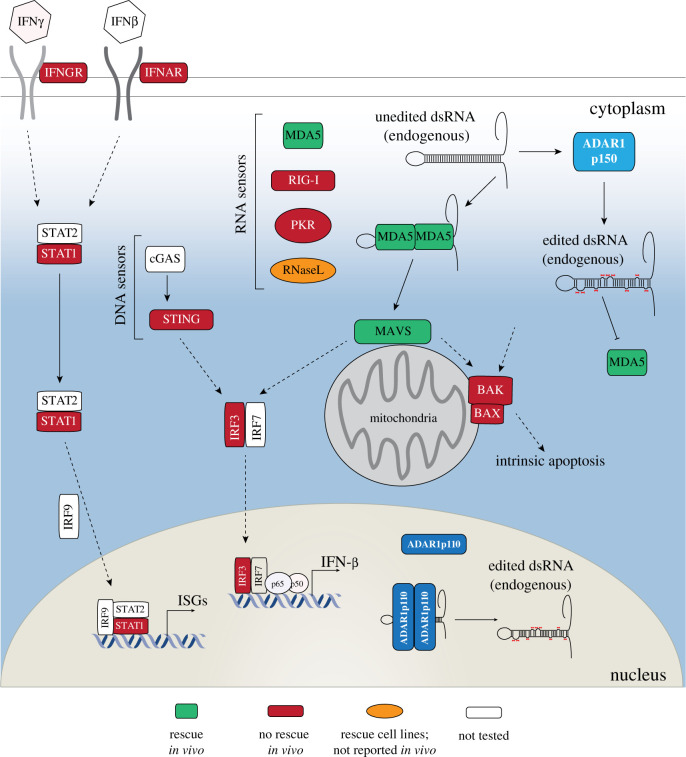
Summary of genetic crosses to test interactions with Adar. (a) Summary of innate immune pathways that respond to unedited dsRNA. Colour coded by whether co-deletion of the components rescue ADAR1-editing deficiency. See table 1 for detailed description of crosses and references.
Figure 3.
Figure 3.
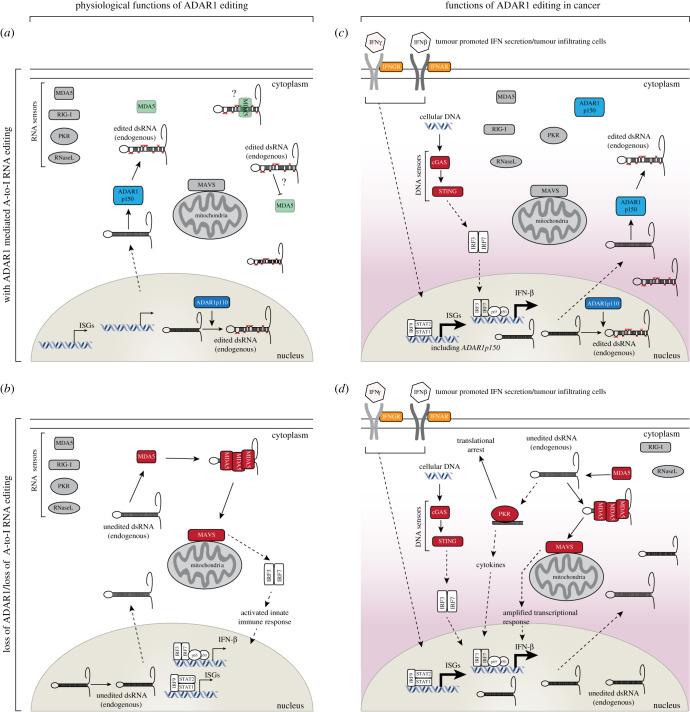
Model for alternative pathways responding to loss of editing by ADAR1 under physiological and pathological states. Under normal homeostatic conditions (a), low levels of dsRNA are produced by the cell, which are edited in both the nucleus and cytoplasm to prevent activation of MDA5. In the absence of editing (b), unedited endogenous dsRNA triggers the activation of MDA5/MAVS resulting in the production of IFN and ISGs. Some cancers have chronic activation of the DNA sensing innate immune pathway, cGAS/STING (c), which leads to increased interferon secretion, induction of ISGs including ADAR1 and PKR and increased dsRNA which is edited by ADAR1. In the absence of editing by ADAR1 in this state (d), the interferon-induced and cellular dsRNA triggers activation of both MDA5/MAVS and PKR leading to further induction of ISGs and translational shutdown. Abbreviations: IFN, interferon. ISGs, interferon-stimulated genes. In (b,d) the active pathway participants are coloured in red.

References

    1. Boccaletto P, et al. 2018. MODOMICS, a database of RNA modification pathways. 2017 update. Nucleic Acids Res 46, D303–D307. (10.1093/nar/gkx1030) - DOI - PMC - PubMed
    1. Xuan JJ, Sun WJ, Lin PH, Zhou KR, Liu S, Zheng LL, Qu LH, Yang JH. 2018. RMBase v2.0, deciphering the map of RNA modifications from epitranscriptome sequencing data. Nucleic Acids Res. 46, D327–D334. (10.1093/nar/gkx934) - DOI - PMC - PubMed
    1. Picardi E, Manzari C, Mastropasqua F, Aiello I, D'Erchia AM, Pesole G. 2015. Profiling RNA editing in human tissues, towards the inosinome Atlas. Sci. Rep. 5, 14941 (10.1038/srep14941) - DOI - PMC - PubMed
    1. Ramaswami G, Zhang R, Piskol R, Keegan LP, Deng P, O'Connell MA, Li JB. 2013. Identifying RNA editing sites using RNA sequencing data alone. Nat. Methods 10, 128–132. (10.1038/nmeth.2330) - DOI - PMC - PubMed
    1. Li JB, Levanon EY, Yoon JK, Aach J, Xie B, Leproust E, Zhang K, Gao Y, Church GM. 2009. Genome-wide identification of human RNA editing sites by parallel DNA capturing and sequencing. Science 324, 1210–1213. (10.1126/science.1170995) - DOI - PubMed

Publication types