Review
. 2020 Nov:41:101041.
doi: 10.1016/j.molmet.2020.101041. Epub 2020 Jun 27.

Regulation of inflammation in diabetes: From genetics to epigenomics evidence

Affiliations
Review

Regulation of inflammation in diabetes: From genetics to epigenomics evidence

Marc Diedisheim et al. Mol Metab. 2020 Nov.

Abstract

Background: Diabetes is one of the greatest public health challenges worldwide, and we still lack complementary approaches to significantly enhance the efficacy of preventive and therapeutic approaches. Genetic and environmental factors are the culprits involved in diabetes risk. Evidence from the last decade has highlighted that deregulation in the immune and inflammatory responses increase susceptibility to type 1 and type 2 diabetes. Spatiotemporal patterns of gene expression involved in immune cell polarisation depend on genomic enhancer elements in response to inflammatory and metabolic cues. Several studies have reported that most regulatory genetic variants are located in the non-protein coding regions of the genome and particularly in enhancer regions. The progress of high-throughput technologies has permitted the characterisation of enhancer chromatin properties. These advances support the concept that genetic alteration of enhancers may influence the immune and inflammatory responses in relation to diabetes.

Scope of review: Results from genome-wide association studies (GWAS) combined with functional and integrative analyses have elucidated the impacts of some diabetes risk-associated variants that are involved in the regulation of the immune system. Additionally, genetic variant mapping to enhancer regions may alter enhancer status, which in turn leads to aberrant expression of inflammatory genes associated with diabetes susceptibility. The focus of this review was to provide an overview of the current indications that inflammatory processes are regulated at the genetic and epigenomic levels in diabetes, along with perspectives on future research avenues that may improve understanding of the disease.

Major conclusions: In this review, we provide genetic evidence in support of a deregulated immune response as a risk factor in diabetes. We also argue about the importance of enhancer regions in the regulation of immune cell polarisation and how the recent advances using genome-wide methods for enhancer identification have enabled the determination of the impact of enhancer genetic variation on diabetes onset and phenotype. This could eventually lead to better management plans and improved treatment responses in human diabetes.

Keywords: Diabetes; Enhancer; Epigenetics; Genetics; Inflammation.


Figures

Figure 1
Figure 1
Inflammatory signals in diabetes. Type 1 diabetes: Activation of immune cells is involved in pancreatic beta-cell death through a variety of inflammatory cytokines. Anti-gene presenting cells (APCs) and T lymphocytes participate in the inflammatory processes that promote the development of T1D. Type 2 diabetes: adipose tissue and liver dysfunction as well as gut dysbiosis contribute to the chronic inflammation. Inflammatory cytokines from T lymphocytes, monocytes and macrophages contribute to the interaction with the pancreatic islets leading to beta cell dysfunction. Examples of T1D/T2D-GWAS candidate genes are represented inside cells.
Figure 2
Figure 2
Enhancer categories differently affect chromatin dynamics and gene transcription. (A) Active enhancers are bordered by widely spaced nucleosomes, bearing modifications, including H3K4me1 and H3K27Ac, bound by lineage-determination transcription factors LDTF (es. PU1, AP1, p65), and histone acetyltransferases (HATs, es. CBP/p300) and signal-dependent transcription factor (SDTF). Active enhancers are associated with promoters bearing Pol II binding, H3K27Ac and H3K4me3 histone marks. Their activation correlates with the induction of both enhancer-promoter interactions (continuous arrow) and transcription. (B) Repressed-poised enhancers have reduced chromatin accessibility and are marked by H3K4me1. repressed-poised enhancers are bound by LDTFs (es. PU1, AP1, p65), histone deacethylase (HDACs) and co-repressors (es. GPS2 and SMRT/NCOR). Associated poised promoters have a bivalent signature (H3K27me3, H3K4me3). Enhancer-promoter interaction and transcriptional de-repression depend on the status of enhancer activation. (C) Latent enhancers are not marked by histone marks. They are associated with poised promoters and become activated in response to external stimuli. Enhancer-promoter (E–P) interaction and transcriptional de-repression depend on the status of enhancer activation (broken arrow).
Figure 3
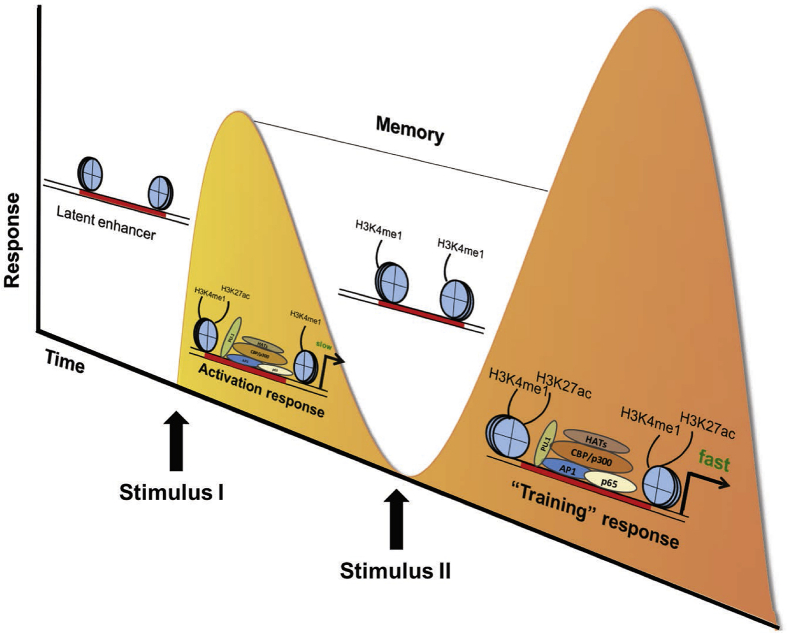
Figure 3
Enhancer keeps memory. Latent enhancers have been associated with epigenetic memory of the exposure to inflammatory signals. In response to a first inflammatory stimulus (such as LPS), many latent enhancers do not return to their latent status but are maintained in “memory” through H3K4me1 marks. Consequently to the memory marks, enhancers have a faster and stronger sense of the second exposure to inflammatory signals.
Figure 4
Figure 4
Enhancer-associated genetic variants and enhancer-promoter interaction changes in response to environmental stimuli. (A) Enhancer SNPs may regulate both enhancer-promoter (E–P) interactions and gene transcription. Environmental stimuli regulate transcription through regulation of chromatin dynamics and TF recruitment at enhancer regions. Enhancer-associated genetic variant 1 alters signal-dependent TF recruitment and chromatin dynamics, leading to absence of E–P interaction and a transcriptional repression (left panel). A different enhancer-associated genetic variant 2 enhances TF recruitment, histone modifications and chromatin remodelling, leading to E–P interaction and increased transcription (right panel). (B) The presence of conferring risk loci determines dynamic chromatin 3D structure organisation. E1 (Enhancer 1), E2 (Enhancer 2), E3 (Enhancer 3) and E4 (Enhancer 4) represent four independent genomic regions. In healthy situations, the binding of TFs to enhancers allows loop formations (left panel). In diabetes-susceptible mice, the presence of SNPs in enhancers (named enhSNP) promotes an inappropriate chromatin looping altering gene transcription of diabetic-susceptible genes.

References

    1. Yamamoto-Honda R., Akanuma Y. vol. 60. World Health Organization; 2002. (Classification of diabetes mellitus). Suppl 7.
    1. Ahlqvist E., Storm P., Käräjämäki A., Martinell M., Dorkhan M., Carlsson A. Novel subgroups of adult-onset diabetes and their association with outcomes: a data-driven cluster analysis of six variables. The Lancet Diabetes and Endocrinology. 2018;6(5):361–369. doi: 10.1016/S2213-8587(18)30051-2. - DOI - PubMed
    1. Hirschhorn J.N. Genetic epidemiology of type 1 diabetes. Pediatric Diabetes. 2003;4(2):87–100. doi: 10.1034/j.1399-5448.2001.00013.x. - DOI - PubMed
    1. Hyttinen V., Kaprio J., Kinnunen L., Koskenvuo M., Tuomilehto J. Genetic liability of type 1 diabetes and the onset age among 22, 650 young Finnish twin pairs: a nationwide follow-up study. Diabetes. 2003;52(4):1052–1055. doi: 10.2337/diabetes.52.4.1052. - DOI - PubMed
    1. Singal D.P., Blajchman M.A. Histocompatibility (HL A) antigens, lymphocytotoxic antibodies and tissue antibodies in patients with diabetes mellitus. Diabetes. 1973;22(6):429–432. doi: 10.2337/diab.22.6.429. - DOI - PubMed

Publication types