


The gut, the bad and the harmless: Candida albicans as a commensal and opportunistic pathogen in the intestine
- PMID: 32604030
- PMCID: PMC7744392
- DOI: 10.1016/j.mib.2020.05.006
The gut, the bad and the harmless: Candida albicans as a commensal and opportunistic pathogen in the intestine
Abstract
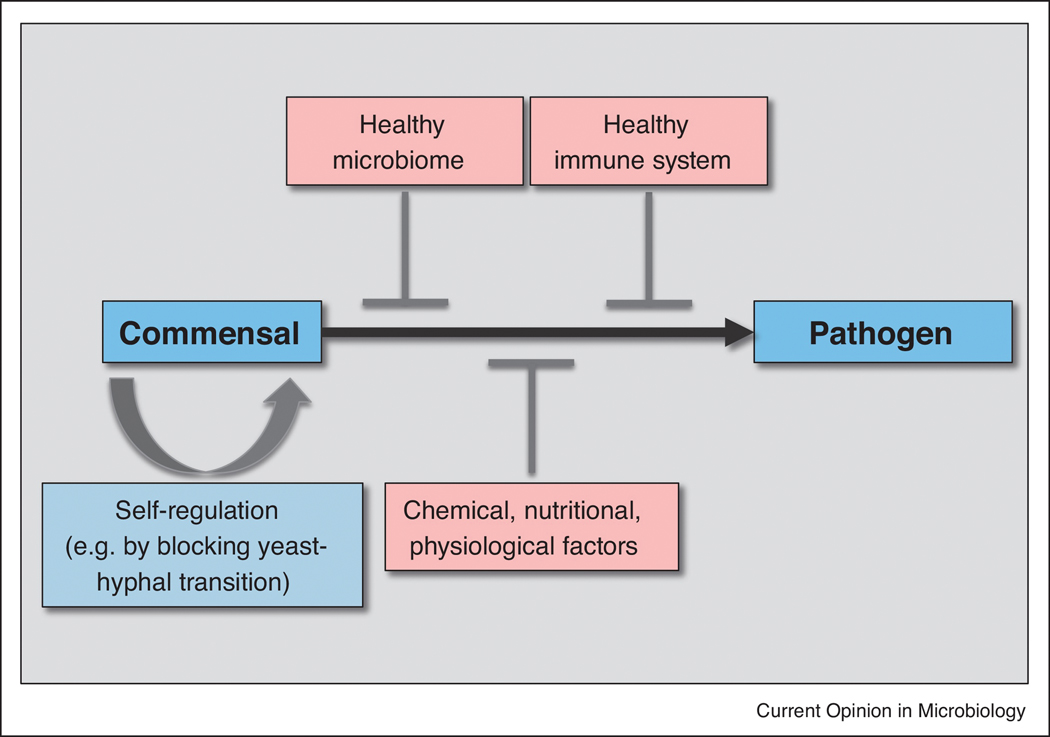
Candida albicans is a regular member of the intestinal microbiota in the majority of the human population. This underscores C. albicans' adaptation to life in the intestine without inducing competitive interactions with other microbes, or immune responses detrimental to its survival. However, specific conditions such as a dysbalanced microbiome, a suppression of the immune system, and an impaired intestinal barrier can predispose for invasive, mostly nosocomial, C. albicans infections. Colonization of the intestine and translocation through the intestinal barrier are fundamental aspects of the processes preceding life-threatening systemic candidiasis. Insights into C. albicans' commensal lifestyle and translocation can thus help us to understand how patients develop candidiasis, and may provide leads for therapeutic strategies aimed at preventing infection. In this review, we discuss the commensal lifestyle of C. albicans in the intestine, the role of morphology for commensalism, the influence of diet, and the interactions with bacteria of the microbiota.
Copyright © 2020 Elsevier Ltd. All rights reserved.
Conflict of interest statement
Conflict of interest
None
Figures

References
-
- Pappas PG, Lionakis MS, Arendrup MC, Ostrosky-Zeichner L, Kullberg BJ: Invasive candidiasis. Nat Rev Dis Primers 2018, 4:18026. - PubMed
-
- Cesaro S, Tridello G, Blijlevens N, Ljungman P, Craddock C, Michallet M, Martin A, Snowden JA, Mohty M, Maertens J, et al. : Incidence, Risk Factors, and Long-term Outcome of Acute Leukemia Patients With Early Candidemia After Allogeneic Stem Cell Transplantation: A Study by the Acute Leukemia and Infectious Diseases Working Parties of European Society for Blood and Marrow Transplantation. Clin Infect Dis 2018, 67:564–572. - PubMed
Publication types
MeSH terms
Grants and funding
LinkOut - more resources
Full Text Sources
Medical
Research Materials
