


Living with Gluten and Other Food Intolerances: Self-Reported Diagnoses and Management
- PMID: 32604710
- PMCID: PMC7353382
- DOI: 10.3390/nu12061892
Living with Gluten and Other Food Intolerances: Self-Reported Diagnoses and Management
Abstract
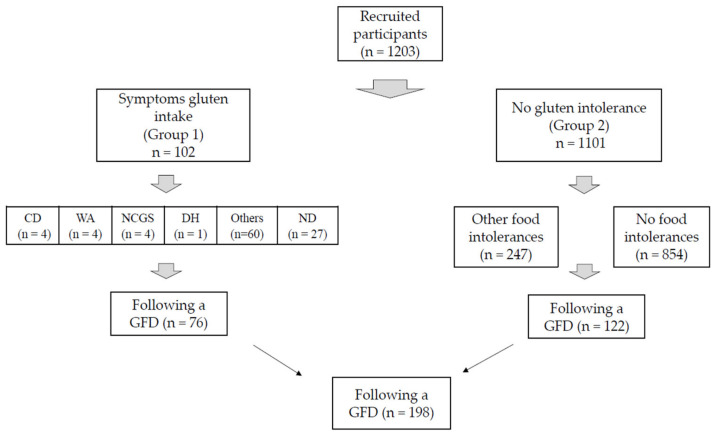
People suffering from a food intolerance (FI) tend to initiate restrictive diets such as a gluten-free diet (GFD), to alleviate their symptoms. To learn about how people live with these problems in daily life (independent of their medical diagnoses), 1203 participants answered a previously validated questionnaire and were divided into: G1 (those self-reporting symptoms after gluten consumption) and G2 (those informing no discomfort after gluten consumption). Self-reported clinical characteristics, diagnoses and diets followed were registered. Twenty nine percent referred some FI (8.5% in G1). In G1, self-reported diagnoses were more frequent (p < 0.0001), including a high proportion of eating and mood disorders. Diagnoses were reported to be given by a physician, but GFD was indicated by professional and nonprofessional persons. In G2, despite declaring no symptoms after gluten consumption, 11.1% followed a GFD. The most frequent answer in both groups was that GFD was followed "to care for my health", suggesting that some celiac patients do not acknowledge it as treatment. Conclusion: close to one third of the population report suffering from some FI. Those perceiving themselves as gluten intolerant report more diseases (p < 0.0001). A GFD is followed by ~11% of those declaring no symptoms after gluten ingestion. This diet is perceived as a healthy eating option.
Keywords: celiac disease; food intolerance; gluten sensitivity; gluten-free diet.
Conflict of interest statement
The authors declare no conflict of interest.
Figures
References
-
- Ng M., Fleming T., Robinson M., Thomson B., Graetz N., Margono C., Mullany E.C., Biryukov S., Abbafati C., Abera S.F., et al. Global, regional, and national prevalence of overweight and obesity in children and adults during 1980-2013: A systematic analysis for the Global Burden of Disease Study 2013. Lancet. 2014;384:766–781. doi: 10.1016/S0140-6736(14)60460-8. - DOI - PMC - PubMed
-
- Kakamu T., Hidaka T., Kumagai T., Masuishi Y., Kasuga H., Endo S., Sato S., Takeda A., Koizumi M., Fukushima T. Unhealthy changes in eating habits cause acute onset hypertension in the normotensive community-dwelling elderly-3 years cohort study. Medicine. 2019;98:e15071. doi: 10.1097/MD.0000000000015071. - DOI - PMC - PubMed
-
- Pasqui F., Poli C., Colecchia A., Marasco G., Festi D. Adverse Food Reaction and Functional Gastrointestinal Disorders: Role of the Dietetic Approach. [(accessed on 14 June 2020)];J. Gastrointest. Liver Dis. 2015 24:319–327. doi: 10.15403/jgld.2014.1121.243.paq. Available online: https://www.jgld.ro/jgld/index.php/jgld/article/view/1188. - DOI - PubMed
MeSH terms
Substances
LinkOut - more resources
Full Text Sources
