


Pd(II)-Catalyzed Enantioselective γ-C(sp3)-H Functionalizations of Free Cyclopropylmethylamines
- PMID: 32605367
- PMCID: PMC7654567
- DOI: 10.1021/jacs.0c04801
Pd(II)-Catalyzed Enantioselective γ-C(sp3)-H Functionalizations of Free Cyclopropylmethylamines
Abstract
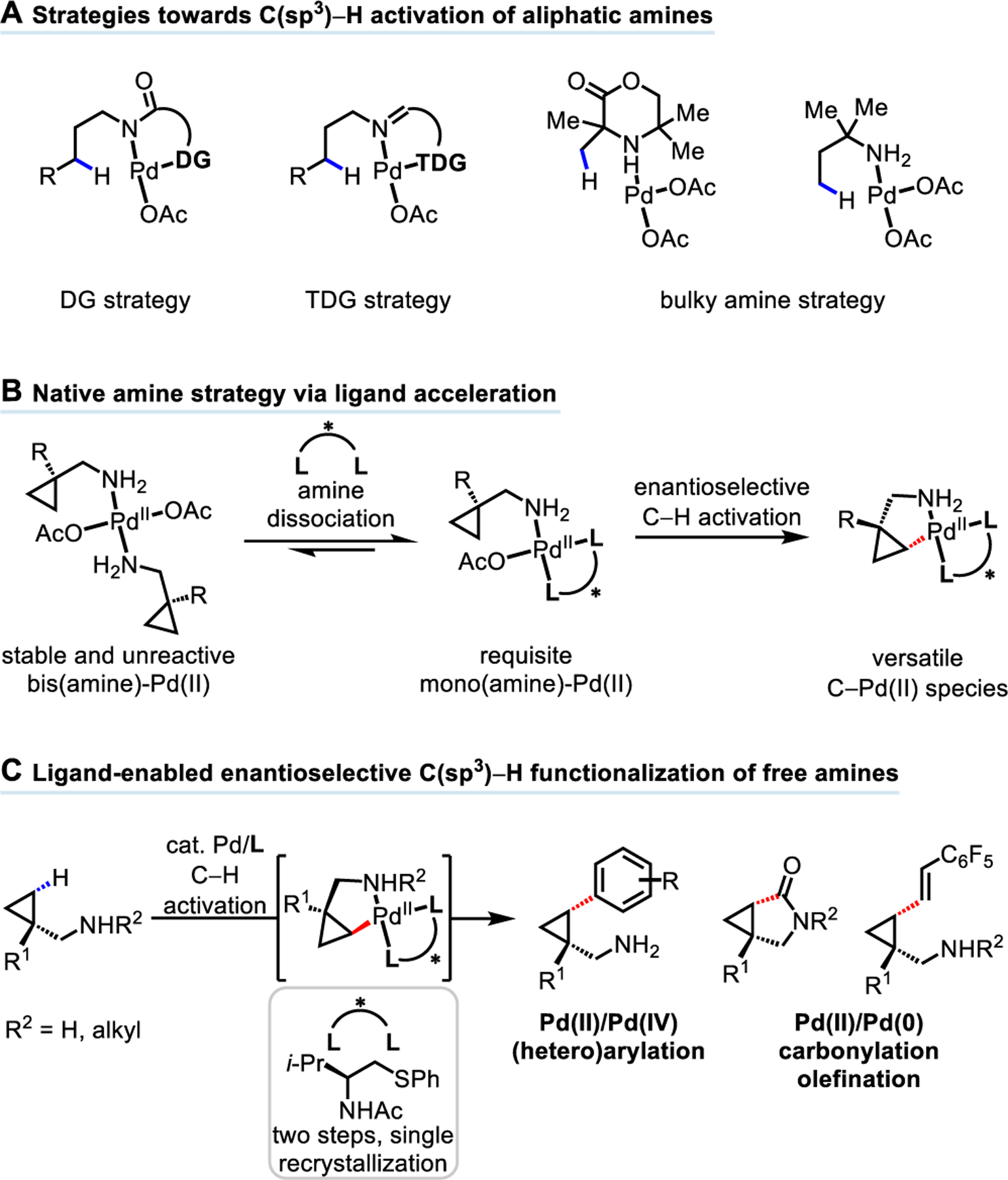
Prized for their ability to reliably forge stereocenters with precise regiocontrol from simple and abundant starting materials, substrate-directable enantioselective reactions are widely used in modern organic synthesis. As such, enantioselective C(sp3)-H functionalization reactions directed by innate functional groups could provide new routes to introduce molecular complexity within the inert hydrocarbon moiety, but to date this approach has been met with little success. While free primary aliphatic amines are common, versatile intermediates in synthesis, they are traditionally unreactive in C(sp3)-H activation reactions. Herein we report the Pd-catalyzed enantioselective C(sp3)-H functionalization of free aliphatic amines (cyclopropylmethylamines) enabled by a chiral bidentate thioether ligand. This ligand's privileged bidentate coordination mode and thioether motif favor the generation of the requisite mono(amine)-Pd(II) intermediate, thus enabling the enantioselective C-H activation of free amines. The resulting C-Pd(II) species could engage in either Pd(II)/Pd(IV) or Pd(II)/Pd(0) catalytic cycles, enabling access to a diverse range of products through (hetero)arylation, carbonylation, and olefination reactions. Consequently, this versatile reactivity offers medicinal chemists a general strategy to rapidly prepare and functionalize biologically relevant amines.
Conflict of interest statement
Notes
The authors declare no competing financial interests.
Figures
References
-
- Hoveyda AH; Evans DA; Fu GC Substrate-directable chemical reactions. Chem. Rev 1993, 93, 1307–1370.
-
- Katsuki T; Sharpless KB The first practical method for asymmetric epoxidation. J. Am. Chem. Soc 1980, 102, 5974–5976.
-
- Noyori R Asymmetric catalysis: science and opportunities (Nobel lecture). Angew. Chem., Int. Ed 2002, 41, 2008–2022. - PubMed
-
- Knowles WS Asymmetric hydrogenations (Nobel lecture). Angew. Chem., Int. Ed 2002, 41, 1998–2007. - PubMed
-
- For reviews, see:
- Giri R; Shi B-F; Engle KM; Maugel N; Yu J-Q Transition metal-catalyzed C−H activation reactions: diastereoselectivity and enantioselectivity. Chem. Soc. Rev 2009, 38, 3242–3272. - PubMed
- Newton CG; Wang S-G; Oliveira CC; Cramer N Catalytic enantioselective transformations involving C−H bond cleavage by transition-metal complexes. Chem. Rev 2017, 117, 8908–8976. - PubMed
- Shao Q; Wu K; Zhuang Z; Qian S; Yu J-Q From Pd(OAc)2 to chiral catalysts: the discovery and development of bifunctional mono-N-protected amino acid ligands for diverse C−H activation reactions. Acc. Chem. Res 2020, 53, 833–851. - PMC - PubMed
Publication types
MeSH terms
Substances
Grants and funding
LinkOut - more resources
Full Text Sources
Research Materials
Miscellaneous
