


Piperine Alters the Pharmacokinetics and Anticoagulation of Warfarin in Rats
- PMID: 32607007
- PMCID: PMC7311098
- DOI: 10.2147/JEP.S257919
Piperine Alters the Pharmacokinetics and Anticoagulation of Warfarin in Rats
Abstract
Introduction: Piperine, the bioactive compound of black pepper, and warfarin are metabolized by cytochrome P450 enzymes and are both highly plasma protein-bound compounds. In this study, we evaluated the effect of co-administered piperine on the pharmacokinetics and anticoagulation of warfarin in rats.
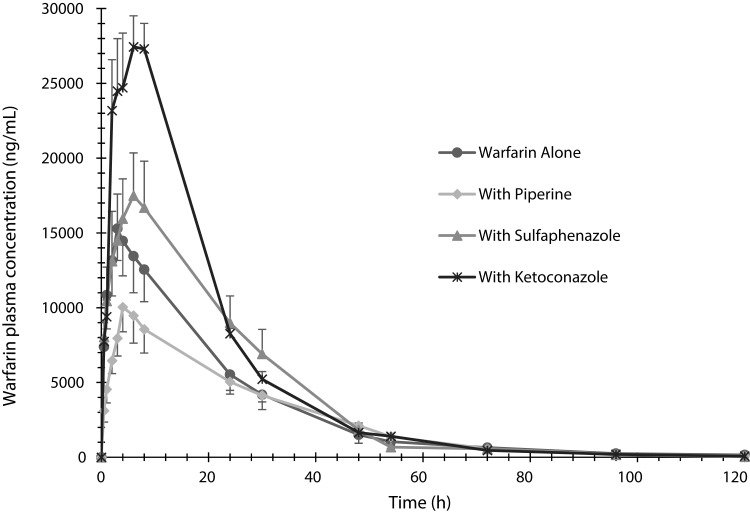
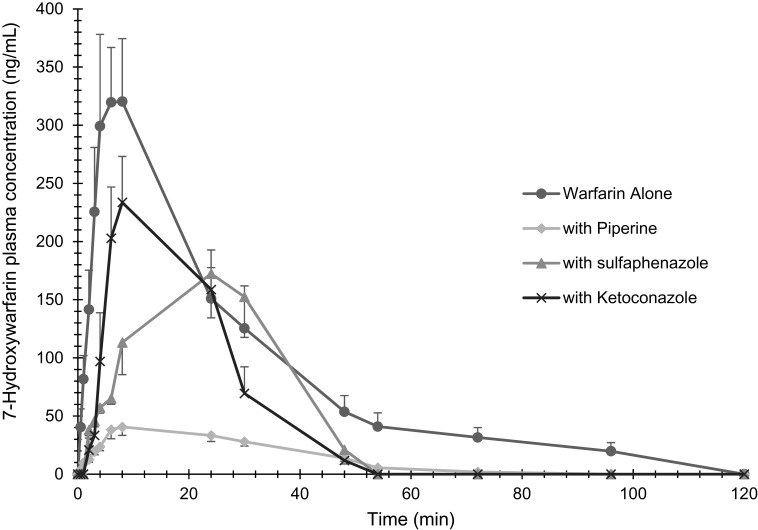
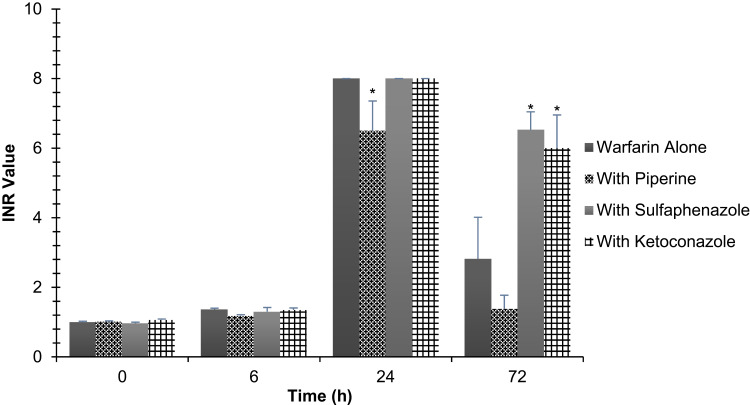
Methods: We studied four Sprague-Dawley rat groups: a negative control group receiving only oral warfarin, a test group receiving warfarin plus piperine, a positive control group receiving warfarin plus sulfaphenazole (CYP2C inhibitor), and another positive control group receiving warfarin plus ketoconazole (CYP3A inhibitor). We also analyzed plasma concentrations of warfarin and its major metabolite, 7-hydoxywarfarin. Blood clotting time, calculated as international normalized ratio (INR), was also measured.
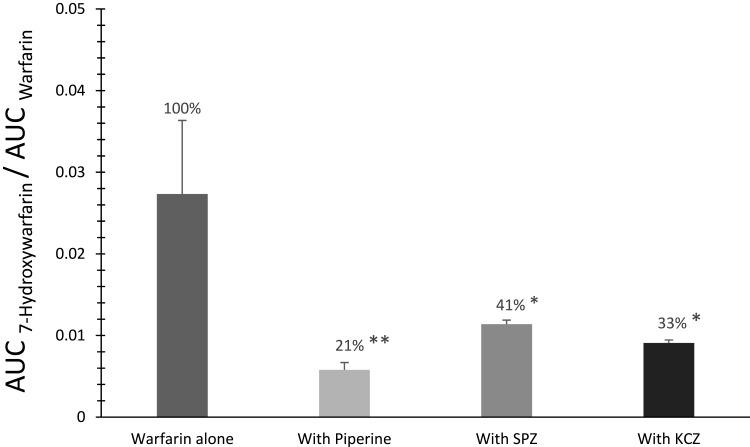
Results: Our results showed that although co-administration of piperine produced a non-significant decrease in warfarin concentrations, it resulted in significantly lower 7-hydroxywarfarin metabolite concentrations. Piperine significantly decreased, by sixfold, AUC0-∞, by eightfold, Cmax, but significantly increased, by fivefold, CL/F and, by sixfold, Vd/F of 7-hydroxywarfarin. The INR values were consistent with the decrease in warfarin concentration in the presence of piperine and showed a significant decrease at 24 h after warfarin dose.
Conclusion: We conclude that piperine could be a potent inhibitor of cytochrome P450 metabolism of warfarin in vivo and, contrary to the expectation, may reduce the plasma concentration and anticoagulation of warfarin. This interaction could have a clinical significance and should be investigated in patients.
Keywords: 7-hydroxywarfarin; black pepper; herb–drug interaction; pharmacokinetics; piperine; warfarin.
© 2020 Zayed et al.
Conflict of interest statement
The authors declare no conflict of interest. The funders had no role in the design of the study; in the collection, analyses, or interpretation of data; in the writing of the manuscript, or in the decision to publish the results.
Figures
References
LinkOut - more resources
Full Text Sources
