Randomized Controlled Trial
. 2021 Feb;23(2):325-334.
doi: 10.1007/s12094-020-02422-7. Epub 2020 Jun 30.

ADMA mediates gastric cancer cell migration and invasion via Wnt/β-catenin signaling pathway

Affiliations
Randomized Controlled Trial

ADMA mediates gastric cancer cell migration and invasion via Wnt/β-catenin signaling pathway

Q Guo et al. Clin Transl Oncol. 2021 Feb.

Abstract

Objective: To explore the role of ADMA in gastric cancer.

Methods: The specimens of 115 gastric cancer patients were analyzed by ELISA and survival analysis. Functional assays were used to assess the effects of ADMA on gastric cancer cells. Experiments were conducted to detect the signaling pathway induced by ADMA in GC.

Results: Gastric cancer patients with high ADMA levels had poor prognosis and low survival rate. Furthermore, high level of ADMA did not affect the proliferation while promoted the migration and invasion of gastric cancer cell. Moreover, ADMA enhanced the epithelial-mesenchymal transition (EMT). Importantly, ADMA positively regulated β-catenin expression in GC and promoted GC migration and invasion via Wnt/β-catenin pathway.

Conclusions: ADMA regulates gastric cancer cell migration and invasion via Wnt/β-catenin signaling pathway and which may be applied to clinical practice as a diagnostic and prognostic biomarker.

Keywords: ADMA; Asymmetric dimethylarginine; EMT; Epithelial-mesenchymal transition; GC; Gastric cancer.


Conflict of interest statement

The authors disclose no potential conflicts of interest.

Figures
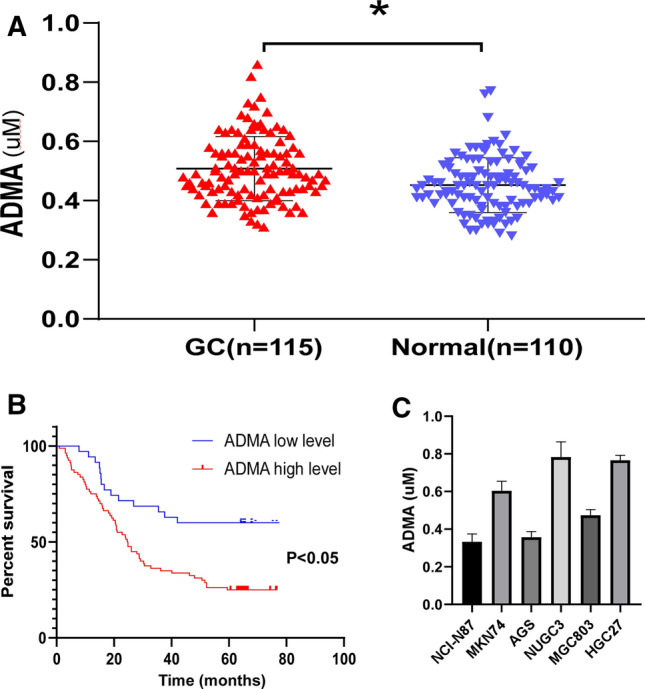
Fig. 1
Fig. 1
The serum ADMA levels were higher in gastric carcinoma and positively correlated with poor prognosis. a The serum ADMA levels in 115 GC patients before surgery and 110 normal subjects. Elisa test was carried out to determine the level of serum ADMA. The graph showed the concentrations of the serum ADMA levels in GC and normal subjects. Unpaired T test was used to compute P value (*P < 0.05). b Kaplan–Meier survival analysis of 115 GC patients with the high or low serum ADMA levels (P < 0.05, log-rank test). c the serum ADMA levels in six GC cell lines
Fig. 2
Fig. 2
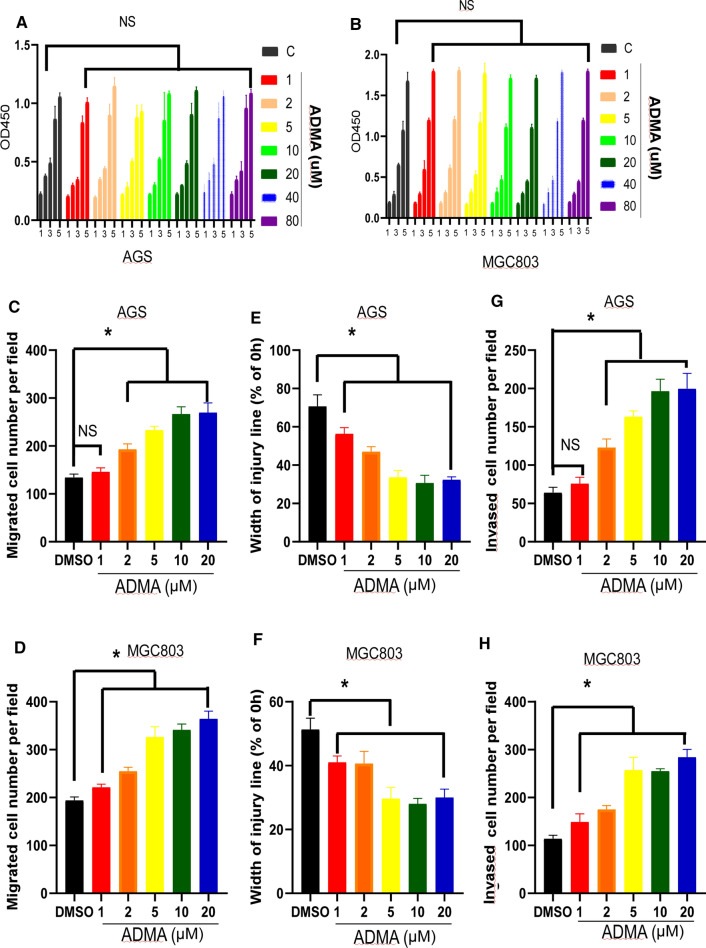
ADMA regulated GC cell migration and invasion but had no treatment on growth in vitro. a, b CCK8 assay demonstrating the influence of different concentrations of ADMA on the proliferation rate of AGS and MGC803 cells. Data were expressed as mean ± SD of three independent experiments (NS indicates no statistical significance). c, d Relative migration of the AGS and MGC803 through an uncoated filter toward serum-containing medium in a Boyden chamber assay. Data were expressed as mean ± SD of three independent experiments (*P < 0.05). e, f Relative motility as determined by the ability of AGS and MGC803 to close a wound made by creating a scratch through a lawn of confluent cells. Data were expressed as mean ± SD of three independent experiments (*P < 0.05). G and H, Relative invasion of the GC cells (AGS and MGC803) through a layer of Matrigel coated on the filter of a Boyden chamber. Data were expressed as mean ± SD of three independent experiments (*P < 0.05)
Fig. 3
Fig. 3
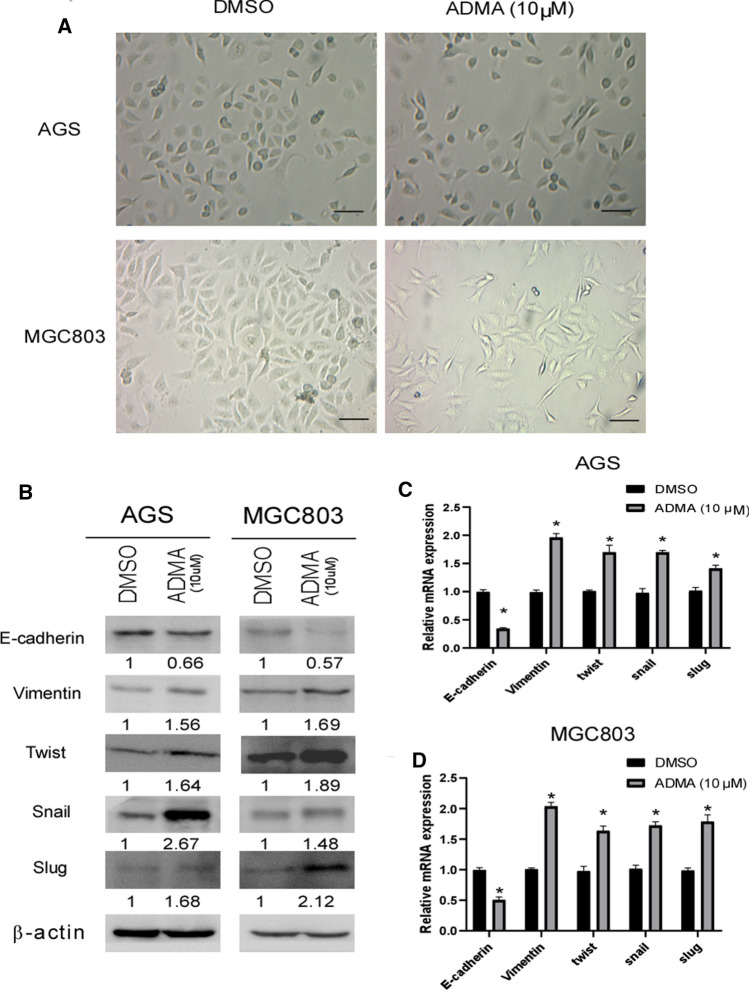
ADMA regulated the expression of EMT markers in the GC cells. a Bright field images of the morphology of AGS and MGC803 cells with the medium in DMSO and ADMA (10 μM) separately. Scale bar, 50 μm. b Western blot analysis illustrating the effect of ADMA(10 μM) on expression of EMT markers in AGS and MGC803 cells. c, d qRT-PCR analysis presenting the effect of ADMA (10 μM) on expression of EMT markers in AGS and MGC803 cells. The results were representative of three independent experiments (*P < 0.05)
Fig. 4
Fig. 4
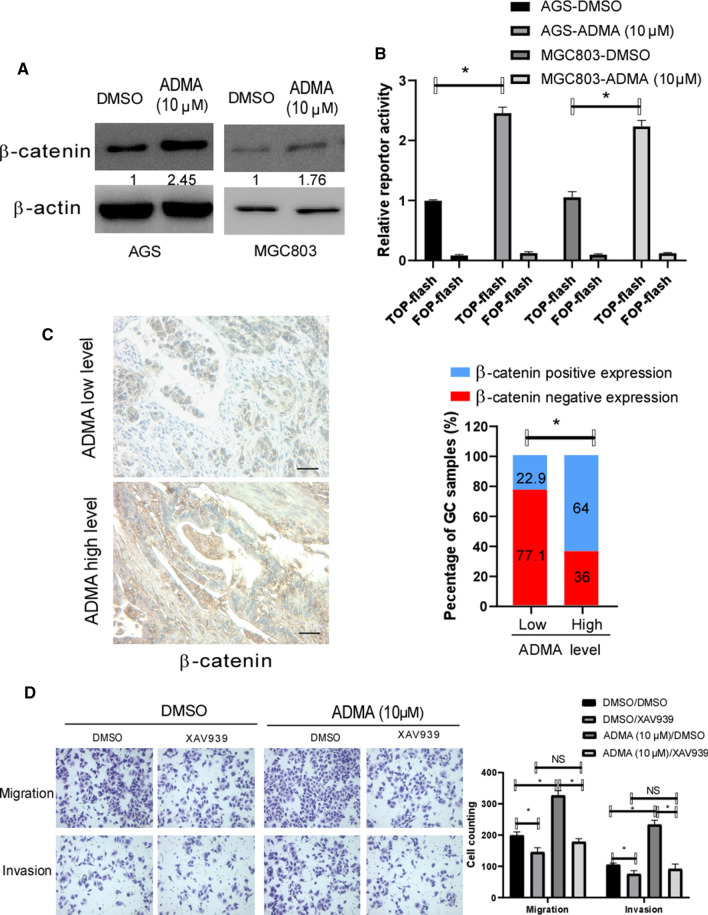
ADMA positively regulated β-catenin expression in GC and mediated through WNT signaling pathway. a Western blot demonstrated that ADMA (10 μM) enhanced the protein levels of β-catenin in AGS and MGC803. β-actin served as a loading control. b The ADMA(10 μM) in GC cell positively correlated with β-catenin activity in TOP-Flash reporter assay. Expression was normalized with Renilla luciferase activity. The experiments were performed three times independently(*P < 0.05). c IHC assay showing the relationship between serum ADMA level and β-catenin in the 115 GC samples. Scale bar, 50 μm. In the GC samples with high ADMA level, the percentage of β-catenin positive expression was 64%, significantly higher than those with low ADMA level (22.9%) (*P < 0.05). d The stimulatory effect of ADMA on the GC cell migration and invasion blocked by WTN inhibitor XAV939, as the representative images were presented (*P < 0.05; NS, no statistical significance)

References

    1. Chen W, Zheng R, Baade PD, et al. Cancer statistics in China, 2015. Cancer J Clin. 2016;66:115–132. doi: 10.3322/caac.21338. - DOI - PubMed
    1. Hohenberger P, Gretschel S. Gastic cancer. Lancet. 2003;362:305–315. doi: 10.1016/S0140-6736(03)13975-X. - DOI - PubMed
    1. Karimi P, Islami F, Anandasabapathy S, Freedman ND, Kamangar F. Gastric cancer: descriptive epidemiology, risk factors, screening, and prevention. Cancer Epidemiol Biomark Prev. 2014;23:700–713. doi: 10.1158/1055-9965.EPI-13-1057. - DOI - PMC - PubMed
    1. Katoh M. Dysregulation of stem cell signaling network due to germline mutation, SNP, helicobacter pylori infection, epigenetic change, and genetic alteration in gastric cancer. Cancer Biol Ther. 2014;6:832–839. doi: 10.4161/cbt.6.6.4196. - DOI - PubMed
    1. Kakinoki R, Kushima R, Matsubara A, et al. Re-evaluation of histogenesis of gastric carcinomas: a comparative histopathological study between Helicobacter pylori-negative and H. pylori-positive cases. Dig Dis Sci. 2009;54:614–620. doi: 10.1007/s10620-008-0389-5. - DOI - PubMed

Publication types

MeSH terms