


Gastrointestinal Malignancies and the COVID-19 Pandemic: Evidence-Based Triage to Surgery
- PMID: 32607860
- PMCID: PMC7325836
- DOI: 10.1007/s11605-020-04712-5
Gastrointestinal Malignancies and the COVID-19 Pandemic: Evidence-Based Triage to Surgery
Abstract
Background: The COVID-19 pandemic has led to widespread cancelation of electively scheduled surgeries, including for colorectal, pancreatic, and gastric cancer. The American College of Surgeons and the Society of Surgical Oncology have released guidelines for triage of these procedures. We seek to synthesize available evidence on delayed resection and oncologic outcomes, while also providing a critical assessment of the released guidelines.
Methods: A systematic review was conducted to identify literature between 2005 and 2020 investigating the impact of time to surgery on oncologic outcomes in colorectal, pancreatic, and gastric cancer.
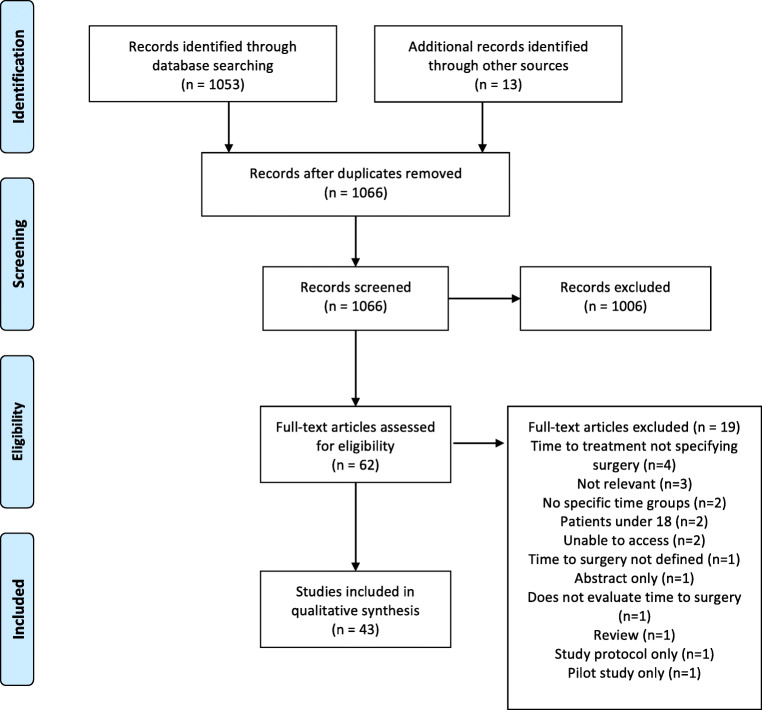
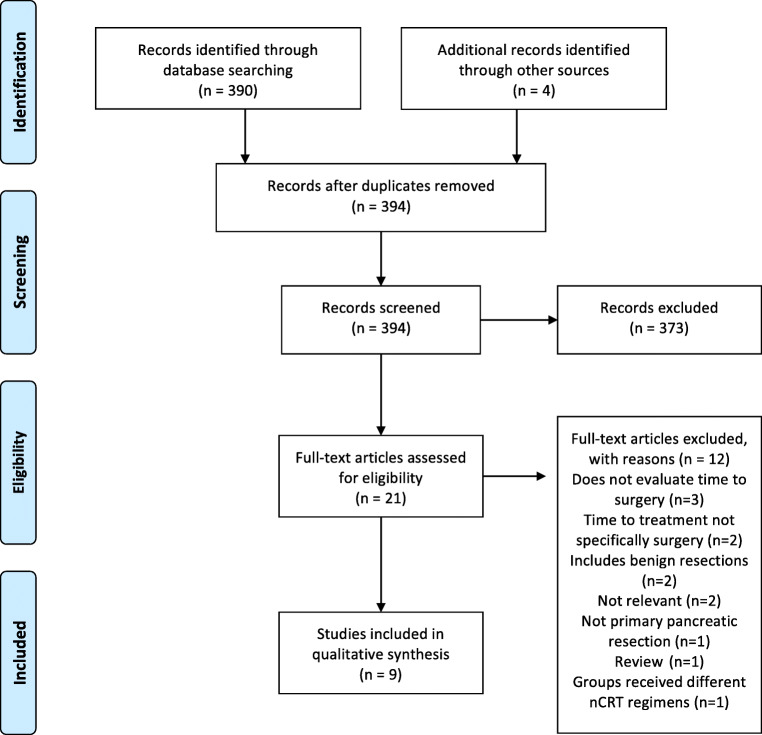
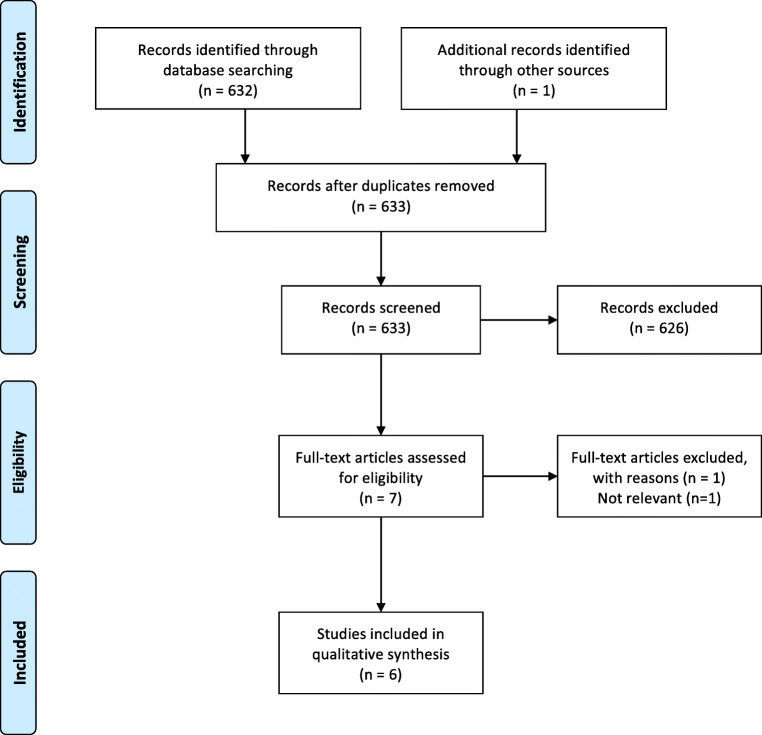
Results: For colorectal cancer, 1066 abstracts were screened and 43 papers were included. In primarily resected colon cancer, delay over 30 to 40 days is associated with lower survival. In rectal cancer, time to surgery over 7 to 8 weeks following neoadjuvant therapy is associated with decreased survival. Three hundred ninety-four abstracts were screened for pancreatic cancer and nine studies were included. Two studies demonstrate increased unexpected progression with delayed surgery over 30 days. Out of 633 abstracts screened for gastric cancer, six studies were included. No identified study demonstrated worse survival with increased time to surgery.
Conclusion: Moderate evidence suggests that delayed resection of colorectal cancer worsens survival; the impact of time to surgery on gastric and pancreatic cancer outcomes is uncertain. Early resection of gastrointestinal malignancies provides the best chance for curative therapy. During the COVID-19 pandemic, prioritization of procedures should account for available evidence on time to surgery and oncologic outcomes.
Keywords: Colorectal cancer; Gastric cancer; Pancreatic cancer; Time to surgery.
Conflict of interest statement
The authors declare that they have no conflict of interest.
Figures
Comment in
-
Gastrointestinal Malignancies and the COVID-19 Pandemic: Evidence-Based Triage to Surgery.J Gastrointest Surg. 2020 Nov;24(11):2698-2699. doi: 10.1007/s11605-020-04796-z. Epub 2020 Sep 15. J Gastrointest Surg. 2020. PMID: 32935269 Free PMC article. No abstract available.
References
-
- Centers for Disease Control and Prevention. Interim Guidance for Healthcare Facilities: Preparing for Community Transmission of COVID-19 in the United States. 2020. https://www.cdc.gov/coronavirus/2019-ncov/healthcare-facilities/guidance.... Accessed 03/09/2020.
-
- American College of Surgeons. COVID-19: Elective Case Triage Guidelines for Surgical Care. 2020. https://www.facs.org/covid-19/clinical-guidance/elective-case.
-
- Society of Surgical Oncology. COVID-19 Resources. 2020. https://www.surgonc.org/resources/covid-19-resources/. Accessed April 6, 2020.
-
- Liberati A, Altman DG, Tetzlaff J, Mulrow C, Gotzsche PC, Ioannidis JP, et al. The PRISMA statement for reporting systematic reviews and meta-analyses of studies that evaluate health care interventions: explanation and elaboration. Ann Intern Med. 2009;151(4):W65–94. doi: 10.7326/0003-4819-151-4-200908180-00136. - DOI - PubMed
-
- Phillips B, Ball, B, Sackett, D, Badenoch, D, Straus, S, Haynes B, Dawes, M. Oxford Centre for Evidence-based Medicine – Levels of Evidence 2009. https://www.cebm.net/2009/06/oxford-centre-evidence-based-medicine-level....
Publication types
MeSH terms
LinkOut - more resources
Full Text Sources
