Review
. 2021 Feb;190(1):41-57.
doi: 10.1007/s11845-020-02264-w. Epub 2020 Jul 1.

Cellular immunotherapies for cancer

Affiliations
Review

Cellular immunotherapies for cancer

Conall Hayes. Ir J Med Sci. 2021 Feb.

Abstract

Cancer is a major burden on the healthcare system, and new therapies are needed. Recently, the development of immunotherapies, which aim to boost or use the immune system, or its constituents, as a tool to fight malignant cells, has provided a major new tool in the arsenal of clinicians and has revolutionized the treatment of many cancers.Cellular immunotherapies are based on the administration of living cells to patients and have developed hugely, especially since 2010 when Sipuleucel-T (Provenge), a DC vaccine, was the first cellular immunotherapy to be approved by the FDA. The ensuing years have seen two further cellular immunotherapies gain FDA approval: tisagenlecleucel (Kymriah) and axicabtagene ciloleucel (Yescarta).This review will give an overview of the principles of immunotherapies before focusing on the major forms of cellular immunotherapies individually, T cell-based, natural killer (NK) cell-based and dendritic cell (DC)-based, as well as detailing some of the clinical trials relevant to each therapy.

Keywords: CAR-T cells; Cancer; Immunotherapy; TCR-T cells.


Figures
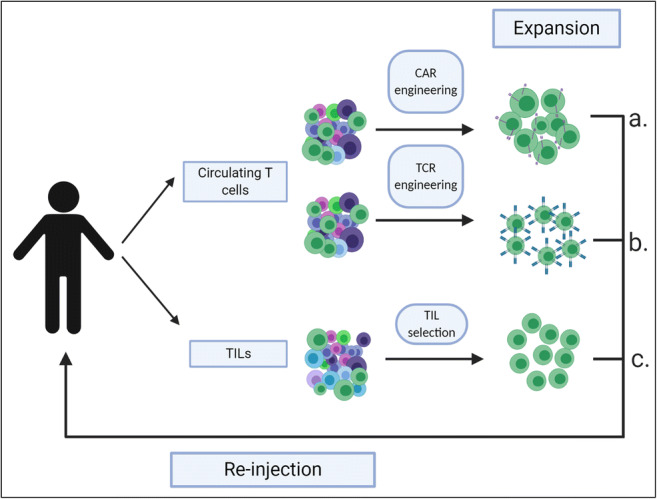
Fig. 1
Fig. 1
Adoptive T cell transfer therapies. Circulating T cells or tumour-infiltrating lymphocytes (TILs) are collected from a patient’s blood or tumour, respectively. Circulating T cells can be engineered to express chimeric antigen receptors (CARs) (a.) or T cell receptors (TCRs) (b.) which allow targeting of specific tumour-associated/specific antigens. These modified T cells can be expanded ex vivo and subsequently re-injected into the same patient as an allogeneic therapy. CAR-T cells and TCR-T cells can also be derived from allogeneic sources (not shown), meaning that the donor and the recipient of the cells are different people. Following tumour resection or biopsy, TILs (c.) can be extracted from the tumour material and those with specificity against tumour antigens can be selectively extracted, expanded and re-infused into the patient
Fig. 2
Fig. 2
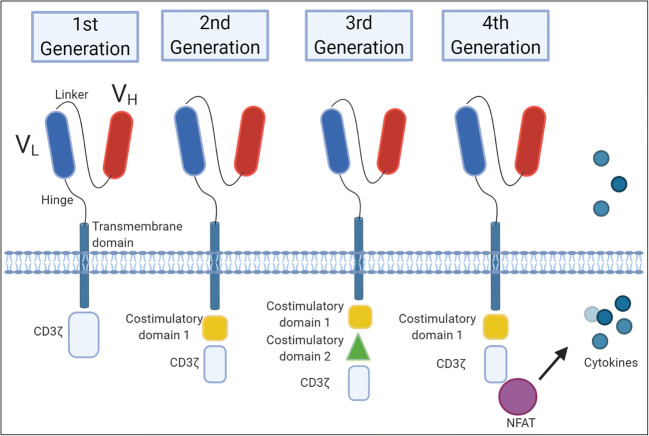
Structure of CARs. All chimeric antigen receptors (CARs) have the same extracellular structure consisting of single-chain variable fragment (ScFV) part of an antibody which is specific for a target tumour antigen. First-generation CARs contain only one intracellular signalling component: CD3ζ. Addition of a co-stimulatory domain, such as CD28 or 4-1BB, to the CD3ζ created second-generation CARs. Third-generation CARs contain two co-stimulatory domains in addition to CD3ζ. Fourth-generation CARs can activate downstream transcription factors, such as NFAT, following CAR antigen recognition resulting in cytokine production
Fig. 3
Fig. 3
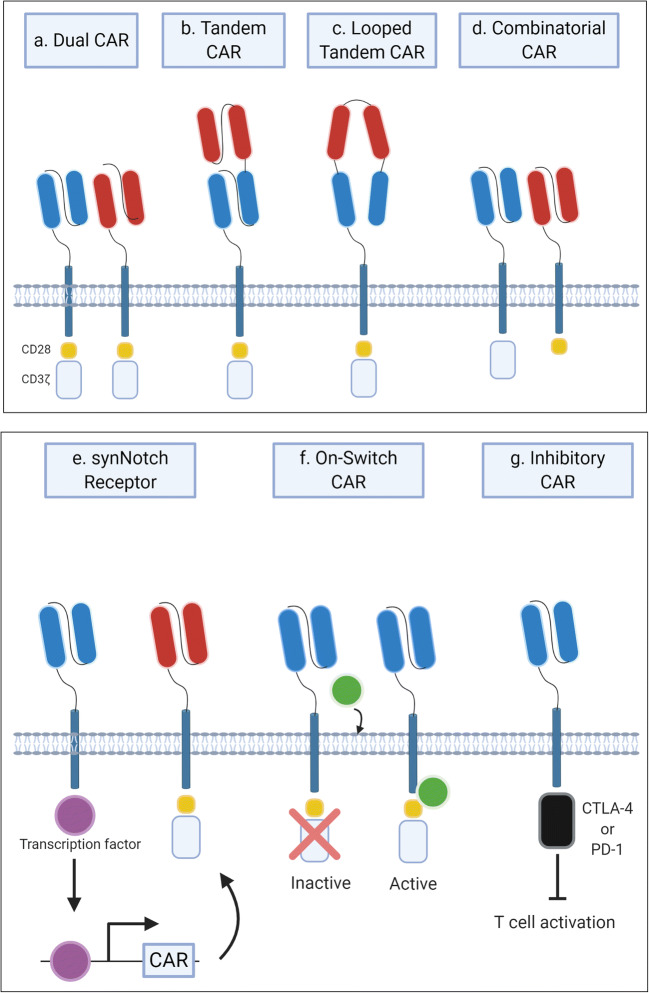
Nuances on CAR-T cell design. (a.) Co-expression of two discrete CARs in one cell is known as a dual CAR. (b. and c.) Tandem CARs express two different scFvs in a single CAR molecule and can be arranged in series as a stack (b.) or in an interrupted looped structure (c). In the case of dual and tandem CAR-T cells, identification of either antigen A or antigen B is sufficient for activation. (d.) Combinatorial CARs are composed of two partners; one incorporates the CD3ζ chain while the other includes the co-stimulatory signalling domain. (e.) Synthetic Notch (synNotch) receptors cause the transcription of a second CAR after antigen identification of their corresponding antigen. Combinatorial and synNotch CARs require both antigens to be recognised for full T cell activation. (f.) ON-Switch CARs require the presence of specific activating molecules to promote fully functional receptor assembly. (g.) Inhibitory CARs (iCARs) include inhibitory signalling motifs such as PD-1 or CTLA-4 that block T cell activation following antigen recognition
Fig. 4
Fig. 4
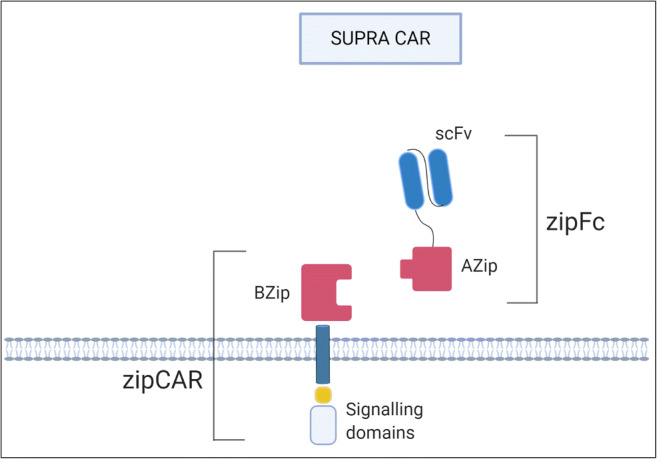
SUPRA CAR. SUPRA CARs consist of a zipCAR and zipFv. The extracellular portion of the CAR is known as a zipCAR which consists of a leucine zipper linked to intracellular signalling domains. The zipFv contains a scFv joined to a corresponding leucine zipper that can bind to the leucine zipper of the zipCAR.
Fig. 5
Fig. 5
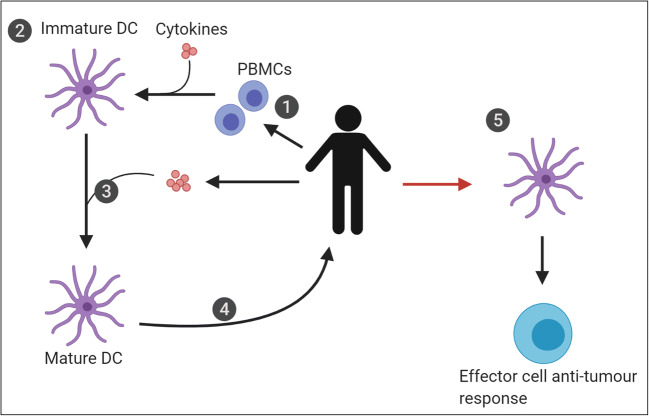
Dendritic cell (DC) vaccines. (1) Gather peripheral blood mononuclear cells. (2) Produce immature DCs using a cytokine cocktail. (3) Loading tumour-derived antigens onto DC. (4) Inject vaccine comprising activated antigen-presenting DCs into the patient. (5) Vaccine triggers anti-tumour immune effector cell responses leading to T cell- and NK cell-mediated tumour killing

References

    1. WHO. Cancer. World Health Organisation,. https://www.who.int/news-room/fact-sheets/detail/cancer (accessed 07 Nov 2019
    1. Cancer Research UK. Worldwide cancer incidence statistics. https://www.cancerresearchuk.org/health-professional/cancer-statistics/w... (accessed 07 November 2019)
    1. de Visser KE, Eichten A, Coussens LM. Paradoxical roles of the immune system during cancer development. Nat Rev Cancer. 2006;6(1):24–37. doi: 10.1038/nrc1782. - DOI - PubMed
    1. Song MK, Park BB, Uhm JE. Resistance Mechanisms to CAR T-Cell Therapy and Overcoming Strategy in B-Cell Hematologic Malignancies. (in eng) Int J Mol Sci. 2019;20(20):5010. doi: 10.3390/ijms20205010. - DOI - PMC - PubMed
    1. Vinay DS, et al. Immune evasion in cancer: mechanistic basis and therapeutic strategies. Semin Cancer Biol. 2015;35:S185–S198. doi: 10.1016/j.semcancer.2015.03.004. - DOI - PubMed