Review
. 2020 Aug 1;161(8):bqaa105.
doi: 10.1210/endocr/bqaa105.

p21-Activated Kinases in Thyroid Cancer

Affiliations
Review

p21-Activated Kinases in Thyroid Cancer

Luis Bautista et al. Endocrinology. .

Abstract

The family of p21-activated kinases (PAKs) are oncogenic proteins that regulate critical cellular functions. PAKs play central signaling roles in the integrin/CDC42/Rho, ERK/MAPK, PI3K/AKT, NF-κB, and Wnt/β-catenin pathways, functioning both as kinases and scaffolds to regulate cell motility, mitosis and proliferation, cytoskeletal rearrangement, and other cellular activities. PAKs have been implicated in both the development and progression of a wide range of cancers, including breast cancer, pancreatic melanoma, thyroid cancer, and others. Here we will discuss the current knowledge on the structure and biological functions of both group I and group II PAKs, as well as the roles that PAKs play in oncogenesis and progression, with a focus on thyroid cancer and emerging data regarding BRAF/PAK signaling.

Keywords: BRAF; PAK; cancer; p21-activated kinase; thyroid cancer.


Figures

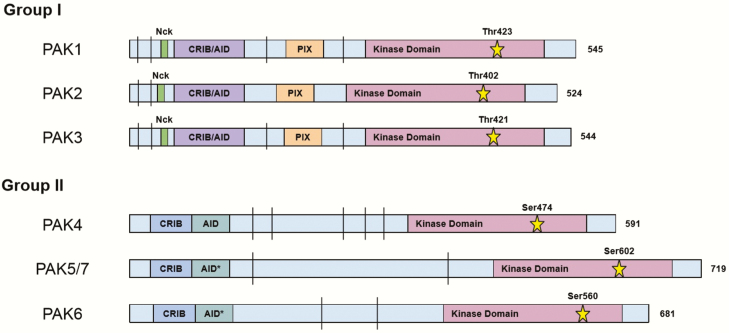
Figure 1.
Figure 1.
PAK isoform structure. Linear representation of groups I and II PAK proteins, with the numbers to right indicating the total number of amino acid residues. Overlapping CRIB (CDC42/RAC interactive binding) domain, also known as the PBD, and AID (Auto-Inhibitory Domain) for group I PAKs is shown in purple. Separate CRIB domain and AID for group II PAKs are shown in blue and aquamarine, respectively. Nck and PIX binding regions are shown in green and orange, respectively. The kinase domain is shown in plum and the catalytic residue is represented by the star, with the corresponding residue number above. The vertical bar (|) indicates proline-rich segments that are potential binding regions for proteins with a SH3 domain. The asterisk indicates that the AID for these proteins, PAK5 and 6, may not actually serve as an inhibitory domain and needs further characterization. Drawing is not to scale.
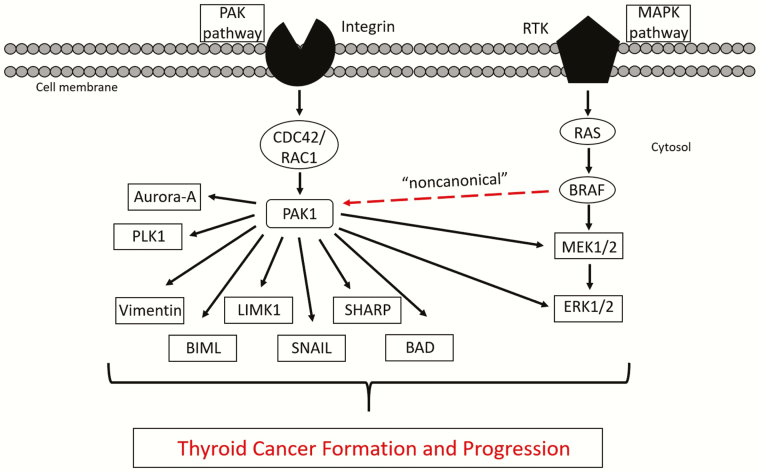
Figure 2.
Figure 2.
PAK/MAPK signaling and the downstream effectors involved in oncogenesis and progression. A restricted view of the PAK/MAPK signaling cascades, and a limited list of PAK substrates that illustrates the diverse mechanisms by which PAK dysregulation can lead to oncogenesis and progression. Overactivation of PAK, whether upstream through mutations in BRAF or RAC1, or PAK overexpression/amplification, lead to transformation exemplary of the hallmarks of cancer. The “noncanonical” activation of PAK by BRAF is noted with a red line.

References

    1. Howlader NAMN, Krapcho M, Miller D, et al. SEER Cancer Statistics Review. 1975–2016. SEER Website; 2020. https://seer.cancer.gov/statfacts/html/thyro.html. Accessed March 15, 2020.
    1. Lim H, Devesa SS, Sosa JA, Check D, Kitahara CM. Trends in thyroid cancer incidence and mortality in the United States, 1974-2013. JAMA. 2017;317(13):1338-1348. - PMC - PubMed
    1. Jung CK, Little MP, Lubin JH, et al. The increase in thyroid cancer incidence during the last four decades is accompanied by a high frequency of BRAF mutations and a sharp increase in RAS mutations. J Clin Endocrinol Metab. 2014;99(2):E276-E285. - PMC - PubMed
    1. Yan KL, Li S, Tseng CH, et al. Rising incidence and incidence-based mortality of thyroid cancer in California, 2000–2017. J Clin Endocrinol Metab. 2020;105(6):1770-1777. - PubMed
    1. Brose MS, Nutting CM, Jarzab B, et al. Sorafenib in radioactive iodine-refractory, locally advanced or metastatic differentiated thyroid cancer: a randomised, double-blind, phase 3 trial. Lancet. 2014;384(9940):319-328. - PMC - PubMed

Publication types

MeSH terms

Substances