


Smoking Prevalence and COVID-19 in Europe
- PMID: 32609839
- PMCID: PMC7337760
- DOI: 10.1093/ntr/ntaa121
Smoking Prevalence and COVID-19 in Europe
Abstract
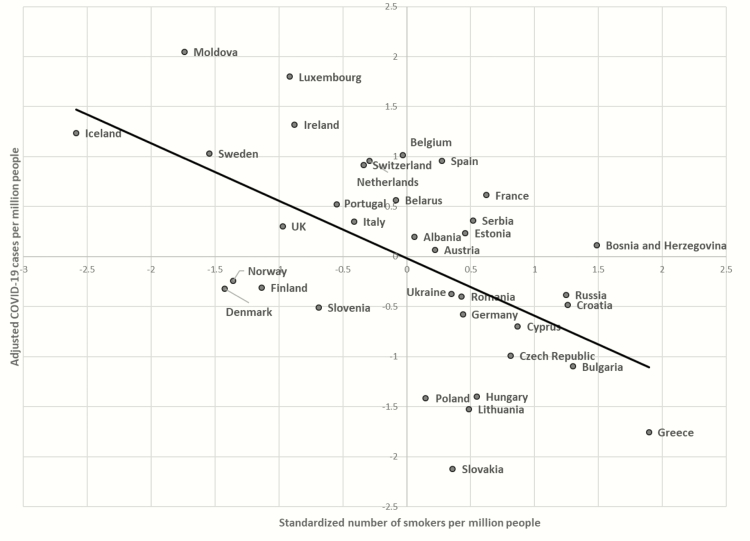
Introduction: This ecological study investigates the association between smoking prevalence and COVID-19 occurrence and mortality in 38 European nations as of May 30, 2020.
Methods: Data were collected from Our World in Data. Regression analysis was conducted to adjust for potential confounding factors such as economic activity (gross domestic product), the rate of COVID-19 testing, and the stringency of COVID-19 control policies.
Results: There was a statistically significant negative association between smoking prevalence and the prevalence of COVID-19 across the 38 European nations after controlling for confounding factors (p = 0.001). A strong association was found between the prevalence of COVID-19 per million people and economic activity (p = 0.002) and the rate of COVID-19 testing (p = 0.0006). Nations with stricter policy enactment showed fewer COVID-19 cases per million people, but the association was not significant (p = 0.122). Delaying policy enactment was associated with a greater prevalence of COVID-19 (p = 0.0535). Evidence of a direct association between smoking prevalence and COVID-19 mortality was not found (p = 0.626). There was a strong positive association between COVID-19 mortality rate and the prevalence of COVID-19 cases (p < 0.0001) as well as the proportion of the population over 65 years of age (p = 0.0034) and a negative association with the rate of COVID-19 testing (p = 0.0023).
Conclusions: We found a negative association between smoking prevalence and COVID-19 occurrence at the population level in 38 European countries. This association may not imply a true or causal relationship, and smoking is not advocated as a prevention or treatment of COVID-19.
Implications: Given the evidence of this ecological study, and of several other studies that found an underrepresentation of smoking prevalence in hospitalized cases, it may be worth examining, in laboratory experiments and controlled human trials, if nicotine offers any protection against COVID-19. Most importantly, to date, no study, including this one, supports the view that smoking acts as a treatment intervention or prophylaxis to reduce the impact or ameliorate the negative health impacts of COVID-19.
© The Author(s) 2020. Published by Oxford University Press on behalf of the Society for Research on Nicotine and Tobacco. All rights reserved.For permissions, please e-mail: journals.permissions@oup.com.
Figures
References
-
- Berlin I, Thomas D, Le Faou AL, Cornuz J. COVID-19 and smoking [published online ahead of print April 3, 2020]. Nicotine Tob Res. 2020. doi: 10.1093/ntr/ntaa059/5815378 - PMC - PubMed
MeSH terms
LinkOut - more resources
Full Text Sources
