Review
. 2020 Jun 29;9(7):522.
doi: 10.3390/pathogens9070522.

Multidrug Resistance (MDR) and Collateral Sensitivity in Bacteria, with Special Attention to Genetic and Evolutionary Aspects and to the Perspectives of Antimicrobial Peptides-A Review

Affiliations
Review

Multidrug Resistance (MDR) and Collateral Sensitivity in Bacteria, with Special Attention to Genetic and Evolutionary Aspects and to the Perspectives of Antimicrobial Peptides-A Review

András Fodor et al. Pathogens. .

Abstract

Antibiotic poly-resistance (multidrug-, extreme-, and pan-drug resistance) is controlled by adaptive evolution. Darwinian and Lamarckian interpretations of resistance evolution are discussed. Arguments for, and against, pessimistic forecasts on a fatal "post-antibiotic era" are evaluated. In commensal niches, the appearance of a new antibiotic resistance often reduces fitness, but compensatory mutations may counteract this tendency. The appearance of new antibiotic resistance is frequently accompanied by a collateral sensitivity to other resistances. Organisms with an expanding open pan-genome, such as Acinetobacter baumannii, Pseudomonas aeruginosa, and Klebsiella pneumoniae, can withstand an increased number of resistances by exploiting their evolutionary plasticity and disseminating clonally or poly-clonally. Multidrug-resistant pathogen clones can become predominant under antibiotic stress conditions but, under the influence of negative frequency-dependent selection, are prevented from rising to dominance in a population in a commensal niche. Antimicrobial peptides have a great potential to combat multidrug resistance, since antibiotic-resistant bacteria have shown a high frequency of collateral sensitivity to antimicrobial peptides. In addition, the mobility patterns of antibiotic resistance, and antimicrobial peptide resistance, genes are completely different. The integron trade in commensal niches is fortunately limited by the species-specificity of resistance genes. Hence, we theorize that the suggested post-antibiotic era has not yet come, and indeed might never come.

Keywords: MDR; adaptive evolution; collateral sensitivity; experimental evolution; global dissemination; intrinsic/acquired resistance; mobility patterns of resistance genes; negative frequency-dependent selection; pangenome.


Conflict of interest statement

The authors declare that the research was conducted in the absence of any commercial or financial relationships that could be construed as a potential conflict of interest. Author László Ötvös Jr. is President of OLPE, LLC, a pharmaceutical consulting firm and inventor of the issued international patent on ARV-1502. He is a senior consultant of Arrevus, Inc., a biotechnology company focusing on the clinical development of ARV-1502 against various bacterial infectious diseases. The remaining authors declare that the research was conducted in the absence of any commercial or financial relationships that could be construed as a potential conflict of interest.

Figures
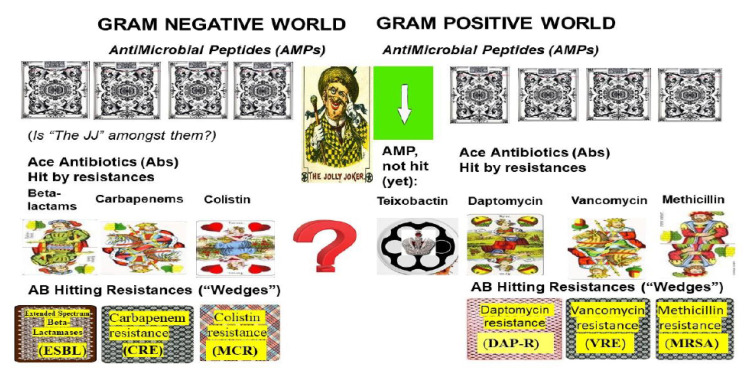
Figure 1
Figure 1
Illustration of the competition between new antbiotics and invoed resistances. The “Card Game” between science (designers of antibiotics) and nature (antibiotic resistance profile designing pathogens). Legend to Figure 1. Both with the Gram-negative (left) and the Gram positive (right) “card tables”, the respective uppermost row represents the cards in the hands of science (antibiotics, antimicrobial peptides), and the lowest line is the cards (resistances) in the hands of nature. Science put down the “first card”, penicillin (let us refer to it as a “Jack”). However, nature replied with the “wedge”, called penicillin-resistance, acting as a trump-card to hit “Jack” in both the Gram-negative and the Gram-positive “card games”. Then, science put down its’ “queen” to hit this “wedge” in both “card-games”: the beta-lactams, such as the amino-penicillin family for the Gram-negative and methicillin for Gram-positive “card games”. They worked properly until nature produced new “wedges” (resistances): the extended spectral beta-lactamases (ESBL) and methicillin-resistance (MRSA), acting as trump cards in the Gram-negative and the Gram-positive “card games”, respectively. Then, science put down “kings” to hit the queen-hitting wedges: carbapenems to overrule ESBL, and vancomycin to overrule MRSA in Gram-negative and Gram-positive “card games”, respectively. Soon after the introduction of the “kings”, nature produced king-hitting trump card “wedges” such as CRE (carbapenem resistance) in the Gram-negatives and vancomycin-resistance (VRE in Enterococci and VRS in Staphs) in the Gram-positive “card games”. “Ace” antibiotics have become urgently needed. The Science took out the “old card” colistin (polymyxin) as an “ace” against the Gram-negative, and the newly discovered antimicrobial peptide against Gram-positives. However, Mother Nature produced new “wedges” again, the colistin- and daptomycin- resistance bacteria. As the game ramps up, “Jolly Jokers” are now needed and being searched for. The first potential “Jolly Joker”, teixobactin [382], was active on Gram-positives. It was isolated and identified 4 years ago, and since then has not invoked resistance. Additional “Jolly Joker” antibiotics acting against both Gram-positive and Gram-negative targets are still needed.
Figure 2
Figure 2
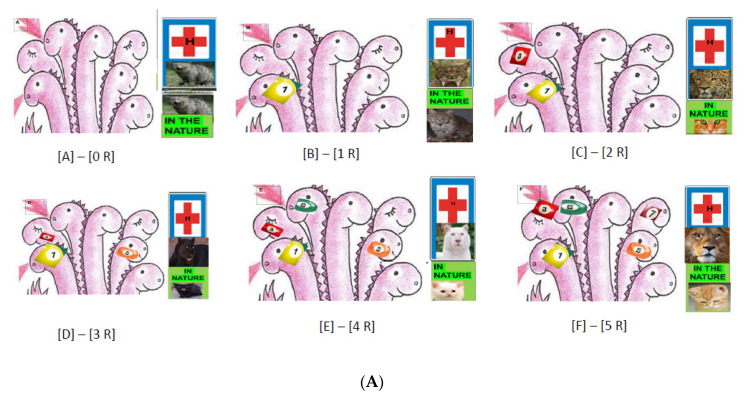
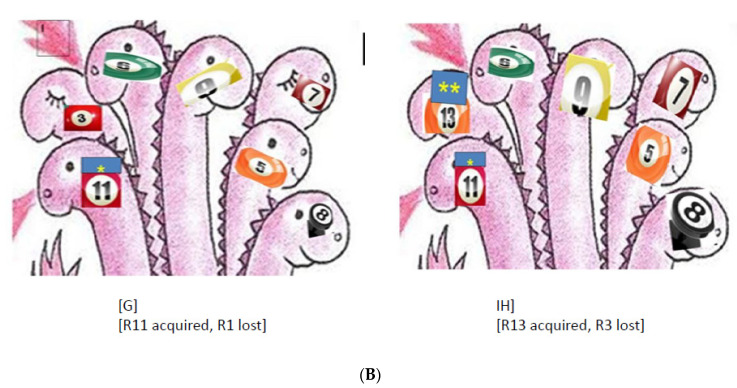
Illustration of Collateral Sensitivity. Trees do not grow to the sky: a metaphoric illustration that the MDR pathogens cannot be overwhelming winners in nature. In Figure 2, the pathogen bacterium is illustrated as a seven-headed monster. (A) demonstration of different trends of adaptive evolution in commensal and hospital environments. (A) Each new antibiotic resistance ([A]—[0 R]; [B]—[1 R];[C]—[2 R]; [D]—[3 R]; [E]—[4 R]; [A]—[5 R]) elevates the genetic load and reduces fitness, which makes the pathogen more vulnerable in antibiotic-free (commensal) conditions symbolized as nature (A). Under antibiotic stress conditions, hospital resistance as a positive selection marker makes the pathogen even more powerful and dangerous. (A) A pathogen without antibiotic resistance (R = 0) has similar strength in the hospital and in nature (the pathogen is symbolized as a wild cat). (B) One antibiotic resistance (R = 1) (#1) makes the pathogen a little stronger (an ounce) in the hospital and a little weaker (bobcat) in nature. (E,F) The more resistant alleles (#1, #3, #5, #6 and #1, #3, #5, #6. #7) that are present, the more strength in the hospital (symbolized ounce and lion, respectively) and elevated weakness (“baby cats”) in nature. (B) Demonstration of collateral sensitivity. (G,H) The load-bearing potential must be limited, at least the phenomenon of collateral sensitivity seems to support this forecast. When the hypothetical seven-fold resistant pathogen (resistant to antibiotics #1, #3, #5 #6, #7, #8, and #9) acquires an 8th (#11*, (G)) and a 9th (#13*, (G,H)), resistance, respectively, it drops out resistance #1 and #3, respectively.
Figure 2
Figure 2
Illustration of Collateral Sensitivity. Trees do not grow to the sky: a metaphoric illustration that the MDR pathogens cannot be overwhelming winners in nature. In Figure 2, the pathogen bacterium is illustrated as a seven-headed monster. (A) demonstration of different trends of adaptive evolution in commensal and hospital environments. (A) Each new antibiotic resistance ([A]—[0 R]; [B]—[1 R];[C]—[2 R]; [D]—[3 R]; [E]—[4 R]; [A]—[5 R]) elevates the genetic load and reduces fitness, which makes the pathogen more vulnerable in antibiotic-free (commensal) conditions symbolized as nature (A). Under antibiotic stress conditions, hospital resistance as a positive selection marker makes the pathogen even more powerful and dangerous. (A) A pathogen without antibiotic resistance (R = 0) has similar strength in the hospital and in nature (the pathogen is symbolized as a wild cat). (B) One antibiotic resistance (R = 1) (#1) makes the pathogen a little stronger (an ounce) in the hospital and a little weaker (bobcat) in nature. (E,F) The more resistant alleles (#1, #3, #5, #6 and #1, #3, #5, #6. #7) that are present, the more strength in the hospital (symbolized ounce and lion, respectively) and elevated weakness (“baby cats”) in nature. (B) Demonstration of collateral sensitivity. (G,H) The load-bearing potential must be limited, at least the phenomenon of collateral sensitivity seems to support this forecast. When the hypothetical seven-fold resistant pathogen (resistant to antibiotics #1, #3, #5 #6, #7, #8, and #9) acquires an 8th (#11*, (G)) and a 9th (#13*, (G,H)), resistance, respectively, it drops out resistance #1 and #3, respectively.

References

    1. Watkins R.R., Bonomo R.A. Overview: Global and local impact of antibiotic resistance. Infect. Dis. Clin. N. Am. 2016;30:313–322. doi: 10.1016/j.idc.2016.02.001. - DOI - PubMed
    1. Magiorakos A.P., Srinivasan A., Carey R.B., Carmeli Y., Falagas M.E., Giske C.G., Harbarth S., Hindler J.F., Kahlmeter G., Olsson-Liljequist B., et al. Multidrug-resistant, extensively drug-resistant and pandrug-resistant bacteria: An international expert proposal for interim standard definitions for acquired resistance. Clin. Microbiol. Infect. 2012;18:268–281. doi: 10.1111/j.1469-0691.2011.03570.x. - DOI - PubMed
    1. El Zowalaty M.E., Al Thani A.A., Webster T.J., El Zowalaty A.E., Schweizer H.P., Nasrallah G.K., Marei H.E., Ashour H.M. Pseudomonas aeruginosa: Arsenal of resistance mechanisms, decades of changing resistance profiles, and future antimicrobial therapies. Future Microbiol. 2015;10:1683–1706. 115. doi: 10.2217/fmb.15.48. - DOI - PubMed
    1. Imperi F., Antunes L.C., Blom J., Villa L., Iacono M., Visca P., Carattoli A. The genomics of Acinetobacter baumannii: Insights into genome plasticity, antimicrobial resistance and pathogenicity. IUBMB Life. 2011;63:1068–1074. doi: 10.1002/iub.531. - DOI - PubMed
    1. Lean S.S., Yeo C.C. Small, enigmatic plasmids of the nosocomial pathogen, Acinetobacter baumannii: Good, bad, who knows? Front. Microbiol. 2017;8:1547. doi: 10.3389/fmicb.2017.01547. - DOI - PMC - PubMed

LinkOut - more resources