


The Acute Impact of External Compression on Back Squat Performance in Competitive Athletes
- PMID: 32610568
- PMCID: PMC7370145
- DOI: 10.3390/ijerph17134674
The Acute Impact of External Compression on Back Squat Performance in Competitive Athletes
Abstract
The aim of the present study was to evaluate the effects of external compression with blood flow restriction on power output and bar velocity changes during the back-squat exercise (SQ). The study included 10 judo athletes (age = 28.4 ± 5.8 years; body mass = 81.3 ± 13.1 kg; SQ one-repetition maximum (1-RM) 152 ± 34 kg; training experience 10.7 ± 2.3 years).
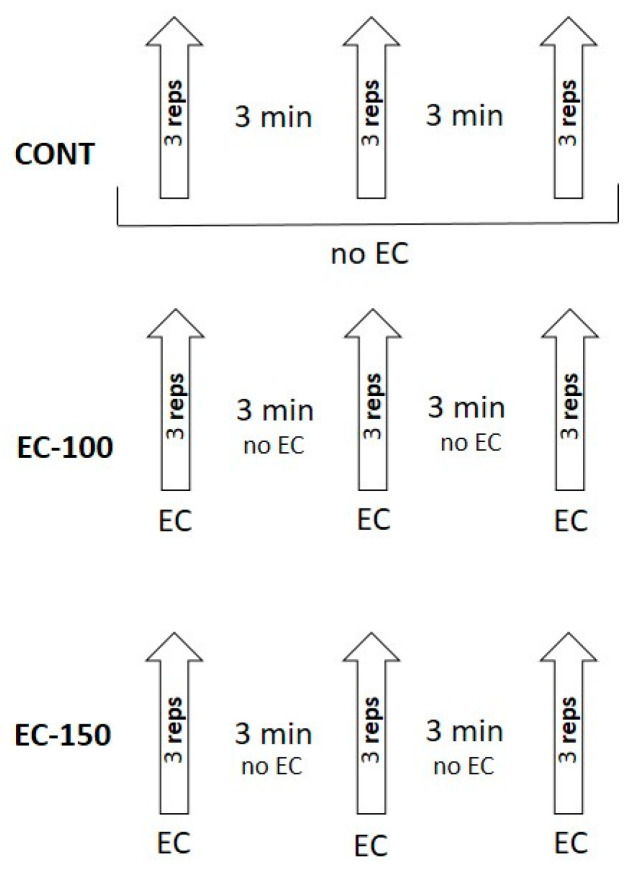
Methods: The experiment was performed following a randomized crossover design, where each participant performed three different exercise protocols: (1) control, without external compression (CONT); (2) intermittent external compression with pressure of 100% arterial occlusion pressure (AOP) (EC-100); and (3) intermittent external compression with pressure of 150% AOP (EC-150). To assess the differences between conditions, the participants performed 3 sets of 3 repetitions of the SQ at 70% 1-RM. The differences in peak power output (PP), mean power output (MP), peak bar velocity (PV), and mean bar velocity (MV) between the three conditions were examined using repeated measures two-way ANOVA.
Results: The post hoc analysis for the main effect of conditions showed a significant increase in PP (p = 0.03), PV (p = 0.02), MP (p = 0.04), and MV (p = 0.03), for the EC-150, compared to the CONT. Furthermore, a statistically significant increase in PP (p = 0.04), PV (p = 0.03), MP (p = 0.02), and MV (p = 0.01) were observed for the EC-150 compared to EC-100. There were no significant changes in PP, PV, MP, and MV, between EC-100 and CONT conditions.
Conclusion: The results indicate that the use of extremely high-pressure external compression (150% AOP) during high-loaded (70% 1-RM) lower limb resistance exercise elicits an acute increase in power output and bar velocity.
Keywords: bar velocity; blood flow restriction; occlusion; performance; power output; resistance exercise.
Conflict of interest statement
The authors declare no conflict of interest.
Figures
References
-
- Patterson S.D., Hughes L., Warmington S., Burr J., Scott B.R., Owens J., Abe T., Nielsen J.L., Libardi C.A., Laurentino G., et al. Blood Flow Restriction Exercise Position Stand: Considerations of Methodology, Application, and Safety. Front. Physiol. 2019;10 doi: 10.3389/fphys.2019.00533. - DOI - PMC - PubMed
Publication types
MeSH terms
LinkOut - more resources
Full Text Sources
Miscellaneous
