Review
. 2020 May;12(2):966-986.
doi: 10.1111/raq.12367. Epub 2019 Jul 8.

Evaluating antimicrobial resistance in the global shrimp industry

Affiliations
Review

Evaluating antimicrobial resistance in the global shrimp industry

Kelly Thornber et al. Rev Aquac. 2020 May.

Abstract

Antimicrobial resistance (AMR) is a growing threat to global public health, and the overuse of antibiotics in animals has been identified as a major risk factor. With high levels of international trade and direct connectivity to the aquatic environment, shrimp aquaculture may play a role in global AMR dissemination. The vast majority of shrimp production occurs in low- and middle-income countries, where antibiotic quality and usage is widely unregulated, and where the integration of aquaculture with family livelihoods offers many opportunities for human, animal and environmental bacteria to come into close contact. Furthermore, in shrimp growing areas, untreated waste is often directly eliminated into local water sources. These risks are very different to many other major internationally-traded aquaculture commodities, such as salmon, which is produced in higher income countries where there are greater levels of regulation and well-established management practices. Assessing the true scale of the risk of AMR dissemination in the shrimp industry is a considerable challenge, not least because obtaining reliable data on antibiotic usage is very difficult. Combating the risks associated with AMR dissemination is also challenging due to the increasing trend towards intensification and its associated disease burden, and because many farmers currently have no alternatives to antibiotics for preventing crop failure. In this review, we critically assess the potential risks the shrimp industry poses to AMR dissemination. We also discuss some of the possible risk mitigation strategies that could be considered by the shrimp industry as it strives for a more sustainable future in production.

Keywords: antibiotics; antimicrobial resistance; aquaculture; international trade; low and middle income countries; shrimp.


Figures

Figure 1
Figure 1
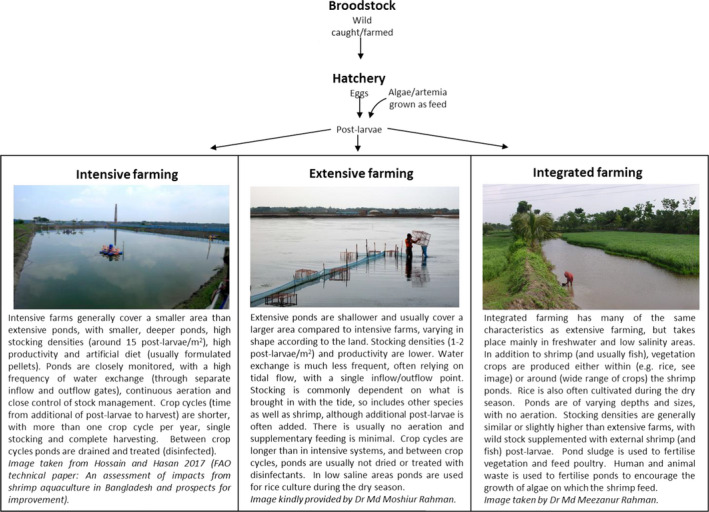
Shrimp farming. Typical shrimp farming process, showing characteristics of the different types of production: intensive, extensive and integrated. Images are of ponds in Bangladesh (credits shown).
Figure 2
Figure 2
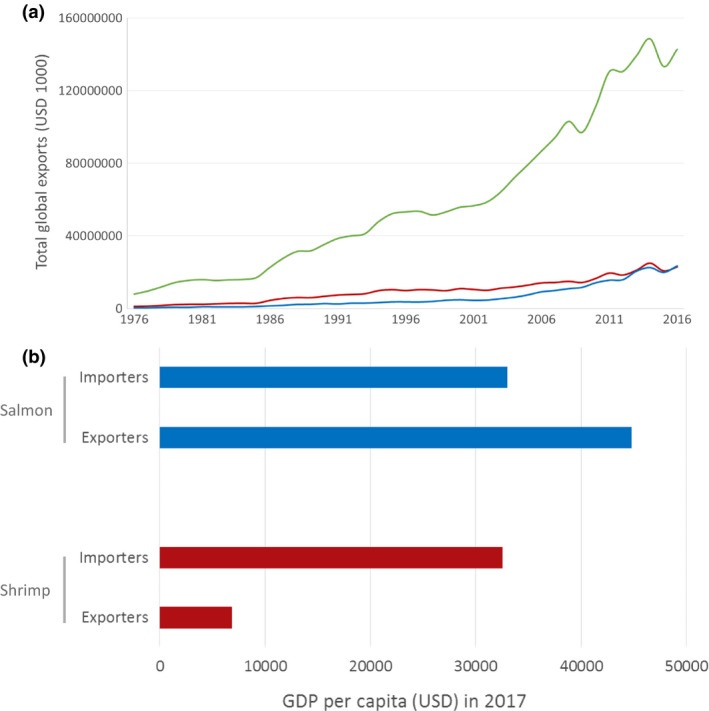
The global shrimp industry. (a) Shrimp and salmon are the highest internationally‐traded seafood commodities by value. In 2016, salmon overtook shrimp as the highest value traded commodity. Data, obtained from the FAO's FishStat J Global Fishery and Aquaculture Commodity Statistics Dataset, shows the total global market value of exports over time. (b) Weighted average GDP per capita of the top 10 shrimp and salmon exporting and importing countries. Weighted averages were calculated by taking the sum of imports/exports (data from the FAO's FishStat J Global Fishery and Aquaculture Commodity Statistics Dataset) for the top 10 countries and calculating each country's fraction of this. This fraction was then multiplied by the GDP per capita for that country (World Bank databank; 2015 data) to obtain the weighted average score. Total aquaculture (green); Shrimp (red); Salmon (blue).
Figure 3
Figure 3
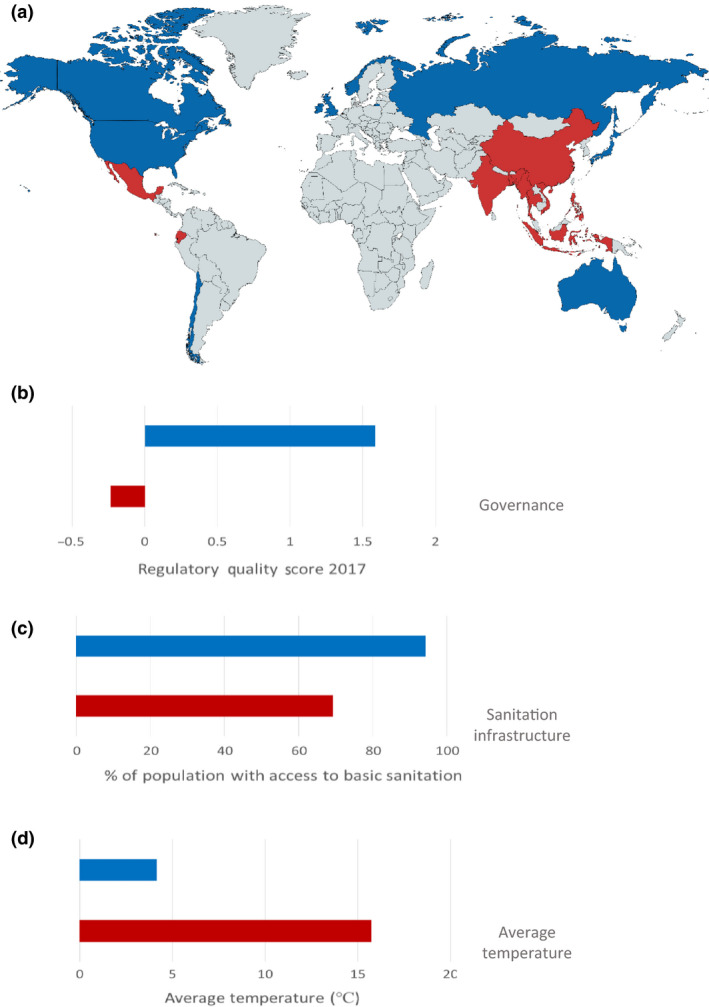
Selected comparisons between the top 10 shrimp and salmon producing countries. (a) Global geographical distributions of the top 10 shrimp (red) and salmon (blue) producing countries. Data obtained from the FAO's FishStat J Global Fishery and Aquaculture Production Statistics Dataset were used to produce the map with www.mapchart.net. (b–d) Differences between shrimp (red) and salmon (blue) producing countries in terms of (b) governance (taken as mean Regulatory Quality Score in 2017; regulatory quality is one of the six dimensions of governance used in the World Governance Indicators Project: http://info.worldbank.org/governance/WGI/#home), (c) sanitation infrastructure (World Bank Databank 2015 data: People using at least basic sanitation services (% of population)) and (d) climate: average monthly temperature between 1991–2015 (World Bank Climate Change Knowledge Portal).
Figure 4
Figure 4
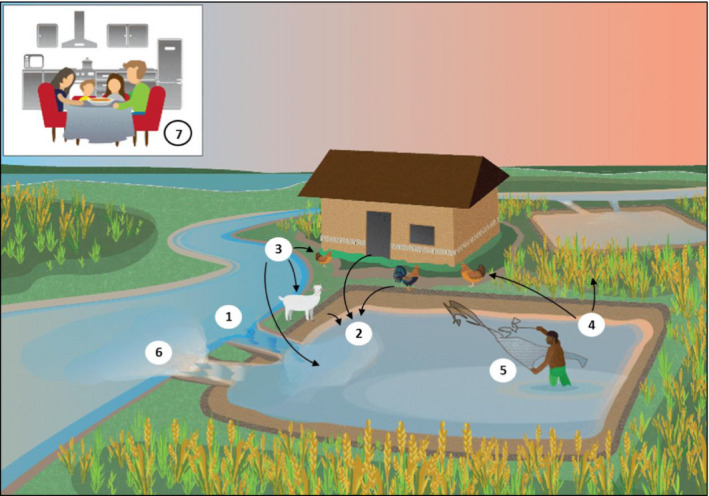
Ways in which shrimp farming poses a potential risk to AMR dissemination for a typical integrated small‐scale shrimp farm. 1. Fresh water is sourced from local water sources and mixed with saline water, in order to reach the desired salinity. These water supplies may be polluted with antibiotics, resistant bacteria and human/animal pathogens. 2. Human and animal waste, containing human/animal pathogens, is often used to fertilize the pond to encourage the growth of algae on which the shrimp feed. 3. Unregulated use of antibiotics, which can be added directly to the pond water and/or to the animals/humans living there. 4. Pond sediment/sludge containing antibiotics and resistant bacteria/pathogens is used as fertilizer for chicken feed and crops, both of which are eaten by the humans. 5. Humans have direct contact with pond water, sediment/sludge and shrimp/other animals. 6. Waste (water and sediment) is released directly back into local water sources, often untreated. 7. Shrimp (and associated bacteria/antibiotic residues) are transported and consumed internationally.
Figure 5
Figure 5
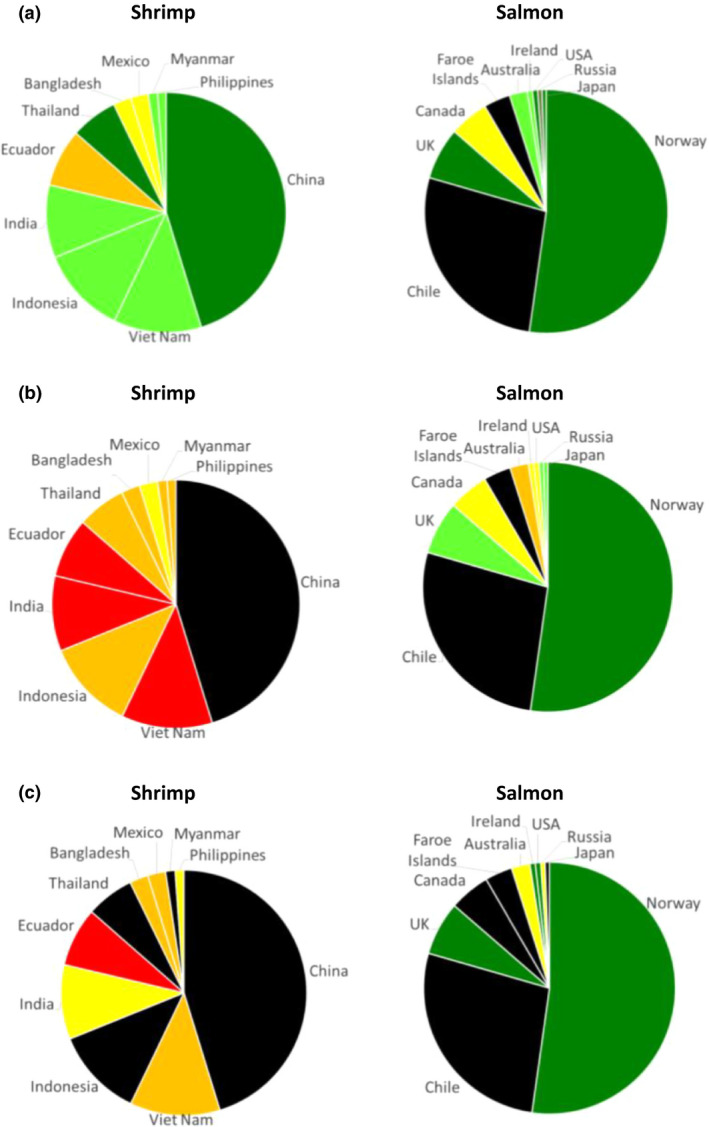
Progress on AMR governance. Data from the WHO AMR self‐assessment survey, in which a multi‐sectoral group from each country is asked to submit annual responses to a questionnaire on AMR and antimicrobial use, in order to monitor progress and identify areas for action. Data shows country responses for the top 10 shrimp‐ and salmon‐producing countries (year two data, 2017–2018, published on 18th July 2018) for the topics below. Countries rate themselves from A (no action being taken; red) to E (best practice; dark green). Responses for each category are shown, taken directly from the self‐assessment survey. Black indicates no response given. Pie chart proportions indicate relative levels of production (in metric tonnes) for each country. OIE: World Organisation for Animal Health. (a) No response (black); No national AMR action plan (red); National AMR action plan under development (orange); National AMR action plan developed (yellow); National AMR action plan approved by government that reflects Global Action Plan objectives, with an operational plan and monitoring arrangements (light green); National AMR action plan has funding sources identified, is being implemented and has relevant sectors involved with a defined monitoring and evaluation process in place) (dark green). (b) No response (black); No national plan or system for monitoring sales/use of antimicrobials in animals (red); Plan agreed for monitoring quantities of antimicrobials sold for/used in animals, based on OIE standards (orange); Data collected and reported on total quantity of antimicrobials sold for/used in animals and their intended type of use (therapeutic or growth promotion) (yellow); On a regular basis, data is collected and reported to the OIE on the total quantity of antimicrobials sold for/used in animals nationally, by antimicrobial (light green); class, by species (aquatic or terrestrial), method of administration, and by type of use (therapeutic or growth promotion) (dark green) Data on antimicrobials used under veterinary supervision in animals are available at farm level, for individual animal species). (c) No response (black); No national plan for a system of monitoring of AMR is available (red); National plan for monitoring AMR but capacity (including laboratory) for surveillance and reporting data on AMR is lacking (orange); Some AMR data is collected locally but may not use a standardised approach and lacks national coordination and/or quality management (yellow); Priority pathogenic/ commensal bacterial species have been identified for surveillance (light green). Data systematically collected and reported on levels of resistance in at least 2 of those bacterial species, involving a laboratory that follows quality management processes, e.g. proficiency testing; National system of surveillance of AMR established for priority pathogens and for relevant commensal bacteria which follows quality assurance processes in line with intergovernmental standards (dark green). Laboratories that report for AMR surveillance follow quality assurance processes).
Figure 6
Figure 6
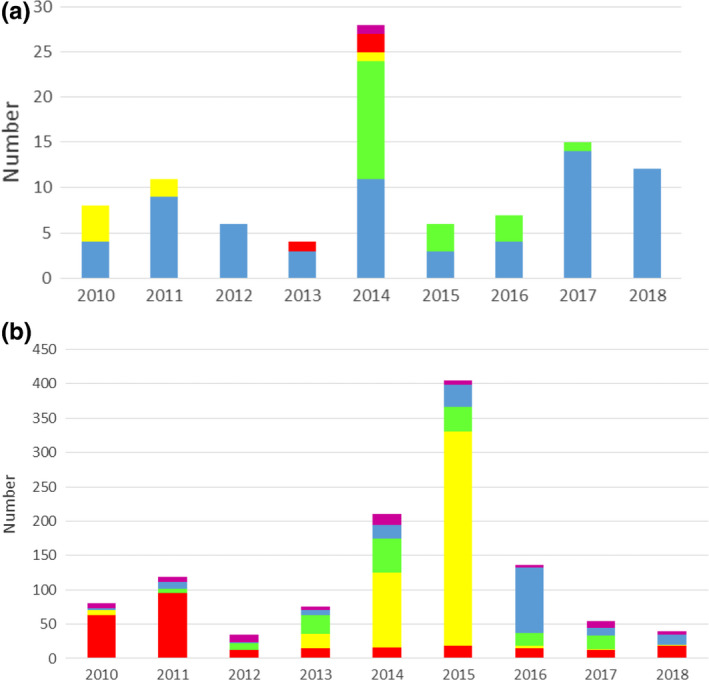
Shrimp export rejections due to the presence of residues of prohibited antibiotics or those exceeding the maximum residual levels permitted. Number of border rejections due to antibiotic residue hazards in (a) EU (data taken from EU's Rapid Alert System for Food and Feed portal on 03/12/2018, analysing search results from 01/01/2010 to 31/10/2018, filtering only shrimp border rejections due to antibiotic residues). India (blue); Vietnam (green); Bangladesh (yellow); China (red); Myanmar (purple). (b) USA (data taken from FDA's Refusal Entry Database, from 01/01/2010 – 31/10/2018, filtering only shrimp border rejections due to antibiotic residues. Data on total number of samples tested each year were not readily available from either database. China (red); Malaysia (yellow); Vietnam (green); India (blue); Others (purple)

References

    1. Ahlstrom CA, Bonnedahl J, Woksepp H, Hernandez J, Olsen B, Ramey AM (2018) Acquisition and dissemination of cephalosporin‐resistant E. coli in migratory birds sampled at an Alaska landfill as inferred through genomic analysis. Scientific Reports 8 (1): 1–11. - PMC - PubMed
    1. Akinbowale OL, Peng H, Barton MD (2006) Antimicrobial resistance in bacteria isolated from aquaculture sources in Australia. Journal of Applied Microbiology 100: 1103–1113. - PubMed
    1. Alderman DJ, Smith P (2001) Development of draft protocols of standard reference methods for antimicrobial agent susceptibility testing of bacteria associated with fish diseases. Aquaculture 196: 211–243.
    1. Ali H, Rico A, Murshed‐e‐Jahan K, Belton B (2016) An assessment of chemical and biological product use in aquaculture in Bangladesh. Aquaculture 454: 199–209.
    1. Anh PT, Kroeze C, Bush SR, Mol APJ (2010) Water pollution by intensive brackish shrimp farming in south‐east Vietnam: causes and options for control. Agricultural Water Management 97: 872–882.

LinkOut - more resources