. 2020 Jun 16:7:112.
doi: 10.3389/fcvm.2020.00112. eCollection 2020.

Key Strategies for Clinical Management and Improvement of Healthcare Services for Cardiovascular Disease and Diabetes Patients in the Coronavirus (COVID-19) Settings: Recommendations From the REPROGRAM Consortium

Affiliations

Key Strategies for Clinical Management and Improvement of Healthcare Services for Cardiovascular Disease and Diabetes Patients in the Coronavirus (COVID-19) Settings: Recommendations From the REPROGRAM Consortium

Sonu Bhaskar et al. Front Cardiovasc Med. .

Abstract

Patients with cardiovascular disease and diabetes are at potentially higher risk of infection and fatality due to COVID-19. Given the social and economic costs associated with disability due to these conditions, it is imperative that specific considerations for clinical management of these patients be observed. Moreover, the reorganization of health services around the pandemic response further exacerbates the growing crisis around limited access, treatment compliance, acute medical needs, and mental health of patients in this specific subgroup. Existing recommendations and guidelines emanating from respective bodies have addressed some of the pressure points; however, there are variations and limitations vis a vis patient with multiple comorbidities such as obesity. This article will pull together a comprehensive assessment of the association of cardiovascular disease, diabetes, obesity and COVID-19, its impact on the health systems and how best health systems can respond to mitigate current challenges and future needs. We anticipate that in the context of this pandemic, the cardiovascular disease and diabetes patients need a targeted strategy to ensure the harm to this group does not translate to huge costs to society and to the economy. Finally, we propose a triage and management protocol for patients with cardiovascular disease and diabetes in the COVID-19 settings to minimize harm to patients, health systems and healthcare workers alike.

Keywords: cardiovascular diseases (CVDs); clinical algorithm; coronavirus disease 2019 (COVID-19); diabetes; healthcare services; obesity; personal protective equipment (PPE).


Figures

Figure 1
Figure 1
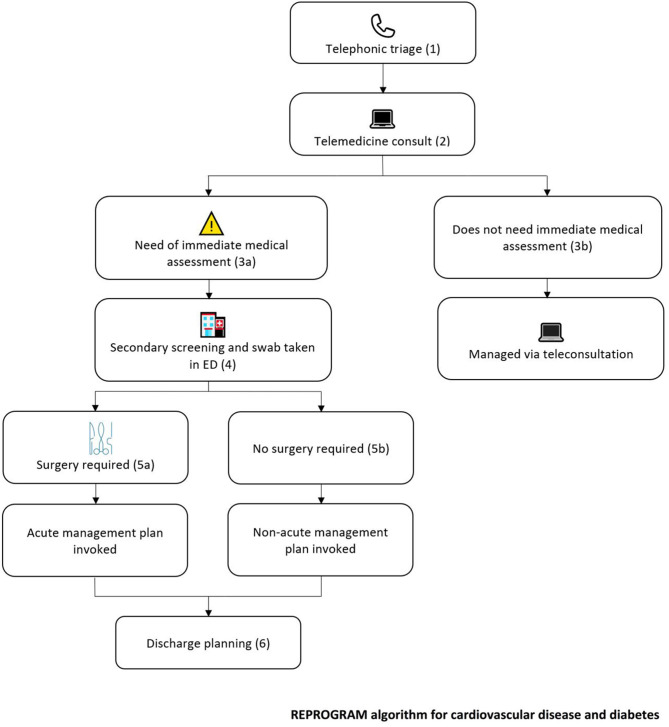
Proposed cardiovascular disease and diabetes risk-adjusted, stage-wise, tele and in-hospital triage and management protocol. (1) All patients seeking outpatient or in-hospital appointment, except the emergency cases, must dial into the hospital for a triage over telephone for risk assessment of COVID-19 cases prior to consultation. The triage will be carried out by the relevant department officer, and will comprise a brief screening for signs, symptoms, and risk factors of COVID-19. Questions should address recent travel history, fever, cough, sore throat, shortness of breath, fatigue, aches and pains, headaches, runny or stuffy nose, diarrhea, sneezing, and loss of smell. Patients should be screened for their body mass index (BMI) and those with BMI ≥ 30 should be closely monitored and strongly advised to self-isolate and follow public health guidelines. Patients with BMI ≥ 30 are at significant risk of mortality after COVID-19 infection. (2) All patients, despite risk factors and symptoms, should be asked to attend a compulsory teleconsultation in order to minimize harm to both the patient and consultant. During the consultation, further assessment of COVID-19 symptoms can be made, and potential impact on underlying diabetes/cardiovascular disease should be assessed. (3a) Should there be a self-reported acute emergency by the patient, or a need for immediate medical attention as per the clinical judgement of the physician, the patient should be asked to present at the emergency department; (b) If immediate medical assessment is not required, management should be carried out via teleconsultation. (4) In the emergency department, the relevant steward must carry out secondary screening for COVID-19 symptoms. After screening, patients should undergo diagnostic testing for COVID-19. Drive-through testing facilities should be deployed for all patients, to minimize exposure to health systems, health workers and the community. Further imaging should also be carried out on patients, with extra precautions being taken to ensure proper cleaning of equipment when imaging COVID-19 positive patients. (5a) For patients who require surgery, the acute management plan should be invoked. If the patient is COVID-19 positive, measures must be taken to protect healthcare workers involved. Minimal number of staff should be involved at the direct interface and risk-minimization should be ensured for any peri-surgical procedures that might involve aerosol production. For COVID-19 negative patients, the routine management plan should be followed; (b) If no surgery is required, the non-acute management plan should be invoked. (6) A plan should be made to ensure proper quarantine of patients after discharge. This could include home isolation and telemonitoring. Patients should be advised to follow hand hygiene, wear masks and practice social distancing.

References

    1. John Hopkins University COVID-19 Global Cases by the Center for Systems Science and Engineering (CSSE). Johns Hopkins University; (2020). Available online at: https://coronavirus.jhu.edu/map.html (accessed April 6, 2020).
    1. Yang X, Yu Y, Xu J, Shu H, Xia Ja, Liu H, et al. Clinical course and outcomes of critically ill patients with SARS-CoV-2 pneumonia in Wuhan, China: a single-centered, retrospective, observational study. Lancet Respir Med. (2020) 8:475–81. 10.1016/S2213-2600(20)30079-5 - DOI - PMC - PubMed
    1. Guan W-j, Ni Z-y, Hu Y, Liang W-h, Ou C-q, He J-x, et al. Clinical Characteristics of Coronavirus Disease 2019 in China. N Engl J Med. (2020) 382:1708–20. 10.1056/NEJMoa2002032 - DOI - PMC - PubMed
    1. Zhang JJ, Dong X, Cao YY, Yuan YD, Yang YB, Yan YQ, et al. Clinical characteristics of 140 patients infected with SARS-CoV-2 in Wuhan, China. Allergy. (2020). 10.1111/all.14238. [Epub ahead of print]. - DOI - PubMed
    1. Wu Z, McGoogan JM. Characteristics of and Important Lessons from the Coronavirus Disease 2019 (COVID-19) Outbreak in China: summary of a report of 72 314 cases from the Chinese Center for Disease Control and Prevention. JAMA. (2020) 323:1239–42. 10.1001/jama.2020.2648 - DOI - PubMed

LinkOut - more resources