Randomized Controlled Trial
. 2020 Aug;103(2_Suppl):54-65.
doi: 10.4269/ajtmh.19-0657.

A Longitudinal Cohort to Monitor Malaria Infection Incidence during Mass Drug Administration in Southern Province, Zambia

Affiliations
Randomized Controlled Trial

A Longitudinal Cohort to Monitor Malaria Infection Incidence during Mass Drug Administration in Southern Province, Zambia

Adam Bennett et al. Am J Trop Med Hyg. 2020 Aug.

Abstract

Rigorous evidence of effectiveness is needed to determine where and when to apply mass drug administration (MDA) or focal MDA (fMDA) as part of a malaria elimination strategy. The Zambia National Malaria Elimination Centre recently completed a community-randomized controlled trial in Southern Province to evaluate MDA and fMDA for transmission reduction. To assess the role of MDA and fMDA on infection incidence, we enrolled a longitudinal cohort for an 18-month period of data collection including monthly malaria parasite infection detection based on polymerase chain reaction and compared time to first infection and cumulative infection incidence outcomes across study arms using Cox proportional hazards and negative binomial models. A total of 2,026 individuals from 733 households were enrolled and completed sufficient follow-up for inclusion in analysis. Infection incidence declined dramatically across all study arms during the period of study, and MDA was associated with reduced risk of first infection (hazards ratio: 0.36; 95% CI: 0.16-0.80) and cumulative infection incidence during the first rainy season (first 5 months of follow-up) (incidence rate ratio: 0.34; 95% CI: 0.12-0.95). No significant effect was found for fMDA or for either arm over the full study period. Polymerase chain reaction infection status at baseline was strongly associated with follow-up infection. The short-term effects of MDA suggest it may be an impactful accelerator of transmission reduction in areas with high coverage of case management and vector control and should be considered as part of a malaria elimination strategy.


Figures
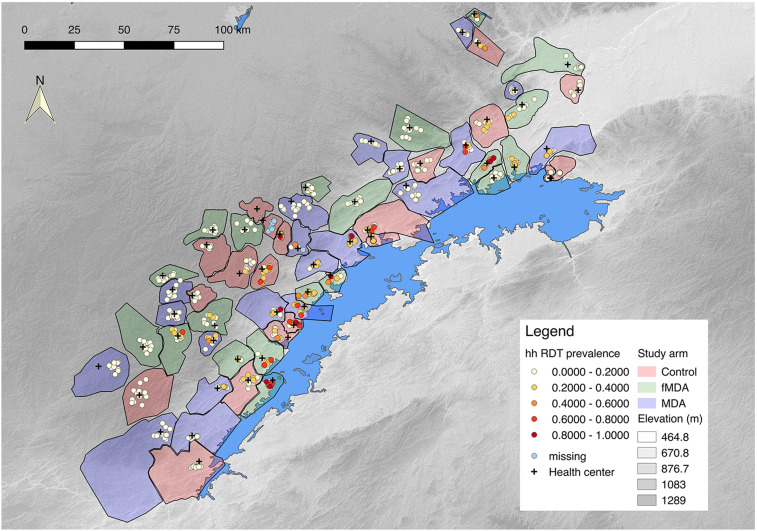
Figure 1.
Figure 1.
Map of study site including study health facility catchments by arm and baseline rapid diagnostic test (RDT) prevalence in cohort households. Baseline data for one control catchment were entirely missing, and baseline RDT values for the neighboring control catchment were missing (indicated in legend).
Figure 2.
Figure 2.
Among individuals enrolled at baseline, total number of individuals with data by month over the 18 months of data collection, by transmission strata and study arm. Bar plots indicate numbers of individuals with data for each month, and among those with adequate follow-up, bar plots indicate numbers with or without a PCR value by month. Dotted line indicates target enrollment per month.
Figure 3.
Figure 3.
Monthly infection rates for polymerase chain reaction (PCR) and mean rainfall over the period of study, by transmission strata and study arm. Timing of each intervention round is indicated by downward arrows. This figure appears in color at www.ajtmh.org.
Figure 4.
Figure 4.
Polymerase chain reaction–based infection incidence rates per health facility catchment by season over the follow-up period, Southern Province, Zambia, January 2015–May 2016. Baseline month (December 2014) removed from first panel.
Figure 5.
Figure 5.
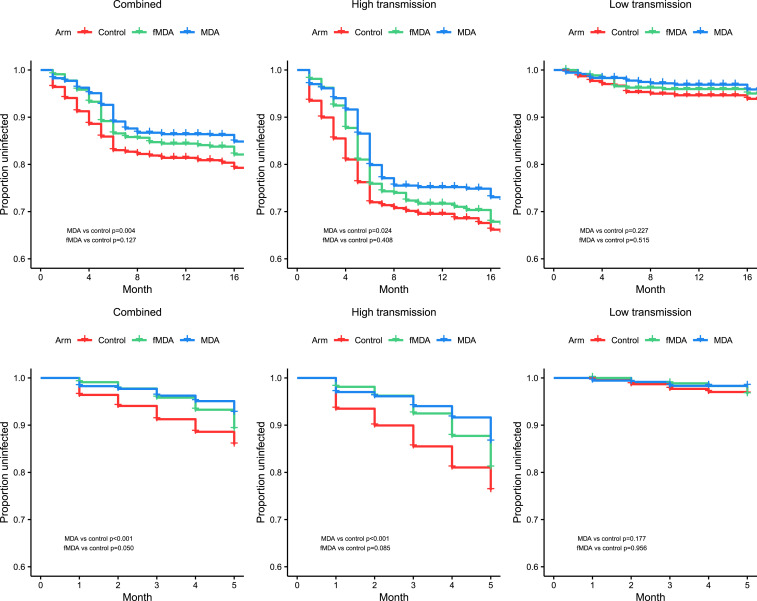
Kaplan–Meier curves by study arm for all catchments combined and high and low transmission strata over the full 17-month cohort study follow-up period (January 2015–May 2016) (top panel) and over the first rainy season only (January 2015–May 2015) (bottom panel). P-values represent results of log-rank test for each arm vs. control.
Figure 6.
Figure 6.
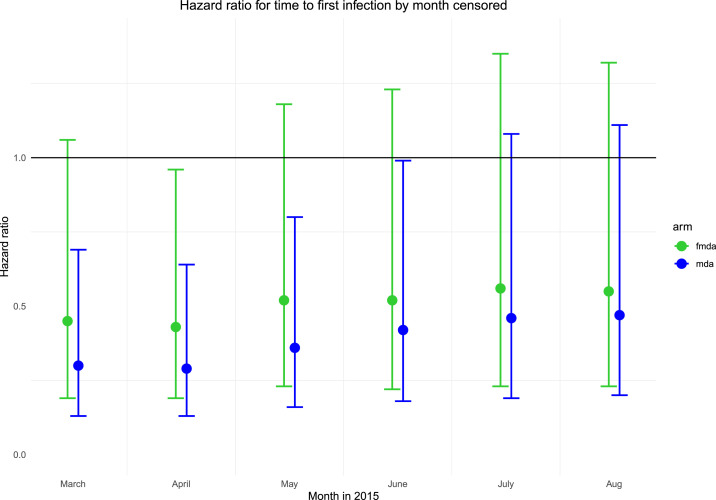
Hazard ratio for mass drug administration (MDA) and focal mass drug administration (fMDA) compared with control from adjusted Cox proportional hazards models, by month, when analysis was censored in 2015. Mass drug administration/focal mass drug administration activities occurred in December 2014 and February 2015. May 2015 represents the end of the first rainy season period. This figure appears in color at www.ajtmh.org.
Figure 7.
Figure 7.
Incidence rate ratios (IRRs) for mass drug administration (MDA) and focal mass drug administration (fMDA) vs. control by time period (season) of follow-up based on adjusted negative binomial models. Mass drug administration/focal mass drug administration campaign rounds occurred in December 2014, February 2015, October 2015, and February 2016. From the adjusted model with a season by arm interaction term (Table 6), coefficients for MDA and fMDA were calculated for each season: the first rainy season (January–May 2015), the dry season (June–November 2015), and the second rainy season (December 2015–May 2016). The IRR for the full period of study is based on the corresponding adjusted model with no season by arm interaction term. This figure appears in color at www.ajtmh.org.

References

    1. Miller JM, Eisele TP, Fraser MS, Lewis MT, Slutsker L, Chizema Kawesha E, 2020. Moving from malaria burden reduction toward elimination: an evaluation of mass drug administration in Southern Province, Zambia. Am J Trop Med Hyg 103 (Suppl 2): 3–6. - PMC - PubMed
    1. Eisele TP, et al. 2015. Assessing the effectiveness of household-level focal mass drug administration and community-wide mass drug administration for reducing malaria parasite infection prevalence and incidence in Southern Province, Zambia: study protocol for a community randomized controlled trial. Trials 16: 347. - PMC - PubMed
    1. Von Seidlein L, et al. 2003. The effect of mass administration of sulfadoxine-pyrimethamine combined with artesunate on malaria incidence: a double-blind, community-randomized, placebo-controlled trial in the Gambia. Trans R Soc Trop Med Hyg 97: 217–225. - PubMed
    1. Poirot E, Skarbinski J, Sinclair D, Kachur SP, Slutsker L, Hwang J, 2013. Mass drug administration for malaria. Cochrane Database Syst Rev 12: CD008846. - PMC - PubMed
    1. Mwesigwa L, et al. 2019. Mass drug administration with dihydroartemisinin-piperaquine and malaria transmission dynamics in the Gambia: a prospective cohort study. Clin Infect Dis 69: 278–286. - PMC - PubMed

Publication types

MeSH terms