Impact of Four Rounds of Mass Drug Administration with Dihydroartemisinin-Piperaquine Implemented in Southern Province, Zambia
- PMID: 32618247
- PMCID: PMC7416977
- DOI: 10.4269/ajtmh.19-0659
Impact of Four Rounds of Mass Drug Administration with Dihydroartemisinin-Piperaquine Implemented in Southern Province, Zambia
Abstract
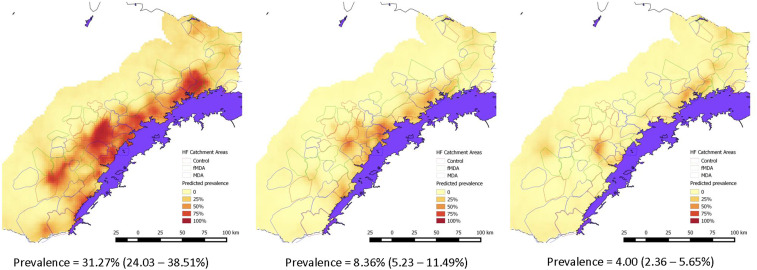
Over the past decade, Zambia has made substantial progress against malaria and has recently set the ambitious goal of eliminating by 2021. In the context of very high vector control and improved access to malaria diagnosis and treatment in Southern Province, we implemented a community-randomized controlled trial to assess the impact of four rounds of community-wide mass drug administration (MDA) and household-level MDA (focal MDA) with dihydroartemisinin-piperaquine (DHAP) implemented between December 2014 and February 2016. The mass treatment campaigns achieved relatively good household coverage (63-79%), were widely accepted by the community (ranging from 87% to 94%), and achieved very high adherence to the DHAP regimen (81-96%). Significant declines in all malaria study end points were observed, irrespective of the exposure group, with the overall parasite prevalence during the peak transmission season declining by 87.2% from 31.3% at baseline to 4.0% in 2016 at the end of the trial. Children in areas of lower transmission (< 10% prevalence at baseline) that received four MDA rounds had a 72% (95% CI = 12-91%) reduction in malaria parasite prevalence as compared with those with the standard of care without any mass treatment. Mass drug administration consistently had the largest short-term effect size across study end points in areas of lower transmission following the first two MDA rounds. In the context of achieving very high vector control coverage and improved access to diagnosis and treatment for malaria, our results suggest that MDA should be considered for implementation in African settings for rapidly reducing malaria outcomes in lower transmission settings.
Conflict of interest statement
Disclosures: The funding source had no role in the conduct, analysis, or interpretation of results of the study. All authors had full access to all the data in the study.
Figures
References
-
- Zambia Ministry of Health , 2015. Zambia National Malaria Indicator Survey 2015. Lusaka, Zambia: Zambia Ministry of Health.
-
- Zambia Ministry of Health , 2017. NMEC, ed. National Malaria Elimination Strategic Plan 2017–2021: A Strategy to Move from Accelerated Burden Reduction to Malaria Elimination in Zambia (Brief). Lusaka, Zambia: Zambia Ministry of Health.
-
- Eisele TP, et al. 2015. Assessing the effectiveness of household-level focal mass drug administration and community-wide mass drug administration for reducing malaria parasite infection prevalence and incidence in Southern Province, Zambia: study protocol for a community randomized controlled trial. Trials 16: 347. - PMC - PubMed
-
- Larsen DA, Bennett A, Silumbe K, Hamainza B, Yukich JO, Keating J, Littrell M, Miller JM, Steketee RW, Eisele TP, 2015. Population-wide malaria testing and treatment with rapid diagnostic tests and artemether-lumefantrine in southern Zambia: a community randomized step-wedge control trial design. Am J Trop Med Hyg 92: 913–921. - PMC - PubMed
Publication types
MeSH terms
Substances
LinkOut - more resources
Full Text Sources
Medical
Miscellaneous