Review
. 2021 Jan;44(1):22-41.
doi: 10.1002/jimd.12281. Epub 2020 Sep 2.

Moving towards clinical trials for mitochondrial diseases

Affiliations
Review

Moving towards clinical trials for mitochondrial diseases

Robert D S Pitceathly et al. J Inherit Metab Dis. 2021 Jan.

Abstract

Primary mitochondrial diseases represent some of the most common and severe inherited metabolic disorders, affecting ~1 in 4,300 live births. The clinical and molecular diversity typified by mitochondrial diseases has contributed to the lack of licensed disease-modifying therapies available. Management for the majority of patients is primarily supportive. The failure of clinical trials in mitochondrial diseases partly relates to the inefficacy of the compounds studied. However, it is also likely to be a consequence of the significant challenges faced by clinicians and researchers when designing trials for these disorders, which have historically been hampered by a lack of natural history data, biomarkers and outcome measures to detect a treatment effect. Encouragingly, over the past decade there have been significant advances in therapy development for mitochondrial diseases, with many small molecules now transitioning from preclinical to early phase human interventional studies. In this review, we present the treatments and management strategies currently available to people with mitochondrial disease. We evaluate the challenges and potential solutions to trial design and highlight the emerging pharmacological and genetic strategies that are moving from the laboratory to clinical trials for this group of disorders.

Keywords: antioxidants; clinical trial; gene therapy; mitochondrial biogenesis; mitophagy; nucleosides; primary mitochondrial disease; treatment.


Figures

FIGURE 1
FIGURE 1
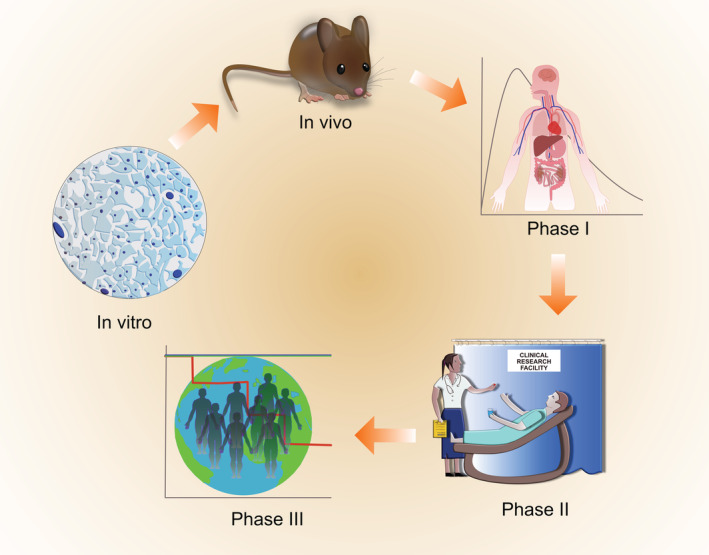
Translational pipeline. Candidate drugs are first investigated in vitro for example, in patient cell lines before in vivo toxicity and efficacy studies in appropriate animal models of disease are undertaken. Clinical trials include phase I studies, in which the candidate therapy is administered to patients or healthy volunteers to assess safety and tolerability, as well as drug pharmacokinetics. Phase II studies assess safety and efficacy of the drug in a small number of patients. Phase III studies assess safety and efficacy of the drug in a larger number of patients with defined outcome measures
FIGURE 2
FIGURE 2
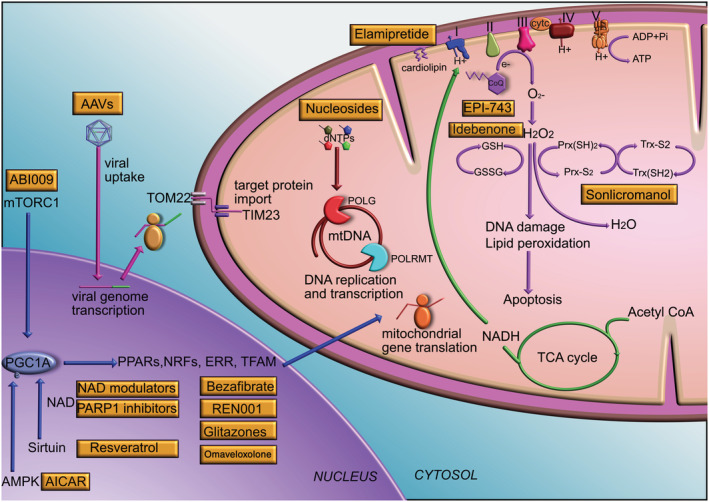
Mechanisms of action of emerging therapies. Drugs affecting mitochondrial biogenesis act on the PGC1α pathway. PGC1α is a master transcriptional coactivator of several transcription factors including PPARα,δ,γ, NRF1,2, ERR and TFAM. PGC1α is activated by phosphorylation by AMPK and deacetylation by NAD+‐dependent sirtuin, and is also controlled by mTOR. Drugs acting on these pathways include AICAR which activates AMPK, resveratrol which activates sirtuin, NAD+ modulators and PARP1 inhibitors which increase NAD+ levels, rapamycin and ABI009 which act on mTORC1, bezafibrate which activates PPARα, REN001 which activates PPARδ, glitazones which activate PPARγ and omaveloxolone which activates NRF2. Gene therapy vectors for example, AAVs transduce target cells by first being endocytosed at the plasma membrane. The viral genome is released in the nucleus where it forms an episome and is transcribed by target cell transcriptional machinery. mRNAs are translated in the cytosol. The nascent protein contains a mitochondrial targeting sequence which enables entry into mitochondria by interacting with the TOM22/TIM23 complex. Nucleoside based trial drugs are currently only applicable to one subtype of MDDS, namely thymidine kinase 2 deficiency. Several candidate therapies act on pathways related to the production of ROS, such as superoxide and hydrogen peroxide. Their intermediates have important cellular signalling functions, but also contribute to disease pathophysiology and cell death in mitochondrial disease. Levels of ROS are controlled by the glutathione and peroxidoredoxin/thioredoxin pathways. EPI743 and idebenone are both CoQ analogues which are thought to affect glutathione levels and Sonlicromanol acts on the peroxidoredoxin/thioredoxin pathway. Key: AAV, adeno‐associated virus; cytc, cytochrome c; CoQ, coenzyme Q; AMPK, AMP activated protein kinase; GSH, glutathione (reduced); GSSG, glutathione (oxidised); ERR, oestrogen related receptor; MDDS, mitochondrial DNA depletion syndrome; mRNA, messenger RNA; mTORC1, mechanistic target of rapamycin complex 1; NAD, nicotinamide adenine dinucleotide; NRF, nuclear respiratory factor; PARP1, poly(ADP‐ribose) polymerase 1; PGC1α, peroxisome proliferator‐activated receptor gamma coactivator 1‐alpha; PPAR, peroxisome proliferator‐activated receptor; POLG, polymerase gamma; Prx, peroxiredoxin; ROS, reactive oxygen species; TCA, tricarboxylic acid; TFAM, transcription factor A, mitochondrial; TIM, translocase of inner membrane; TOM, translocase of outer membrane; Trx, thioredoxin
FIGURE 3
FIGURE 3
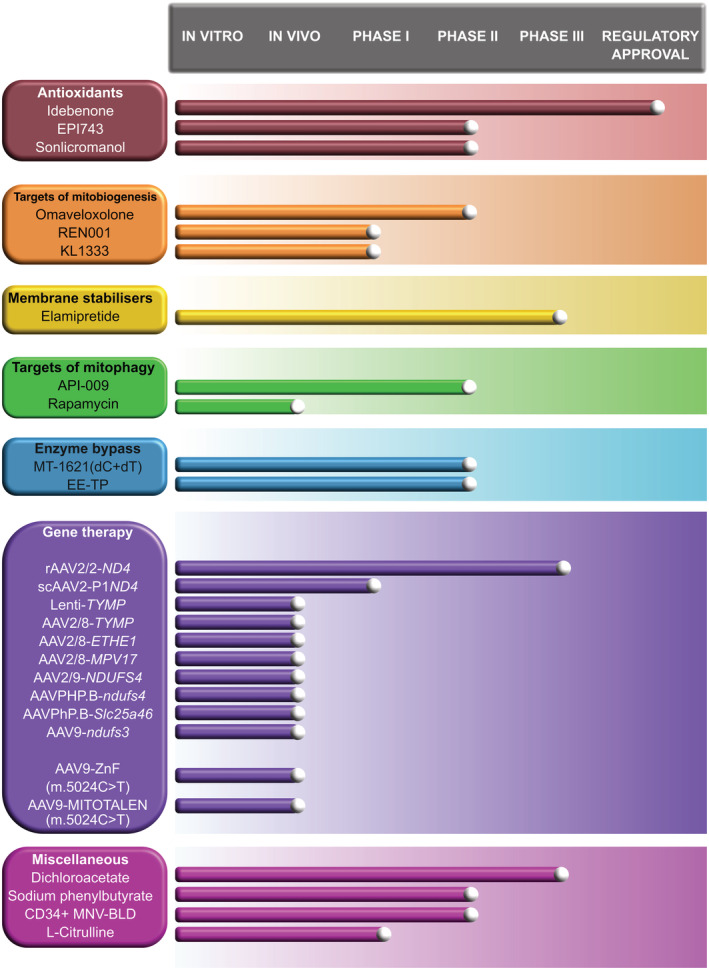
Progress in clinical trial development for mitochondrial disorders including trials that have been completed and those that are currently recruiting

References

    1. Gorman GS, Schaefer AM, Ng Y, et al. Prevalence of nuclear and mitochondrial DNA mutations related to adult mitochondrial disease. Ann Neurol. 2015;77(5):753‐759. - PMC - PubMed
    1. Rahman J, Rahman S. Mitochondrial medicine in the omics era. Lancet. 2018;391(10139):2560‐2574. - PubMed
    1. Rahman S. Mitochondrial disease in children. J Intern Med. 2020;287:609‐633. - PubMed
    1. Dogan Sukru A, Pujol C, Maiti P, et al. Tissue‐specific loss of DARS2 activates stress responses independently of respiratory chain deficiency in the heart. Cell Metab. 2014;19(3):458‐469. - PubMed
    1. Kauppila JHK, Baines HL, Bratic A, et al. A phenotype‐driven approach to generate mouse models with pathogenic mtDNA mutations causing mitochondrial disease. Cell Rep. 2016;16(11):2980‐2990. - PMC - PubMed

Publication types