


Liver Enzyme Elevation in Coronavirus Disease 2019: A Multicenter, Retrospective, Cross-Sectional Study
- PMID: 32618658
- PMCID: PMC7288765
- DOI: 10.14309/ajg.0000000000000717
Liver Enzyme Elevation in Coronavirus Disease 2019: A Multicenter, Retrospective, Cross-Sectional Study
Abstract
Introduction: Elevated liver enzyme levels are observed in patients with coronavirus disease 2019 (COVID-19); however, these features have not been characterized.
Methods: Hospitalized patients with COVID-19 in Zhejiang Province, China, from January 17 to February 12, 2020, were enrolled. Liver enzyme level elevation was defined as alanine aminotransferase level >35 U/L for men and 25 U/L for women at admission. Patients with normal alanine aminotransferase levels were included in the control group. Reverse transcription polymerase chain reaction was used to confirm severe acute respiratory syndrome coronavirus 2 (SARS-CoV-2) infection, and patients symptomatic with SARS-CoV-2 infection were defined as patients with COVID-19. Epidemiological, demographic, clinical, laboratory, treatment, and outcome data were collected and compared.
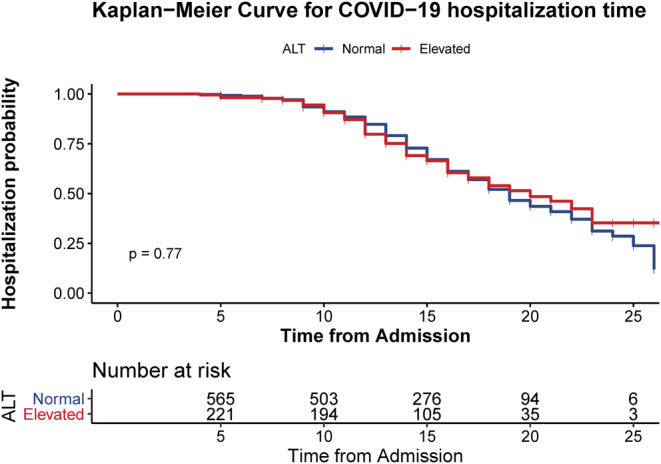
Results: Of 788 patients with COVID-19, 222 (28.2%) patients had elevated liver enzyme levels (median [interquartile range {IQR}] age, 47.0 [35.0-55.0] years; 40.5% women). Being male, overweight, and smoking increased the risk of liver enzyme level elevation. The liver enzyme level elevation group had lesser pharyngalgia and more diarrhea than the control group. The median time from illness onset to admission was 3 days for liver enzyme level elevation groups (IQR, 2-6), whereas the median hospitalization time for 86 (38.7%) discharged patients was 13 days (IQR, 11-16). No differences in disease severity and clinical outcomes were noted between the groups.
Discussion: We found that 28.2% of patients with COVID-19 presented with elevated liver enzyme levels on admission, which could partially be related to SARS-CoV-2 infection. Male patients had a higher risk of liver enzyme level elevation. With early medical intervention, liver enzyme level elevation did not worsen the outcomes of patients with COVID-19.
Conflict of interest statement
Figures

Comment in
-
Elevated Liver Chemistries in COVID-19-Is It Not a Concern?Am J Gastroenterol. 2021 Feb 1;116(2):424. doi: 10.14309/ajg.0000000000000914. Am J Gastroenterol. 2021. PMID: 32947321 Free PMC article. No abstract available.
-
Reply to Kumar and Kulkarni.Am J Gastroenterol. 2021 Feb 1;116(2):424-425. doi: 10.14309/ajg.0000000000001067. Am J Gastroenterol. 2021. PMID: 33284185 No abstract available.
References
Publication types
MeSH terms
LinkOut - more resources
Full Text Sources
Miscellaneous
