


Spatiotemporal clustering analysis of Expanded Program on Immunization (EPI) vaccination coverage in Pakistan
- PMID: 32620798
- PMCID: PMC7335212
- DOI: 10.1038/s41598-020-67839-0
Spatiotemporal clustering analysis of Expanded Program on Immunization (EPI) vaccination coverage in Pakistan
Abstract
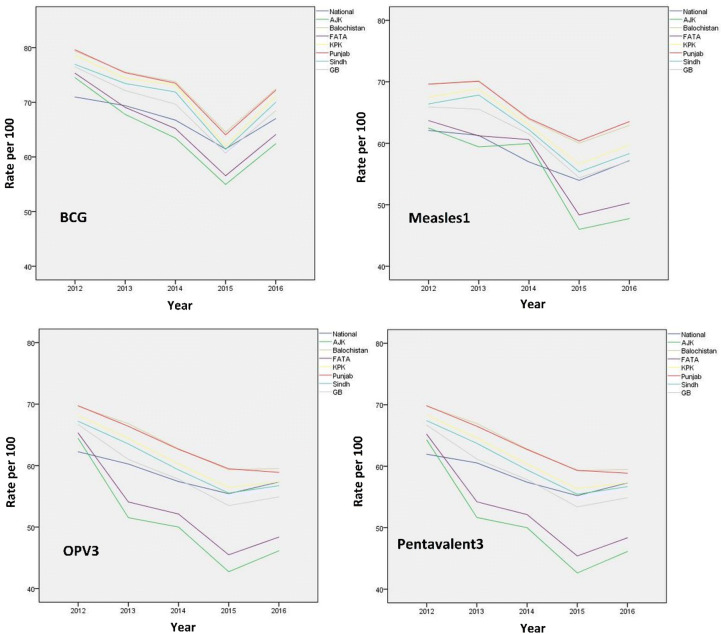
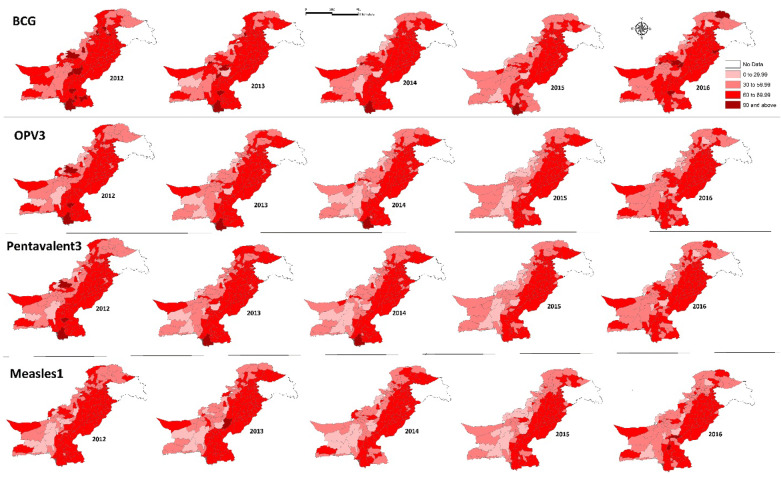
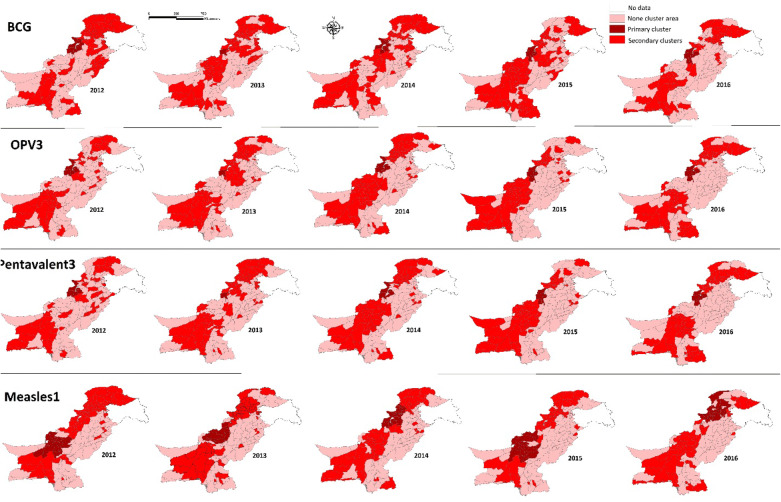
Universal vaccination coverage is still far from desired targets in many global regions including Pakistan, despite the success stories and its scientifically proven benefits. EPI Pakistan vaccination coverage data 2012-2016, at district level was collected from Federal EPI Pakistan. District-wise population data were collected from Pakistan Bureau of Statistics. Descriptive statistics and sequence plots were performed in SPSS 13.0. Purely spatial scanning analysis was done in SaTScan 9.4.4 using discrete Poisson model for detection of low vaccination coverage clusters. Geographical information system (GIS) was used to display spatial patterns and clusters of low vaccination coverage districts in Pakistan. Average annual EPI vaccination coverage in each study year were; 70.98 in 2012, 69.39% in 2013, 66.74% in 2014, 61.47% in 2015, and 67.01% in 2016, respectively. Cumulative average national vaccination rate (2012-2016) for all types of EPI vaccines was 60.60%. Average national vaccination rate for BCG, OPV3, pentavalent3 and measles1 was 67.12%, 58.53%, 58.47%, and 58.29%, respectively. Spatial cluster analysis demonstrated that most of low coverage districts for BCG, OPV3 and pentavalent3 were from FATA and KPK; while measles1 low coverage districts belonged to Balochistan. Future research should probe factors involved in low vaccination coverage in high risk districts.
Conflict of interest statement
The authors declare no competing interests.
Figures
References
-
- Lim SS, Stein DB, Charrow A, Murray CJ. Tracking progress towards universal childhood immunisation and the impact of global initiatives: A systematic analysis of three-dose diphtheria, tetanus, and pertussis immunisation coverage. Lancet. 2008;372:2031–2046. doi: 10.1016/S0140-6736(08)61869-3. - DOI - PubMed
Publication types
MeSH terms
Substances
LinkOut - more resources
Full Text Sources
