


Increasing trends in regional heatwaves
- PMID: 32620857
- PMCID: PMC7334217
- DOI: 10.1038/s41467-020-16970-7
Increasing trends in regional heatwaves
Abstract
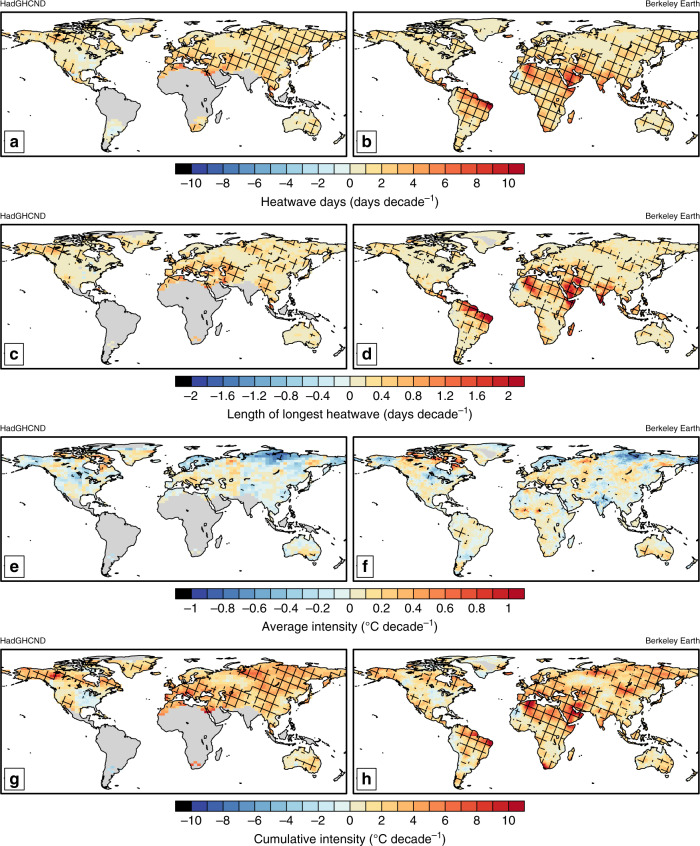
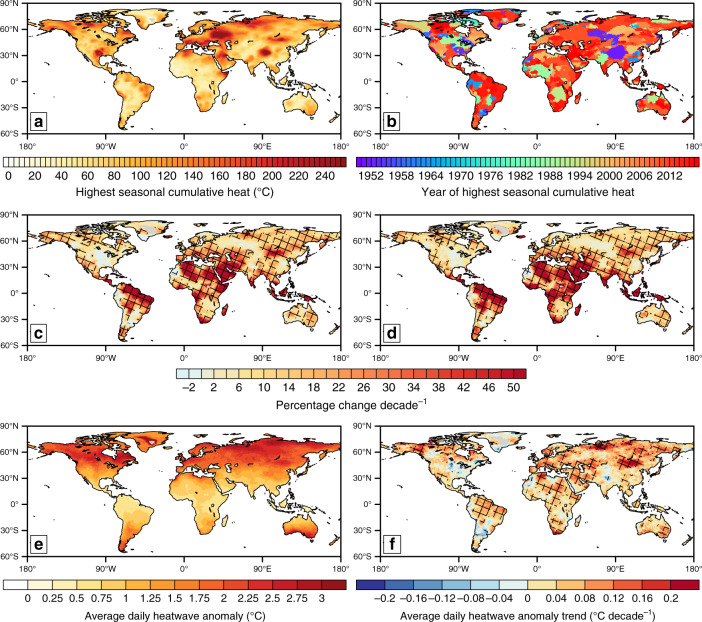
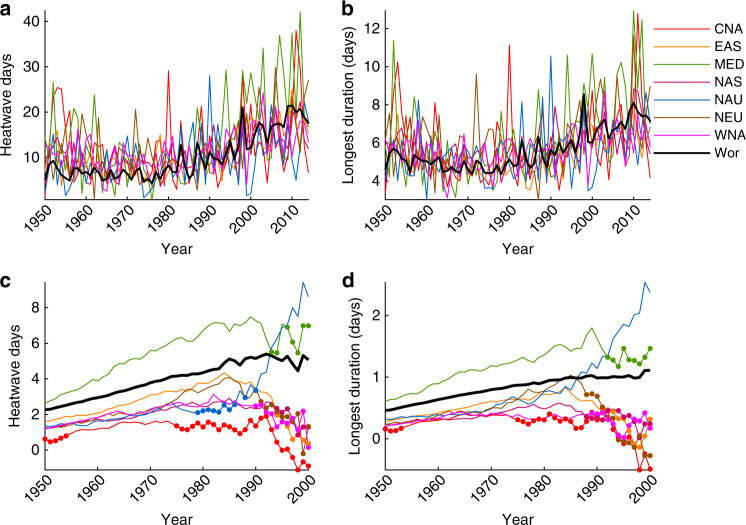
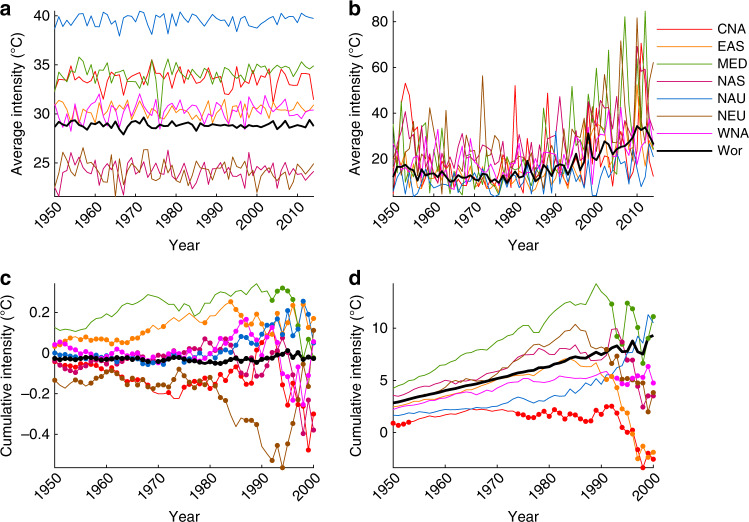
Heatwaves have increased in intensity, frequency and duration, with these trends projected to worsen under enhanced global warming. Understanding regional heatwave trends has critical implications for the biophysical and human systems they impact. Until now a comprehensive assessment of regional observed changes was hindered by the range of metrics employed, underpinning datasets, and time periods examined. Here, using the Berkeley Earth temperature dataset and key heatwave metrics, we systematically examine regional and global observed heatwave trends. In almost all regions, heatwave frequency demonstrates the most rapid and significant change. A measure of cumulative heat shows significant increases almost everywhere since the 1950s, mainly driven by heatwave days. Trends in heatwave frequency, duration and cumulative heat have accelerated since the 1950s, and due to the high influence of variability we recommend regional trends are assessed over multiple decades. Our results provide comparable regional observed heatwave trends, on spatial and temporal scales necessary for understanding impacts.
Conflict of interest statement
The authors declare no competing interests.
Figures
References
-
- Perkins SE, Alexander LV. On the measurement of heat waves. J. Clim. 2013;26:4500–4517. doi: 10.1175/JCLI-D-12-00383.1. - DOI
-
- Thornton PK, van de Steeg J, Notenbaert A, Herrero M. The impacts of climate change on livestock and livestock systems in developing countries: a review of what we know and what we need to know. Agric. Syst. 2009;101:113–127. doi: 10.1016/j.agsy.2009.05.002. - DOI
-
- Lobell DB, Field CB. Global scale climate–crop yield relationships and the impacts of recent warming. Environ. Res. Lett. 2007;2:01400. doi: 10.1088/1748-9326/2/1/014002. - DOI
Publication types
Associated data
LinkOut - more resources
Full Text Sources
