


Spa therapy with physical rehabilitation is an alternative to usual spa therapy protocol in symptomatic knee osteoarthritis
- PMID: 32620866
- PMCID: PMC7334225
- DOI: 10.1038/s41598-020-67436-1
Spa therapy with physical rehabilitation is an alternative to usual spa therapy protocol in symptomatic knee osteoarthritis
Abstract
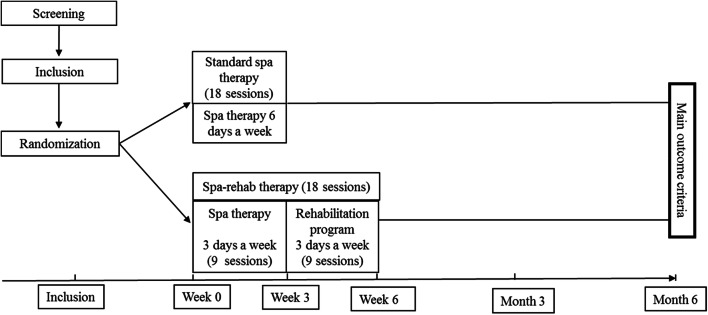
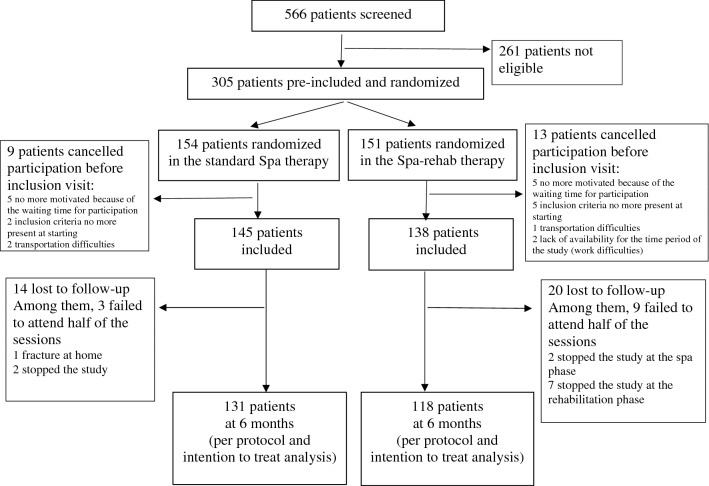
The objective of the study was to demonstrate the non-inferiority of low-frequency spa therapy combined with rehabilitation (Spa-rehab) versus standard spa therapy at 6 months for symptomatic knee osteoarthritis (KOA). A prospective, randomized, monocenter, non-inferiority trial with recruitment of community-based symptomatic KOA patients was performed. Standard spa therapy comprised standardized spa treatment, 6 days a week for 3 weeks, and Spa-rehab therapy comprised spa sessions, 3 days a week for 3 weeks, followed by a dedicated rehabilitation program, 3 days a week for 3 weeks. The primary endpoint was achieving at 6 months a minimal clinically important improvement (MCII) for pain on a visual analog scale and/or an MCII for function on the WOMAC index and no knee surgery (composite MCII). Secondary endpoints were composite MCII at 3 months and achieving a Patient Acceptable Symptom State (PASS) for pain and function at 3 and 6 months. Among 283 patients included, 145 were allocated to standard spa therapy and 138 to Spa-rehab therapy. We could not demonstrate the non-inferiority of Spa-rehab therapy for the primary endpoint: difference for responders - 0.08 [90% CI (- 0.18 to 0.02), p = 0.14]. However, the difference test between the groups was not significant (p = 0.18). Spa-rehab therapy was not inferior to standard spa therapy for the composite MCII at 3 months or the PASS at 3 and 6 months. Spa-rehab therapy can reasonably be proposed to patients with symptomatic KOA. This protocol may be more cost-effective than standard spa therapy and avoid absenteeism from work and accommodation costs for patients who live close to a centre.
Conflict of interest statement
The authors declare no competing interests.
Figures
References
-
- GBD 2017 Disease and Injury Incidence and Prevalence Collaborators Global, regional, and national incidence, prevalence, and years lived with disability for 354 diseases and injuries for 195 countries and territories, 1990–2017: a systematic analysis for the Global Burden of Disease Study 2017. Lancet Lond Engl. 2018;392:1789–1858. doi: 10.1016/S0140-6736(18)32279-7. - DOI - PMC - PubMed
-
- WHO Scientific Group on the Burden of Musculoskeletal Conditions at the Start of the New Millennium. World Health Organ Tech. Rep. Ser.919, 1–218 (2003). - PubMed
-
- Eumusc. Musculoskeletal Health in Europe. Eumusc (accessed 10 June 2018); https://www.eumusc.net/myUploadData/files/30%2520August%2520v5%2520Final... (2011).
Publication types
MeSH terms
LinkOut - more resources
Full Text Sources
