


Probiotic Bifidobacterium breve in Improving Cognitive Functions of Older Adults with Suspected Mild Cognitive Impairment: A Randomized, Double-Blind, Placebo-Controlled Trial
- PMID: 32623402
- PMCID: PMC7592675
- DOI: 10.3233/JAD-200488
Probiotic Bifidobacterium breve in Improving Cognitive Functions of Older Adults with Suspected Mild Cognitive Impairment: A Randomized, Double-Blind, Placebo-Controlled Trial
Erratum in
-
Corrigendum to "Probiotic bifidobacterium breve in improving cognitive functions of older adults with suspected mild cognitive impairment: A randomized, double-blind, placebo-controlled trial".J Alzheimers Dis. 2026 Feb;109(4):1985. doi: 10.1177/13872877251407772. Epub 2025 Dec 16. J Alzheimers Dis. 2026. PMID: 41401019 No abstract available.
Abstract
Background: Probiotics use has been associated with modulation of inflammation and considered as a possible intervention for CNS diseases such as mild cognitive impairment (MCI) and dementia.
Objective: We aimed to test the effect of the probiotic strain, Bifidobacterium breve A1 (MCC1274), to restore cognition in a physically healthy, suspected MCI population.
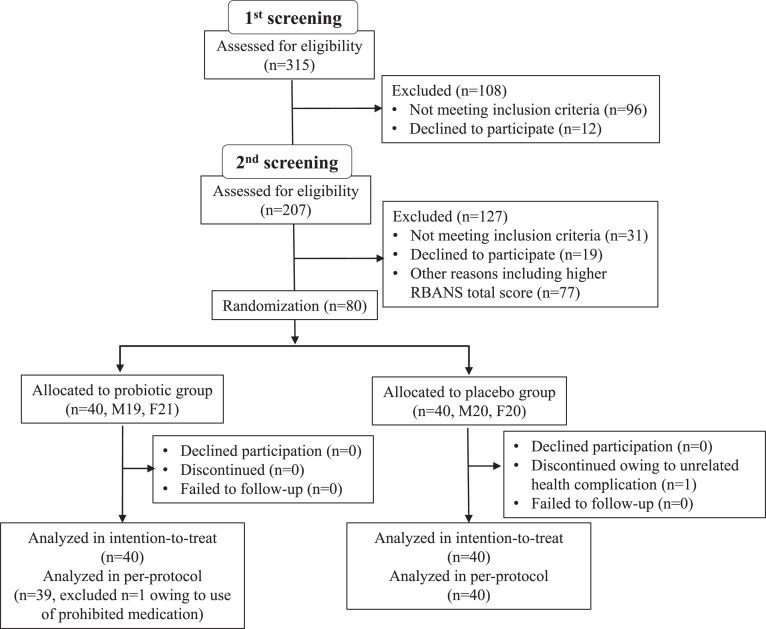
Methods: In this randomized, double-blind, placebo-controlled trial, 80 healthy older adults suffering from MCI were divided into two even groups to receive once daily either probiotic (B. breve A1, 2×10¹⁰ CFU) or placebo for 16 weeks using a computer-generated algorithm. Cognitive functions were assessed by the Repeatable Battery for the Assessment of Neuropsychological Status (RBANS) and the Japanese version of the MCI Screen (JMCIS) tests before and after the study as primary and secondary endpoints, respectively.
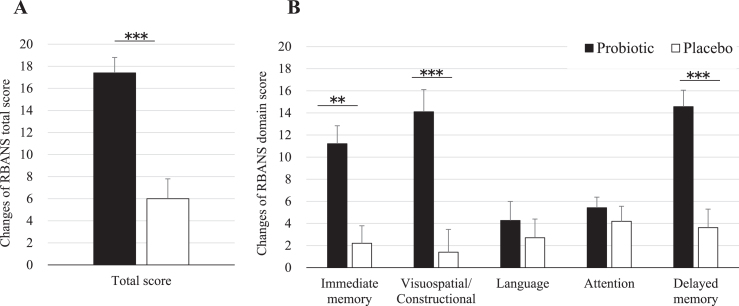
Results: 79 participants completed the study, and no adverse events were observed. RBANS total score was significantly improved in probiotic group compared with placebo (mean between-group difference 11.3 [95% CI 6.7 to 15.8]; p < 0.0001) after 16 weeks of consumption, in particular with significant improvement in domain scores of immediate memory, visuospatial/constructional, and delayed memory (p < 0.0001), in both intention-to-treat (ITT) analysis and per-protocol (PP) analysis. JMCIS score was also improved versus placebo in ITT analysis (p = 0.052) and PP analysis (p = 0.036).
Conclusion: Study results indicate B. breve A1 is a safe and effective approach for improving memory functions of suspected MCI subjects.
Keywords: Bifidobacterium; clinical trial; dementia; memory; mild cognitive impairment; probiotics.
Conflict of interest statement
Authors’ disclosures are available online (
Figures
References
-
- Morris JC, Storandt M, Miller JP, McKeel DW, Price JL, Rubin EH, Berg L (2001) Mild cognitive impairment represents early-stage Alzheimer disease. Arch Neurol 58, 397–405. - PubMed
-
- Aisen PS (2019) Editorial: Failure after failure. What next in AD drug development? J Prev Alzheimers Dis 6, 150. - PubMed
Publication types
MeSH terms
LinkOut - more resources
Full Text Sources
Other Literature Sources
Medical
Miscellaneous
