Review
. 2020 Jun 26;53(3):33-42.
doi: 10.1267/ahc.20011. Epub 2020 Jun 16.

Vitamin D and the Host-Gut Microbiome: A Brief Overview

Affiliations
Review

Vitamin D and the Host-Gut Microbiome: A Brief Overview

Nuraly S Akimbekov et al. Acta Histochem Cytochem. .

Abstract

There is a growing body of evidence for the effects of vitamin D on intestinal host-microbiome interactions related to gut dysbiosis and bowel inflammation. This brief review highlights the potential links between vitamin D and gut health, emphasizing the role of vitamin D in microbiological and immunological mechanisms of inflammatory bowel diseases. A comprehensive literature search was carried out in PubMed and Google Scholar using combinations of keywords "vitamin D," "intestines," "gut microflora," "bowel inflammation". Only articles published in English and related to the study topic are included in the review. We discuss how vitamin D (a) modulates intestinal microbiome function, (b) controls antimicrobial peptide expression, and (c) has a protective effect on epithelial barriers in the gut mucosa. Vitamin D and its nuclear receptor (VDR) regulate intestinal barrier integrity, and control innate and adaptive immunity in the gut. Metabolites from the gut microbiota may also regulate expression of VDR, while vitamin D may influence the gut microbiota and exert anti-inflammatory and immune-modulating effects. The underlying mechanism of vitamin D in the pathogenesis of bowel diseases is not fully understood, but maintaining an optimal vitamin D status appears to be beneficial for gut health. Future studies will shed light on the molecular mechanisms through which vitamin D and VDR interactions affect intestinal mucosal immunity, pathogen invasion, symbiont colonization, and antimicrobial peptide expression.

Keywords: bowel inflammation; gut microflora; intestine; vitamin D.


Conflict of interest statement

VIIThe authors declare that there are no conflicts of interest.

Figures
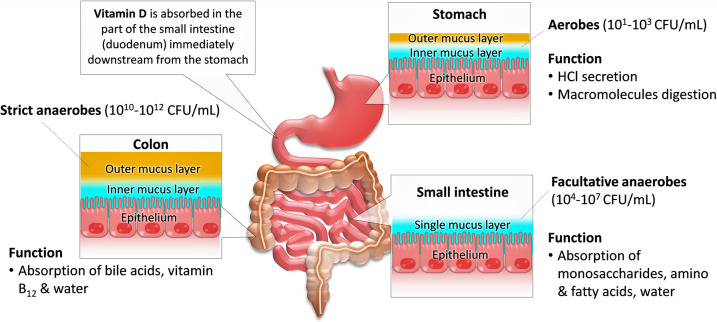
Fig. 1.
Fig. 1.
Distribution and predominance of the gut microbiota in the digestive tract. The total amount of microbiota increases gradually along the gastrointestinal tract (GIT), with low concentrations in the stomach and higher levels in the colon. The stomach harbors around 101–3 CFU/ml. An increasing abundance and diversity are found in the small intestine (duodenum, jejunum, ileum), and colon. The predominant members of the gut microbiota are anaerobic. Dietary or supplemental vitamin D is absorbed through the small intestine (especially through the duodenum) as a fat-soluble vitamin.
Fig. 2.
Fig. 2.
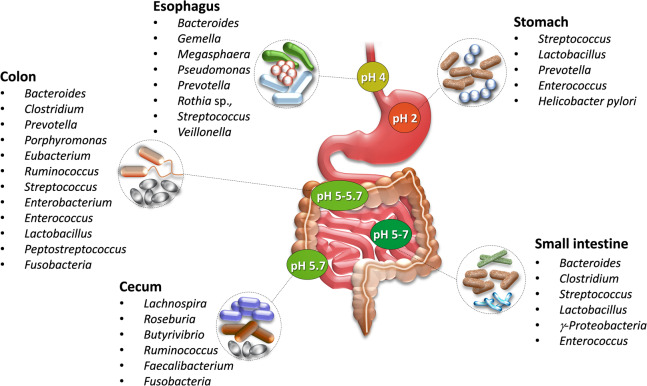
Microbial diversity and composition across gut sections (adapted and modified from [29]). The gut microbiota varies with pH and oxygen tension, flow rates of digestive fluids, substrate availability, and host secretions. pH plays a key role in microbial community dynamics. The stomach and proximal small intestine are particularly unfavorable for bacterial residence, and very few bacteria are resistant to the acidic microenvironment. The highest biodiversity is in the colon, in which the pH is around 5.
Fig. 3.
Fig. 3.
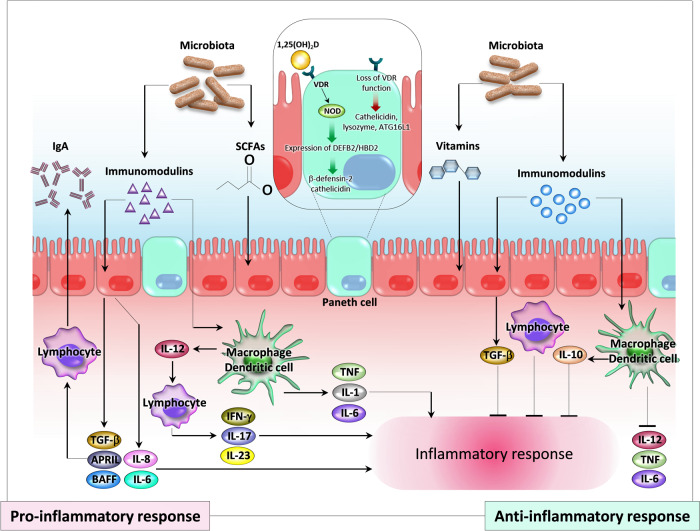
Immunomodulation by the gut microbiota and potential participation of vitamin D in the pathogenesis of inflammatory bowel disease (IBD) (adapted and modified from [4, 62]). Members of the gut microbiota and their metabolites modulate mucosal immunity. The gut microbiota may produce bioactive “immunomodulins” and regulatory cytokines that have both pro- and anti-inflammatory functions. Immunostimulation can occur due to release of proinflammatory cytokines from various cells (epithelial, mononuclear, and lymphocytes). Anti-inflammatory responses can occur through production of transforming growth factor (TGF-β) and interleukin 10 (IL-10) from epithelial and mononuclear cells. In Paneth cells, NOD2 transcription is stimulated by vitamin D/VDR and signaling through NOD2 promotes expression of DEFB2/HBD2 (β-defensin 2 and cathelicidin). Loss of VDR function causes changes in the microbiota and reduces host defense by inhibiting production of cathelicidin, lysozyme, and ATG16L1. SCFA, short-chain fatty acids; APRIL, a proliferation-inducing ligand; BAFF, B cell-activating factor; TNF, tumor necrosis factor; VDR, vitamin D receptor; NOD, nucleotide-binding oligomerization domain.
Fig. 4.
Fig. 4.
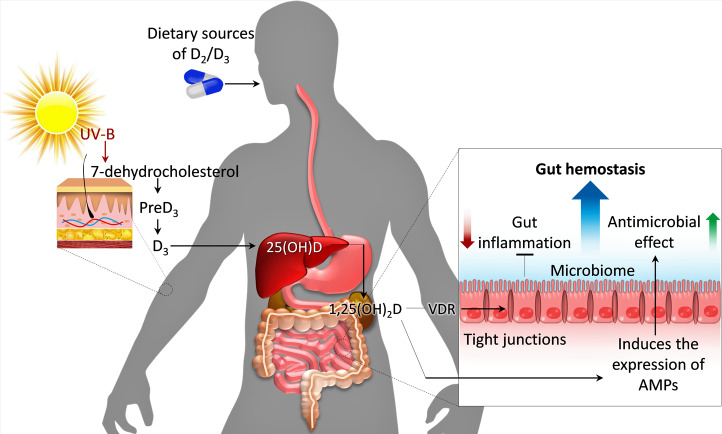
The role of vitamin D and the microbiota in gut homeostasis and inflammation (adapted and modified from [78]). The two major pathways to generate vitamin D are: 1) exposing the skin to sunlight, and 2) consuming vitamin D in the diet or as a supplement. Vitamin D and VDR interactions maintain the gut microbiota by regulating expression of antimicrobial peptides (AMPs) and maintaining the barrier functions of the gut mucosa.

References

    1. Ahluwalia B., Magnusson M. K. and Ohman L. (2017) Mucosal immune system of the gastrointestinal tract: maintaining balance between the good and the bad. Scand. J. Gastroenterol. 52; 1185–1193. - PubMed
    1. Akimbekov N. S., Ortoski R. A. and Razzaque M. S. (2020) Effects of sunlight exposure and vitamin D supplementation on HIV patients. J. Steroid Biochem. Mol. Biol. 200; 105664. - PubMed

    1. Ananthakrishnan A. N., Cheng S.-C., Cai T., Cagan A., Gainer V. S., Szolovits P., et al. (2014) Association between reduced plasma 25-hydroxy vitamin D and increased risk of cancer in patients with inflammatory bowel diseases. Clin. Gastroenterol. Hepatol. 12; 821–827. - PMC - PubMed
    1. Ardesia M., Ferlazzo G. and Fries W. (2015) Vitamin D and inflammatory bowel disease. Biomed. Res. Int. 2015; 470805. - PMC - PubMed
    1. Bashir M., Prietl B., Tauschmann M., Mautner S. I., Kump P. K., Treiber G., et al. (2016) Effects of high doses of vitamin D3 on mucosa-associated gut microbiome vary between regions of the human gastrointestinal tract. Eur. J. Nutr. 55; 1479–1489. - PMC - PubMed