Review
. 2020 Jun 17:11:1109.
doi: 10.3389/fimmu.2020.01109. eCollection 2020.

CAR-T Cells Hit the Tumor Microenvironment: Strategies to Overcome Tumor Escape

Affiliations
Review

CAR-T Cells Hit the Tumor Microenvironment: Strategies to Overcome Tumor Escape

Alba Rodriguez-Garcia et al. Front Immunol. .

Abstract

Chimeric antigen receptor (CAR) T cell therapies have demonstrated remarkable efficacy for the treatment of hematological malignancies. However, in patients with solid tumors, objective responses to CAR-T cell therapy remain sporadic and transient. A major obstacle for CAR-T cells is the intrinsic ability of tumors to evade immune responses. Advanced solid tumors are largely composed of desmoplastic stroma and immunosuppressive modulators, and characterized by aberrant cell proliferation and vascularization, resulting in hypoxia and altered nutrient availability. To mount a curative response after infusion, CAR-T cells must infiltrate the tumor, recognize their cognate antigen and perform their effector function in this hostile tumor microenvironment, to then differentiate and persist as memory T cells that confer long-term protection. Fortunately, recent advances in synthetic biology provide a wide set of tools to genetically modify CAR-T cells to overcome some of these obstacles. In this review, we provide a comprehensive overview of the key tumor intrinsic mechanisms that prevent an effective CAR-T cell antitumor response and we discuss the most promising strategies to prevent tumor escape to CAR-T cell therapy.

Keywords: adoptive cell transfer (ACT); chimeric antigen receptors (CAR); immunosuppressive tumor microenvironment; immunotherapy; inhibitory receptors; solid tumors.


Figures

Figure 1
Figure 1
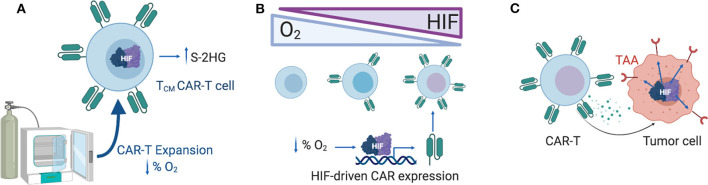
Exploiting the hypoxia response pathway for CAR-T therapy. (A) Expanding CAR-T cells ex vivo under reduced oxygen concentrations (1–5% O2) might support the enrichment of memory-like T cells, a process mediated by S-2HG. (B) CAR expression can be gradually modulated by increasing levels of HIF-1α in T cells, generating a hypoxia-responsive CAR-T with increased CAR expression in hypoxic tumors and reduced CAR expression in the periphery. (C) Selection of TAAs that are upregulated under hypoxic conditions in solid tumors might limit off-tumor CAR-T cell activity. HIF-1α, Hypoxia-inducible factor 1 alpha; S-2HG, S-2-hydroxyglutarate; TAA, tumor associated antigen.
Figure 2
Figure 2
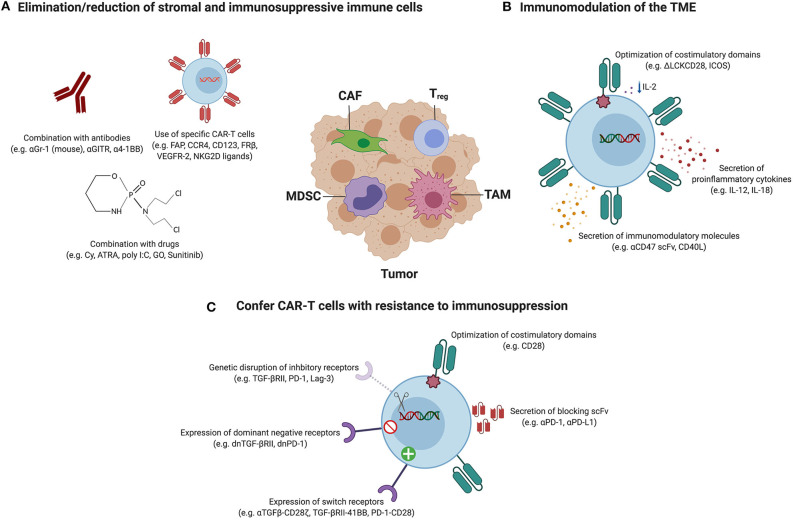
Therapeutic strategies to overcome the immunosuppressive TME. Tumors are infiltrated with stromal cells, such as cancer-associated fibroblasts (CAFs), and immune cells, including regulatory T cells (Tregs), tumor-associated macrophages (TAMs) and myeloid-derived suppressor cells (MDSCs) which support cancer progression and promote immunosuppression. Therapeutic strategies utilized to hit these components to enhance the efficacy of CAR-T cell therapy can be categorized in three classes, and the most relevant examples are represented in this figure. (A) Elimination or reduction of stromal and immunosuppressive immune cells: the combination of CAR-T cells with agents such as antibodies or drugs has resulted in decreased frequencies of Tregs and/or MDSCs. Alternatively, CARs have been designed to target antigens expressed on CAFs, Tregs, TAMs and MDSCs to directly deplete them. (B) Immunomodulation of the TME: this group of strategies aims at manipulating the TME to create a favorable environment that allows a better performance of the CAR-T cells. Some examples include the modulation of the tumor cytokine milieu by the expression of proinflammatory cytokines by CAR-T cells or by the optimization of costimulatory signaling domains in order to reduce IL-2 secretion and therefore impair Treg expansion and tumor infiltration. Immunomodulatory molecules that are able to polarize M2 TAMs into an antitumor M1 phenotype can also be expressed from CAR-T cells. (C) Confer CAR-T cells with intrinsic resistance to immunosuppression: CAR-T cells can be modified to be resistant to immunosuppression by endowing them with dominant-negative receptors (to disrupt signaling) or chimeric switch receptors (to convert negative signaling into positive), or by abrogating the expression of inhibitory receptors using genome-editing tools. Alternatively, antibodies blocking inhibitory receptors or ligands can be secreted by CAR-T cells. Also, it has been reported that the incorporation of particular costimulatory domains or the expression of some proinflammatory cytokines by CAR-T cells confer intrinsic resistance to Treg-mediated immunosuppression.

References

    1. Guedan S, Calderon H, Posey AD, Maus MV. Engineering and design of chimeric antigen receptors. Mol Ther Methods Clin Develop. (2019) 12:145–56. 10.1016/j.omtm.2018.12.009 - DOI - PMC - PubMed
    1. June CH, O'Connor RS, Kawalekar OU, Ghassemi S, Milone MC. CAR T cell immunotherapy for human cancer. Science. (2018) 359:1361–5. 10.1126/science.aar6711 - DOI - PubMed
    1. June CH, Sadelain M. Chimeric antigen receptor therapy. N Engl J Med. (2018) 379:64–73. 10.1056/NEJMra1706169 - DOI - PMC - PubMed
    1. Majzner RG, Mackall CL. Clinical lessons learned from the first leg of the CAR T cell journey. Nat Med. (2019) 25:1341–55. 10.1038/s41591-019-0564-6 - DOI - PubMed
    1. D'Agostino M, Raje N. Anti-BCMA CAR T-cell therapy in multiple myeloma: can we do better? Leukemia. (2019) 34:21–34. 10.1038/s41375-019-0669-4 - DOI - PubMed

Publication types

MeSH terms

Substances