


Update of the tolerable upper intake level for vitamin D for infants
- PMID: 32626014
- PMCID: PMC7009676
- DOI: 10.2903/j.efsa.2018.5365
Update of the tolerable upper intake level for vitamin D for infants
Abstract
Following a request from the European Commission, the Panel on Dietetic Products, Nutrition and Allergies (NDA) was asked to revise the tolerable upper intake level (UL) for vitamin D for infants (≤ 1 year) set in 2012. From its literature review, the Panel concluded that the available evidence on daily vitamin D intake and the risk of adverse health outcomes (hypercalciuria, hypercalcaemia, nephrocalcinosis and abnormal growth patterns) cannot be used alone for deriving the UL for infants. The Panel conducted a meta-regression analysis of collected data, to derive a dose-response relationship between daily supplemental intake of vitamin D and mean achieved serum 25(OH)D concentrations. Considering that a serum 25(OH)D concentration of 200 nmol/L or below is unlikely to pose a risk of adverse health outcomes in infants, the Panel estimated the percentage of infants reaching a concentration above this value at different intakes of vitamin D. Based on the overall evidence, the Panel kept the UL of 25 μg/day for infants aged up to 6 months and set a UL of 35 μg/day for infants 6-12 months. The Panel was also asked to advise on the safety of the consumption of infant formulae with an increased maximum vitamin D content of 3 μg/100 kcal (Commission Delegated Regulation (EU) 2016/127 repealing Directive 2006/141/EC in 2020). For infants aged up to 4 months, the intake assessment showed that the use of infant formulae containing vitamin D at 3 μg/100 kcal may lead some infants to receive an intake above the UL of 25 μg/day from formulae alone without considering vitamin D supplemental intake. For infants aged 4-12 months, the 95th percentile of vitamin D intake (high consumers) estimated from formulae and foods fortified or not with vitamin D does not exceed the ULs, without considering vitamin D supplemental intake.
Keywords: 25(OH)D; UL; adverse health outcomes; infants; intake; vitamin D.
© 2018 European Food Safety Authority. EFSA Journal published by John Wiley and Sons Ltd on behalf of European Food Safety Authority.
Figures
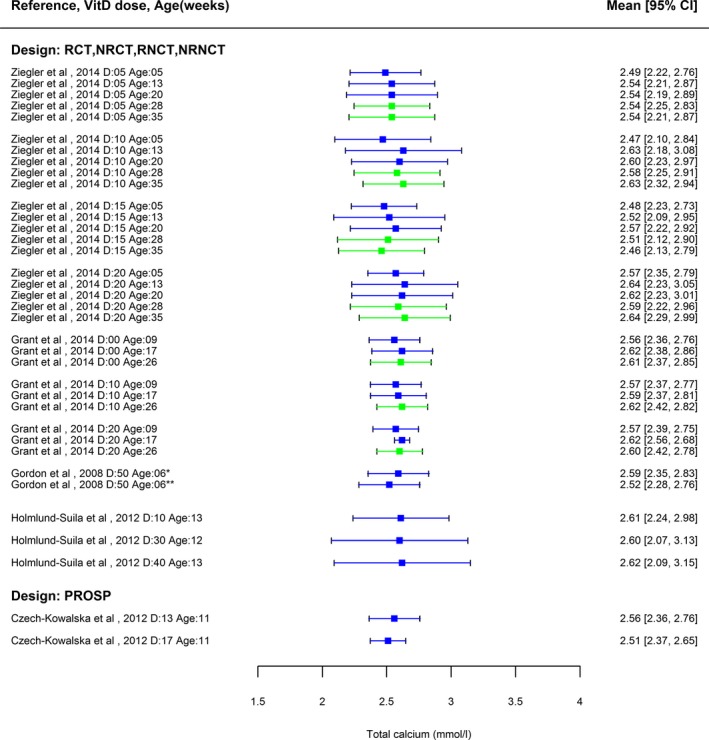
*Vitamin D3 **Vitamin D2
CI: confidence interval; D: vitamin D dose (μg/day).
Values for trials (NRCT: non‐randomised controlled trial; NRNCT: non‐randomised non‐controlled trial; RCT: randomised controlled trial; RNCT: randomised non‐controlled trial) and prospective studies (PROSP) are indicated separately.
Age: age of the infants in weeks (rounded). Calcium concentrations at baseline are not shown. Measurements before 6 months of age (blue) or after 6 months of age (green).
References
-
- Ahmad IA and Al‐Agha AE, 2013. Hypervitaminosis D causing nephrogenic diabetes insipidus in a 5‐month‐old infant. Saudi Medical Journal, 34, 187–189. - PubMed
-
- Ala‐Houhala M, 1985. 25‐Hydroxyvitamin D levels during breast‐feeding with or without maternal or infantile supplementation of vitamin D. Journal of Pediatric Gastroenterology and Nutrition, 4, 220–226. - PubMed
-
- Ala‐Houhala M, Koskinen T, Parviainen MT and Visakorpi JK, 1988. 25‐Hydroxyvitamin D and vitamin D in human milk: effects of supplementation and season. American Journal of Clinical Nutrition, 48, 1057–1060. - PubMed
-
- Allen RE, Dangour AD and Tedstone AE, 2014. Update of the vitamin D content of fortified foods and supplements in the UK National Diet and Nutrition Survey Nutrient Databank. Nutrition Bulletin, 39, 247–245.
-
- American Academy of Pediatrics , 1999. Ultraviolet light: a hazard to children. American Academy of Pediatrics. Committee on Environmental Health. Pediatrics, 104, 328–333. - PubMed
LinkOut - more resources
Full Text Sources