


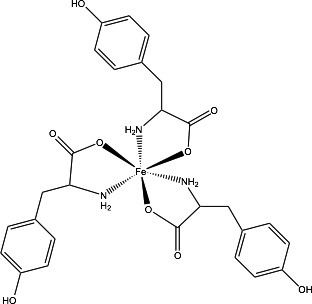
Safety and efficacy of TYFER™ (ferric tyrosine chelate) as a zootechnical feed additive for chickens, turkeys and minor poultry species for fattening or reared for laying/breeding
- PMID: 32626231
- PMCID: PMC7009228
- DOI: 10.2903/j.efsa.2019.5608
Safety and efficacy of TYFER™ (ferric tyrosine chelate) as a zootechnical feed additive for chickens, turkeys and minor poultry species for fattening or reared for laying/breeding
Abstract
Following a request from the European Commission, EFSA was asked to deliver a scientific opinion on the safety and efficacy of the product TYFER™ (ferric tyrosine chelate) as zootechnical feed additive for chickens, turkeys and minor poultry species for fattening or reared for laying/breeding. The additive is safe for chickens for fattening at the maximum expected level of 200 mg TYFER™/kg complete feed; this conclusion can be extended to chickens reared for laying/breeding and extrapolated to turkeys and all minor poultry species for fattening or reared for laying/breeding. No concerns for consumer safety are expected from the use of the additive in poultry nutrition. The EFSA Panel on Additives and Products or Substances used in Animal Feed (FEEDAP) considers that the additive poses a risk to users by inhalation, and should also be considered as an irritant to skin, eyes and mucous membranes. Due to the presence of nickel, ferric tyrosine chelate should also be considered as a dermal and respiratory sensitiser. The supplementation of feed with the additive is not expected to pose an environmental risk. TYFER™ used at the minimum recommended level (20 mg/kg feed) in chickens diets has the potential to improve zootechnical parameters of birds. The additive at 20 mg/kg feed has the potential to reduce the caecal load Campylobacter spp. by at least 1 log10-units in chickens for fattening, thus with a potential impact to reduce the risk of human campylobacteriosis; however, the Panel notes that the load of Campylobacter in the chickens caecum is one of the multiple factors that contribute to Campylobacter load in carcases-meat. The conclusions on the efficacy of the additive can be extended to chickens reared for laying/breeding and extrapolated to turkeys and all minor poultry species for fattening or reared for laying/breeding. The Panel recommends including a specification for maximum lithium content in a potential authorisation of the additive.
Keywords: Campylobacter; TYFER™; efficacy; ferric tyrosine chelate; gut flora stabilisers; safety; zootechnical additives.
© 2019 European Food Safety Authority. EFSA Journal published by John Wiley and Sons Ltd on behalf of European Food Safety Authority.
Figures
References
-
- ACGIH (American Conference of Governmental Industrial Hygienists), 2008. TLVs and BEIs. Threshold Limit Values for Chemical Substances and Physical Agents and Biological Exposure Indices. Cincinnati, OH, USA.
-
- Allen VM, Bullb SA, Corrya JEL, Dominguec G, Jørgensenb F, Frostd JA, Whytee R, Gonzalez A, Elvissb N and Humphrey TJ, 2007. Campylobacter spp. contamination of chicken carcasses during processing in relation to flock colonisation. International Journal of Food Microbiology, 113, 54–61. - PubMed
-
- Chokboonmongkol C, Patchanee P, Gölz G, Zessin K‐H and Alter T, 2013. Prevalence, quantitative load, and antimicrobial resistance of Campylobacter spp. from broiler ceca and broiler skin samples in Thailand. Poultry Science, 92, 462–467. - PubMed
-
- EFSA (European Food Safety Authority), 2008. Technical Guidance of the Scientific Panel on Additives and Products or Substances used in Animal Feed (FEEDAP) for assessing the safety of feed additives for the environment. EFSA Journal 2008;6(10):842, 28 pp. 10.2903/j.efsa.2008.842 - DOI
-
- EFSA BIOHAZ Panel (EFSA Panel Biological Hazards), 2011. Scientific Opinion on Campylobacter in broiler meat production: control options and performance objectives and/or targets at different stages of the food chain. EFSA Journal 2011;9(4):2105, 141 pp. 10.2903/j.efsa.2011.2105 - DOI
LinkOut - more resources
Full Text Sources
Other Literature Sources
Miscellaneous