


Guidance on the use of the Threshold of Toxicological Concern approach in food safety assessment
- PMID: 32626331
- PMCID: PMC7009090
- DOI: 10.2903/j.efsa.2019.5708
Guidance on the use of the Threshold of Toxicological Concern approach in food safety assessment
Abstract
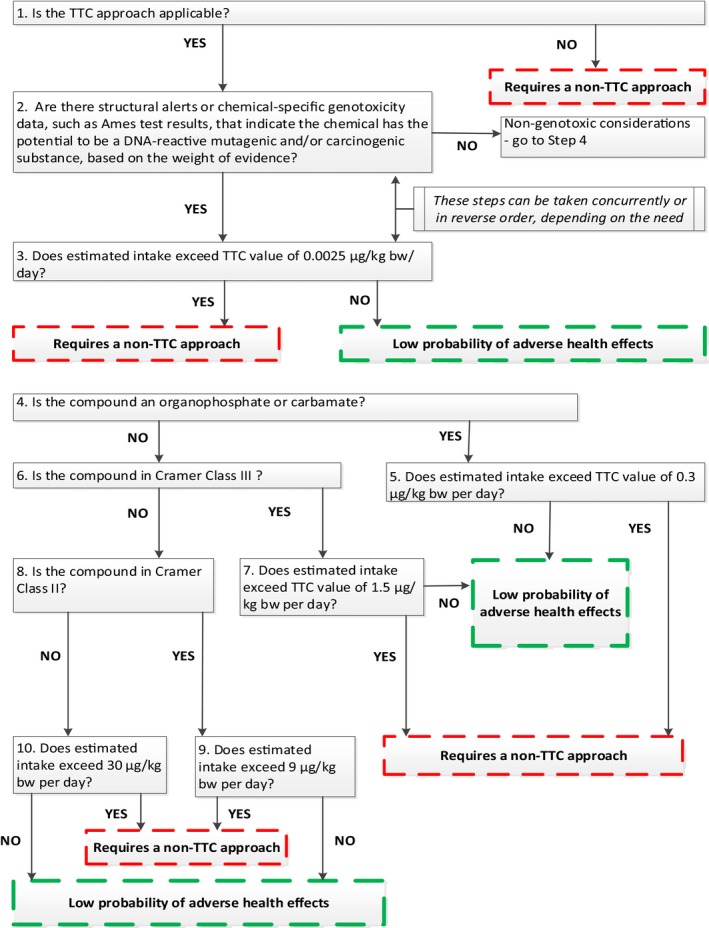
The Scientific Committee confirms that the Threshold of Toxicological Concern (TTC) is a pragmatic screening and prioritisation tool for use in food safety assessment. This Guidance provides clear step-by-step instructions for use of the TTC approach. The inclusion and exclusion criteria are defined and the use of the TTC decision tree is explained. The approach can be used when the chemical structure of the substance is known, there are limited chemical-specific toxicity data and the exposure can be estimated. The TTC approach should not be used for substances for which EU food/feed legislation requires the submission of toxicity data or when sufficient data are available for a risk assessment or if the substance under consideration falls into one of the exclusion categories. For substances that have the potential to be DNA-reactive mutagens and/or carcinogens based on the weight of evidence, the relevant TTC value is 0.0025 μg/kg body weight (bw) per day. For organophosphates or carbamates, the relevant TTC value is 0.3 μg/kg bw per day. All other substances are grouped according to the Cramer classification. The TTC values for Cramer Classes I, II and III are 30 μg/kg bw per day, 9 μg/kg bw per day and 1.5 μg/kg bw per day, respectively. For substances with exposures below the TTC values, the probability that they would cause adverse health effects is low. If the estimated exposure to a substance is higher than the relevant TTC value, a non-TTC approach is required to reach a conclusion on potential adverse health effects.
Keywords: Cramer classification scheme; Threshold of toxicological concern; risk assessment.
© 2019 European Food Safety Authority. EFSA Journal published by John Wiley and Sons Ltd on behalf of European Food Safety Authority.
Figures
References
-
- Baken KA, Sjerps RMA, Schriks M and van Wezel AP, 2018. Toxicological risk assessment and prioritization of drinking water relevant contaminants of emerging concern. Environment International, 118, 293–303. - PubMed
-
- Barlow SM, Kozianowski G, Wurtzen G and Schlatter J, 2001. Threshold of toxicological concern for chemical substances present in the diet. Report of a workshop, 5–6 October 1999, Paris, France. Food and Chemical Toxicology, 39, 893–905. - PubMed
-
- Belanger SE, Sanderson H, Embry MR, Coady K, DeZwart D, Farr BA, Gutsell S, Halder M, Sternberg R and Wilson P, 2015. It is time to develop ecological thresholds of toxicological concern to assist environmental hazard assessment. Environmental Toxicology and Chemistry, 34, 2864–2869. - PubMed
-
- Bhatia S, Schultz T, Roberts D, Shen J, Kromidas L and Api AM, 2015. Comparison of Cramer classification between Toxtree, the OECD QSAR Toolbox and expert judgment. Regulatory Toxicology and Pharmacology, 71, 52–62. - PubMed
LinkOut - more resources
Full Text Sources
Other Literature Sources