


Blood donor recruitment in Guangzhou, China, during the 2019 novel coronavirus (COVID-19) epidemic
- PMID: 32627205
- PMCID: PMC7361411
- DOI: 10.1111/trf.15971
Blood donor recruitment in Guangzhou, China, during the 2019 novel coronavirus (COVID-19) epidemic
Abstract
Background: The coronavirus disease 2019 (COVID-19) epidemic affected blood collection in Guangzhou, China.
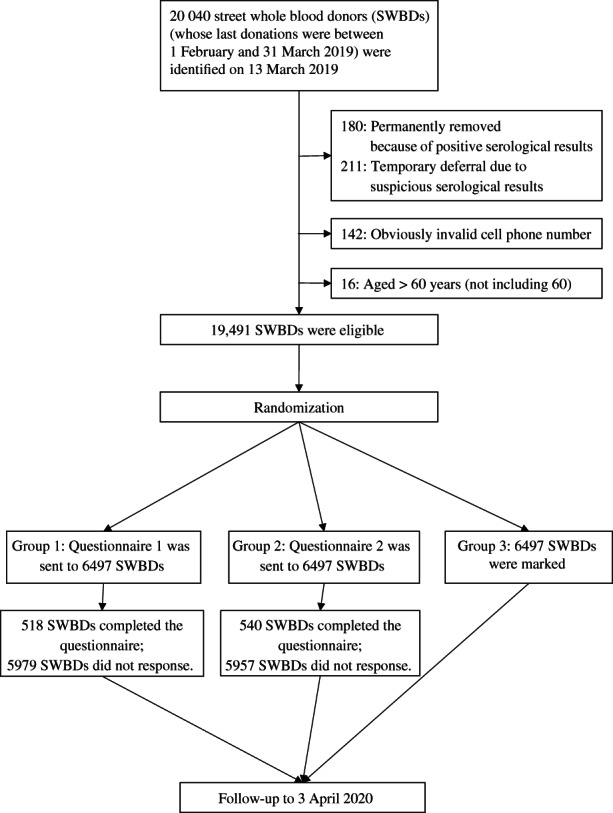
Study design and methods: This paper includes three studies. The observational study reported the trends of blood collection during the epidemic in Guangzhou, China. The cross-sectional survey investigated factors influencing blood donation during the COVID-19 epidemic, and a self-administered questionnaire was given to 1584 street whole blood donors (SWBDs) who donated during the epidemic. The randomized controlled trial involved 19 491 SWBDs who donated in 2019 but did not donate during the epidemic. Trial participants were randomly assigned to two intervention groups: Group 1 completed Questionnaire 1, which contained precautionary measures in response to COVID-19 and other messages about blood donation during the epidemic; Group 2 completed Questionnaire 2, which did not include this information. A control group did not receive any questionnaire.
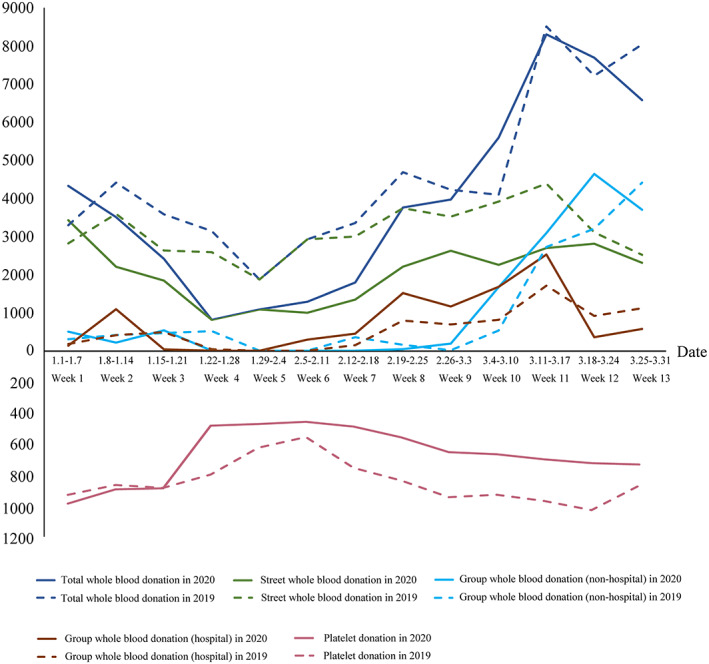
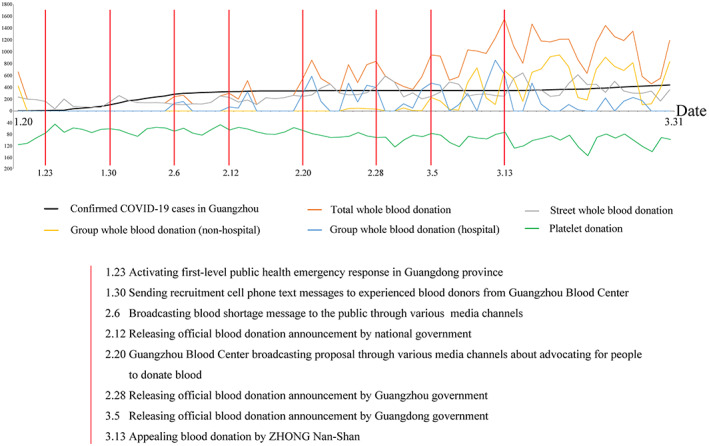
Results: As measures were implemented, the number of blood donors increased accordingly. Both first-time and repeat SWBDs perceived the same level of blood need and donated blood because it would save lives. SWBDs who completed Questionnaire 1 expressed a greater intention to donate during the epidemic. Enabling blood donors to perceive a higher level of blood need and a lower level of COVID-19 infection risk related to blood donation mobilized experienced SWBDs to donate within 3 weeks. Intention-to-treat analyses and average-treatment-effect-on-the-treated estimations confirmed that Questionnaire 1 could motivate SWBDs to actually donate blood.
Conclusion: Various measures could ease blood shortage during the COVID-19 epidemic. Administration of Questionnaire 1 could increase blood donations during the epidemic.
© 2020 AABB.
Conflict of interest statement
The authors declare no potential conflict of interest.
Figures
References
-
- National Bureau of Statistics of China . Annual by Province 2019. [accessed 2020 Jun 2] Available from: http://data.stats.gov.cn/english/easyquery.htm?cn=E0103.
-
- Simonetti A, Ezzeldin H, Walderhaug M, et al. An inter‐regional US blood supply simulation model to evaluate blood availability to support planning for emergency preparedness and medical countermeasures. Disaster Med Public Health Prep 2018;12:201‐10. - PubMed
-
- Veronica H, Philip K, Yan Q, et al. APBN Rapid Brief White Paper: 2019 Novel Coronavirus (SARS‐CoV‐2); Expected Challenges and Risks to Blood Safety, Manila, Philippines: Asia Pacific Blood Network; 2020.
-
- Karacan E, Cengiz Seval G, Aktan Z, et al. Blood donors and factors impacting the blood donation decision: motives for donating blood in Turkish sample. Transfus Apher Sci 2013;49:468‐73. - PubMed
Publication types
MeSH terms
Grants and funding
LinkOut - more resources
Full Text Sources
Medical
