. 2020 Oct 5;59(41):18110-18115.
doi: 10.1002/anie.202006030. Epub 2020 Aug 18.

Stereoselective Synthesis of Tropanes via a 6π-Electrocyclic Ring-Opening/ Huisgen [3+2]-Cycloaddition Cascade of Monocyclopropanated Heterocycles

Affiliations

Stereoselective Synthesis of Tropanes via a 6π-Electrocyclic Ring-Opening/ Huisgen [3+2]-Cycloaddition Cascade of Monocyclopropanated Heterocycles

Carina M Sonnleitner et al. Angew Chem Int Ed Engl. .

Abstract

The synthesis of tropanes via a microwave-assisted, stereoselective 6π-electrocyclic ring-opening/ Huisgen [3+2]-cycloaddition cascade of cyclopropanated pyrrole and furan derivatives with electron-deficient dipolarophiles is demonstrated. Starting from furans or pyrroles, 8-aza- and 8-oxabicyclo[3.2.1]octanes are accessible in two steps in dia- and enantioselective pure form, being versatile building blocks for the synthesis of pharmaceutically relevant targets, especially for new cocaine analogues bearing various substituents at the C-6/C-7 positions of the tropane ring system. Moreover, the 2-azabicyclo[2.2.2]octane core (isoquinuclidines), being prominently represented in many natural and pharmaceutical products, is accessible via this approach.

Keywords: bicyclo[3.2.1]octanes; cocaine analogues; furans and pyrroles; isoquinuclidines; microwave-assisted [3+2]-cycloaddition; tropanes.


Conflict of interest statement

The authors declare no conflict of interest.

Figures
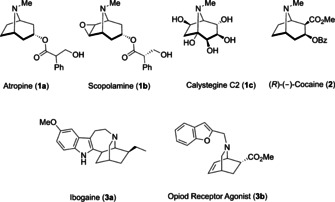
Figure 1
Figure 1
Important representatives of biological active tropane and isoquinuclidine alkaloids.
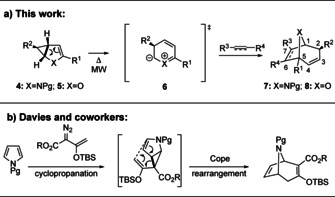
Scheme 1
Scheme 1
Strategies to tropanes via cyclopropanated pyrroles and furans.
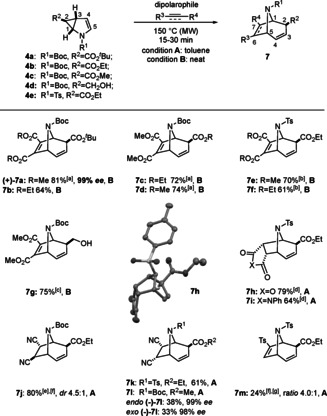
Scheme 2
Scheme 2
Substrate scope of [3+2]‐cycloadditions for the synthesis of 8‐azabicyclo[3.2.1]octanes 7: 0.3–1 mmol 4, dipolarophile (2.7 equiv); [a] Scale‐up: 4.39 mmol 4 a were employed to yield 1.54 g of 7 a; 4.03 mmol 4 b were employed to yield 1.15 g of 7 c; 4.18 mmol 4 c were employed to yield 1.18 g of 7 d; [b] 170 °C; [c] 100 °C; [d] 1 h, 1.1 equiv of dipolarophile; [e] Major diastereomer shown; [f] Combined isolated yield of two diastereomers; [g] Major regioisomer shown.
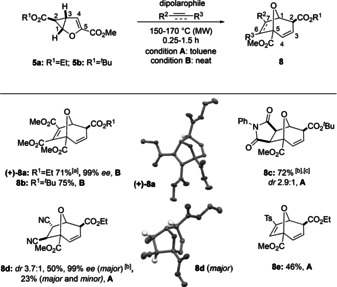
Scheme 3
Scheme 3
Substrate scope of [3+2]‐cycloadditions for the synthesis of 8‐oxabicyclo[3.2.1]octanes 8: 0.4–2.7 mmol 5, dipolarophile (2.7 equiv); [a] Scale‐up: 7.87 mmol (−)‐5 a were employed to yield 1.98 g of (+)‐8 a; [b] Major diastereomer shown. [c] Combined isolated yield of two diastereomers.
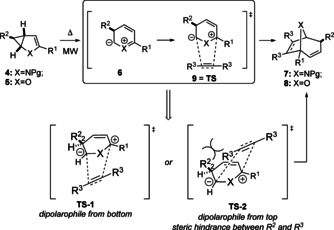
Scheme 4
Scheme 4
Stereochemical model for the [3+2]‐cycloaddition of 4 and 5.
Scheme 5
Scheme 5
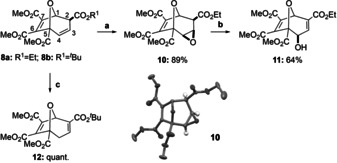
Derivatization reactions of the 8‐oxabicyclo[3.2.1]octane framework 8 a,b. Conditions: 8 a: a) mCPBA (3.5 equiv), CH2Cl2, 50 °C, 18 h, 89 %; b) flash chromatography, 1 % triethylamine (TEA), 64 %; 8 b: c) TEA (1.3 equiv), CH2Cl2, 25 °C, 30 min, quant.
Scheme 6
Scheme 6
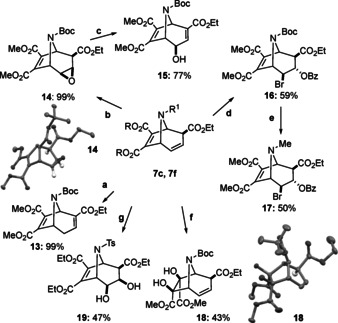
Derivatization reactions of the 8‐azabicyclo[3.2.1]octane framework 7 c and 7 f. Conditions: a) TEA (1.3 equiv), CH2Cl2, 2 h, 99 %; b) mCPBA (4.0 equiv), CH2Cl2, 25 °C, 3 days, 99 %; c) flash chromatography, 1 % TEA, 77 %; d) (i) NBS (2.0 equiv), acetone/H2O (3:1 v/v), 0 to 25 °C, 21 h; (ii) BzCl (1.5 equiv), DMAP (0.5 equiv), TEA (5.0 equiv), CH2Cl2, 25 °C, 8 h, 59 %; e) (i) TFA (33 equiv), CH2Cl2, 25 °C, 1.5 h, (ii) 37 % aq CH2O (6.0 equiv), NaBH3CN (3.0 equiv), MeCN, 25 °C, 1 h, 50 %; f) K2OsO4⋅2 H2O (0.05 equiv), NMO (2.0 equiv), H2O, acetone, 0 °C, 12 h, 43 %; g) RuCl3⋅3 H2O (6 mol %), NaIO4 (1.6 equiv), MeCN, H2O, 0 to 25 °C, 2 days, 47 %.
Scheme 7
Scheme 7
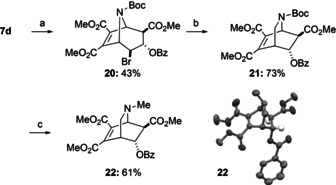
Isoquinuclidine synthesis by homoallylic radical rearrangement. Conditions: (a) (i) NBS (4.0 equiv), acetone/H2O (4:1 v/v), 0 to 25 °C, 3 days; (ii) BzCl (1.5 equiv), DMAP (0.5 equiv), TEA (5.0 equiv), CH2Cl2, 25 °C, 15 h, 43 %; (b) azobisisobutyronitrile (AIBN) (0.1 equiv), Bu3SnH (1.6 equiv), benzene, reflux, 5 h, 73 %; (c) (i) TFA (33 equiv), CH2Cl2, 25 °C, 1 h, (ii) 37 % aq CH2O (11 equiv), NaBH3CN (8.2 equiv), MeCN, 25 °C, 1.5 h, 61 %.
Scheme 8
Scheme 8
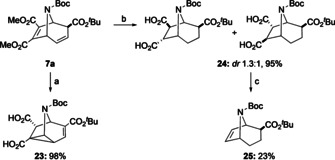
Base‐induced formation of 6‐azatricyclo[3.2.1.02, 7]octane 23 (a) and oxidative degradation of diacid 24 to 25 (b,c). Conditions: a) NaOH (2.0 equiv), THF, 0 to 25 °C, 5.5 h, then HCl, 0 °C, 98 %; b) (i) H2, Pd/C (10 mol %), EtOH/THF (1:4 v/v), 60 bar, 25 °C, 4 h, (ii) NaOH (2.0 equiv), THF, 0 to 25 °C, 4 h, then HCl, 0 °C, 95 %; c) Pb(OAc)4 (2.4 equiv), C5H5N, 67 °C, 6 h, 23 %.

References

    1. None
    1. Fodor G., Dharanipragada R., Nat. Prod. Rep. 1994, 11, 443; - PubMed
    1. O'Hagan D., Nat. Prod. Rep. 2000, 17, 435; - PubMed
    1. O'Hagan D., Nat. Prod. Rep. 1997, 14, 637.
    1. None

Publication types

LinkOut - more resources