Clinical Trial
. 2021 Apr;21(4):1477-1492.
doi: 10.1111/ajt.16174. Epub 2020 Aug 9.

Phase 3 trial of human islet-after-kidney transplantation in type 1 diabetes

Affiliations
Clinical Trial

Phase 3 trial of human islet-after-kidney transplantation in type 1 diabetes

James F Markmann et al. Am J Transplant. 2021 Apr.

Abstract

Allogeneic islet transplant offers a minimally invasive option for β cell replacement in the treatment of type 1 diabetes (T1D). The CIT consortium trial of purified human pancreatic islets (PHPI) in patients with T1D after kidney transplant (CIT06), a National Institutes of Health-sponsored phase 3, prospective, open-label, single-arm pivotal trial of PHPI, was conducted in 24 patients with impaired awareness of hypoglycemia while receiving intensive insulin therapy. PHPI were manufactured using standardized processes. PHPI transplantation was effective with 62.5% of patients achieving the primary endpoint of freedom from severe hypoglycemic events and HbA1c ≤ 6.5% or reduced by ≥ 1 percentage point at 1 year posttransplant. Median HbA1c declined from 8.1% before to 6.0% at 1 year and 6.3% at 2 and 3 years following transplant (P < .001 for all vs baseline), with related improvements in hypoglycemia awareness and glucose variability. The improved metabolic control was associated with better health-related and diabetes-related quality of life. The procedure was safe and kidney allograft function remained stable after 3 years. These results add to evidence establishing allogeneic islet transplant as a safe and effective treatment for patients with T1D and unstable glucose control despite intensive insulin treatment, supporting the indication for PHPI in the post-renal transplant setting.

Keywords: basic (laboratory) research/science; clinical research/practice; diabetes; diabetes: type 1; islet transplantation.


Conflict of interest statement

DISCLOSURE

The authors of this manuscript have conflicts of interest to disclose as described by the American Journal of Transplantation. The following authors reported potential dualities of interest (relationships with a company whose products or services are related to the subject matter of the manuscript): Dr Kamoun: Omixon: Scientific Advisory Board; Luminex Corporation: Transplant Diagnostic Advisory Board. Dr Rickels: Xeris Pharmaceuticals (research support); Sernova Corporation (consultant); Semma Therapeutics (consultant). Dr Markmann: eGenesis and Qihan Bio, Scientific Advisory Board. Dr Senior: Novo Nordisk (grant support to institution); ViaCyte (grant support to institution). Dr Ricordi: co-inventor on patents related to islet isolation processing aspects that are in part used for current islet cell product manufacturing (does not receive any royalty or financial benefit from these patents or from islet cell processing activities). Dr Oberholzer: Siglion Therapeutics (Consultant); BetaO2 (Consultant): CellTrans, Inc (President). Dr Alejandro: eGenesis (Consultant), Eli Lilly (Consultant), Vertex Pharmaceuticals (Consultant). Dr Bellin: ViaCyte Inc. (research support), Dexcom (research support), Insulet (Data Safety Monitoring Board membership). Dr Shapiro: ViaCyte Inc. (Consultant). BJH: Sanofi (Consultant), Novartis (Consultant), Dompé (Consultant).

No other potential dualities of interest relative to this manuscript were reported.

Figures
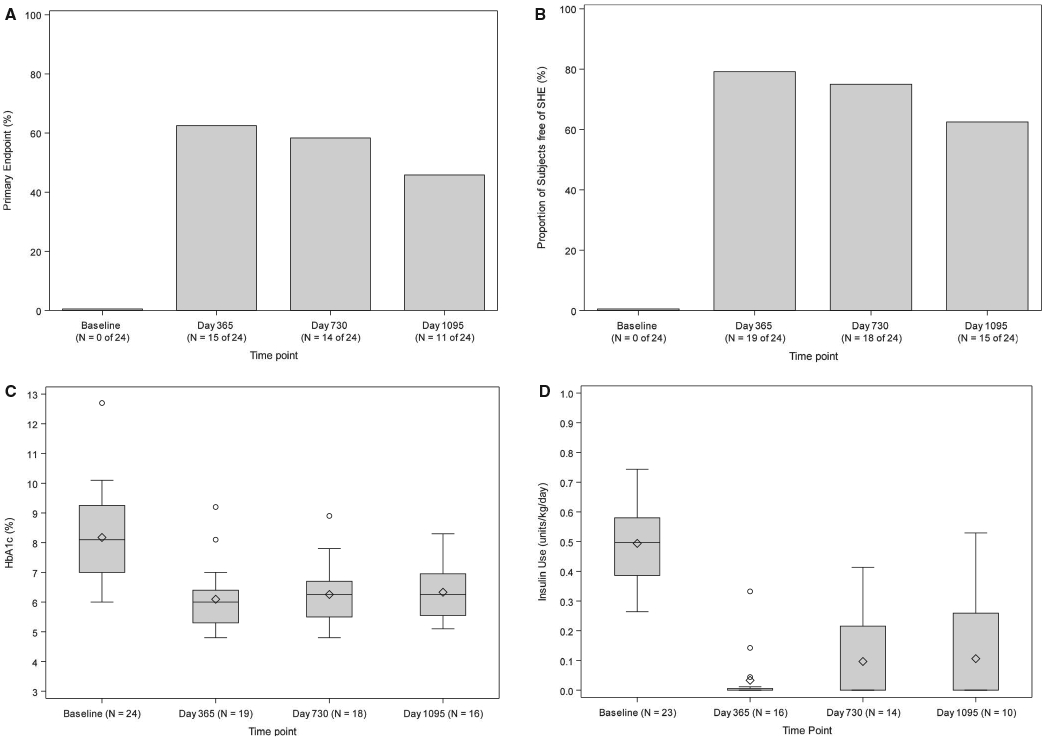
FIGURE 1
FIGURE 1
A, primary endpoint (%). An exact 1-sided test for a proportion of ≤.27 vs >0.27 was performed at day 365, day 730, and day 1095. The P values were P = .0003 at day 365, P = .0012 at day 730, and P = .0369 at day 1095. The threshold for statistical significance based on the Benjamini-Hochberg (BH) false discovery rate (FDR) method was 0.0167. B, Free of severe hypoglycemic event (SHE) (%). An exact 1-sided test for proportion ≤0.5 vs >0.5 was performed at day 365, day 730, and day 1095. The P values were P = .0033 at day 365, P = .0113 at day 730, and P = .1537 at day 1095. The threshold for statistical significance based on the BH FDR method was 0.0167. C, HbA1c (%). The Wilcoxon signed rank test for paired outcomes was used to compare the HbA1c levels (%) between baseline and day 365, day 730, and day 1095 following initial purified human pancreatic islets (PHPI) product transplant. The BH method was used to adjust the level of significance in order to preserve the overall false discovery rate of 10%. The upper BH boundary was 0.0794 and the P values for the 2-sided Wilcoxon signed rank tests were P < .0001 for day 365, P = .0016 for day 730, and P = .0002 for day 1095. D, Insulin use (U/kg/d). The Wilcoxon signed rank test for paired outcomes was used to compare insulin use (U/kg/d) at day 365, day 730, and day 1095 following initial PHPI product transplant. The BH method was used to adjust the level of significance in order to preserve the overall false discovery rate of 10%. The upper BH boundary was 0.0794 and the P values for the 2-sided Wilcoxon signed rank tests were P < .0001 for day 365, P = .0001 for day 730, and P = .0020 for day 1095
FIGURE 2
FIGURE 2
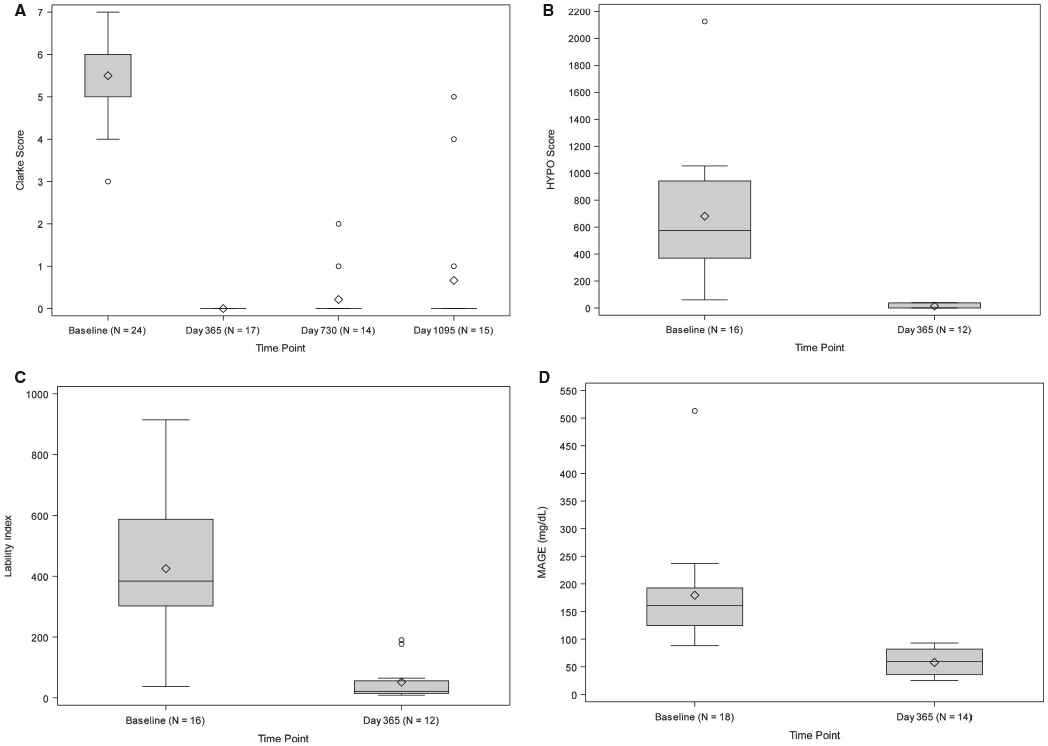
A, Clarke score. The Wilcoxon signed rank Test for paired outcomes was used to compare the median Clarke Survey score between baseline (N = 24) and day 365, day 730, and day 1095 following initial purified human pancreatic islets (PHPI) product transplant. The Benjamini-Hochberg (BH) method was used to adjust the level of significance in order to preserve the overall false discovery rate of 10%. The upper BH boundary was 0.0794 and the P values for the 2-sided Wilcoxon signed rank tests were P < .0001 for day 365, P = .0001 for day 730, and P = .0001 for day 1095. B, hypoglycemia (HYPO) score. The Wilcoxon signed rank test for paired outcomes was used to compare changes in median HYPO score between baseline and day 365 following initial PHPI product transplant. BH method was used to adjust the level of significance to preserve the overall false discovery rate of 10%. The upper BH boundary was 0.0794 and the P value for the 2-sided Wilcoxon signed rank test was .0078. Note: HYPO score results were only collected through day 365. C, Lability index (LI). The Wilcoxon signed rank test for paired outcomes was used to compare the changes in median LI scores between baseline and day 365 following initial PHPI product transplant. The BH method was used to adjust the level of significance to preserve the overall false discovery rate of 10%. The upper BH boundary was 0.0794 and the P value for the 2-sided Wilcoxon signed rank test was .0078. Note: LI results were only collected through day 365. D, Mean amplitude of glycemic excursions (MAGE) score. The Wilcoxon signed rank test for paired outcomes was used to compare changes in MAGE score between baseline and day 365 following initial PHPI product transplant. The BH method was used to adjust the level of significance to preserve the overall false discovery rate of 10%. The upper BH boundary was 0.0794 and the P value for the 2-sided Wilcoxon signed rank test was .0020. Note: MAGE score results were only collected through day 365
FIGURE 3
FIGURE 3
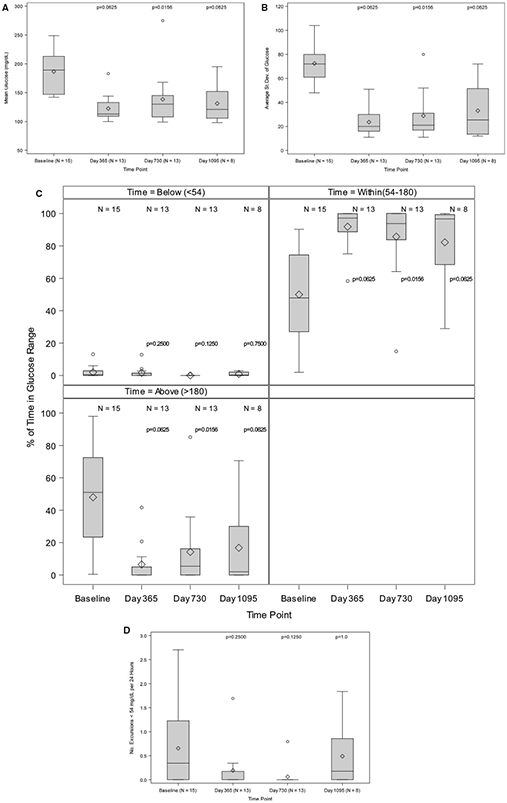
A, Mean glucose levels (mg/dL). The Wilcoxon signed rank test for paired outcomes was used to compare mean continuous glucose monitoring system (CGMS®) glucose (mg/dL) from baseline to day 365, day 730, and day 1095 following initial purified human pancreatic islets (PHPI) product transplant. The Benjamini-Hochberg (BH) method was used to adjust the level of significance to preserve the overall false discovery rate of 10%. The upper BH boundary was 0.0794 and the P values for the 2-sided Wilcoxon signed rank tests were P = .0625 for day 365, P = .0156 for day 730, and P = .0625 for day 1095. B, Average SD of glucose levels (mg/dL). The Wilcoxon signed rank test for paired outcomes was used to compare average SD of glucose levels (mg/dL) from baseline to day 365, day 730 and day 1095 following initial PHPI product transplant. The BH method was used to adjust the level of significance to preserve the overall false discovery rate (FDR) of 10%. The upper BH boundary was 0.0794 and the P values for the 2-sided Wilcoxon signed rank tests were P = .0625 for day 365, P = .0156 for day 730, and P = .0625 for day 1095. C, Percent of time in glucose range. The Wilcoxon signed rank test for paired outcomes was used to compare CGMS® percent excursions for < 54, within (54-180), and >180, from baseline to day 365, day 730, and day 1095 following initial PHPI product transplant. The BH method was used to adjust the level of significance to preserve the overall FDR of 10%. The upper BH boundary was 0.0794 and the P values for the 2-sided Wilcoxon signed rank tests were, respectively, P = .2500, P = .0625 and P = .0625 for day 365; P = .1250, P = .0156, and P = .0156 for day 730; and P = .7500, P = .0625, and P = .0625 for day 1095. D, Glucose level (mg/dL) number of excursions < 54 mg/dL per 24 h. The Wilcoxon signed rank test for paired outcomes was used to compare the median number of hypoglycemic excursions per day from baseline to day 365, day 730, and day 1095 following initial PHPI product transplant. The BH method was used to adjust the level of significance to preserve the overall FDR of 10%. The upper BH boundary was 0.0794 and the P values for the 2-sided Wilcoxon signed rank tests were P = .2500 for day 365, P = .1250 for day 730, and P = 1.0 for day 1095
FIGURE 4
FIGURE 4
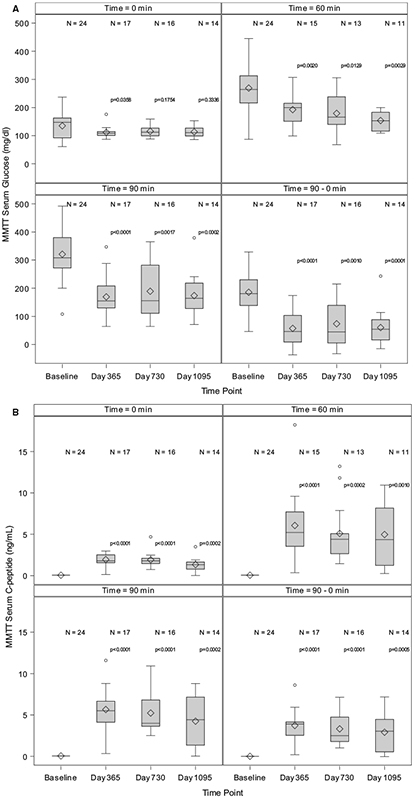
A, Mixed-meal tolerance test (MMTT)-derived serum glucose levels. The Wilcoxon signed rank test for paired outcomes was used to compare glucose measures for basal (0 minutes), 60 minutes, 90 minutes, and the change from 0 minutes to 90 minutes from baseline to day 365, day 730, and day 1095 following initial purified human pancreatic islets (PHPI) product transplant. The Benjamini-Hochberg (BH) method was used to adjust the level of significance to preserve the overall false discovery rate (FDR) of 10%. The upper BH boundary was 0.0794 and the P values for the 2-sided Wilcoxon signed rank tests were, respectively, P = .0358, P = .0020, P < .0001, and P < .0001 for day 365; P = .1754, P = .0129, P = .0017, and P = .0010 for day 730; and P = .3336, P = .0029, P = .0002, and P = .0001 for day 1095. Note: The 60-minute glucose levels (mg/dL) were not required in Protocol CIT06 (CIT consortium trial of PHPI transplant in patients with type 1 diabetes after kidney transplant). B, MMTT-derived serum C-peptide levels. The Wilcoxon signed rank test for paired outcomes was used to compare C-peptide measures for basal (0 minutes), 60 minutes, 90 minutes, and the change from 0 minutes to 90 minutes from baseline to day 365, day 730, and day 1095 following initial PHPI product transplant. The BH method was used to adjust the level of significance to preserve the overall FDR of 10%. The upper BH boundary was 0.0794 and the P values for the 2-sided Wilcoxon signed rank tests were, respectively, P < .0001, P < .0001, P < .0001 and P < .0001 for day 365; P < .0001, P = .0002, P < .0001, and P < .0001 for day 730; and P = .0002, P = .0010, P = .0002, and P = .0005 for day 1095.
FIGURE 5
FIGURE 5
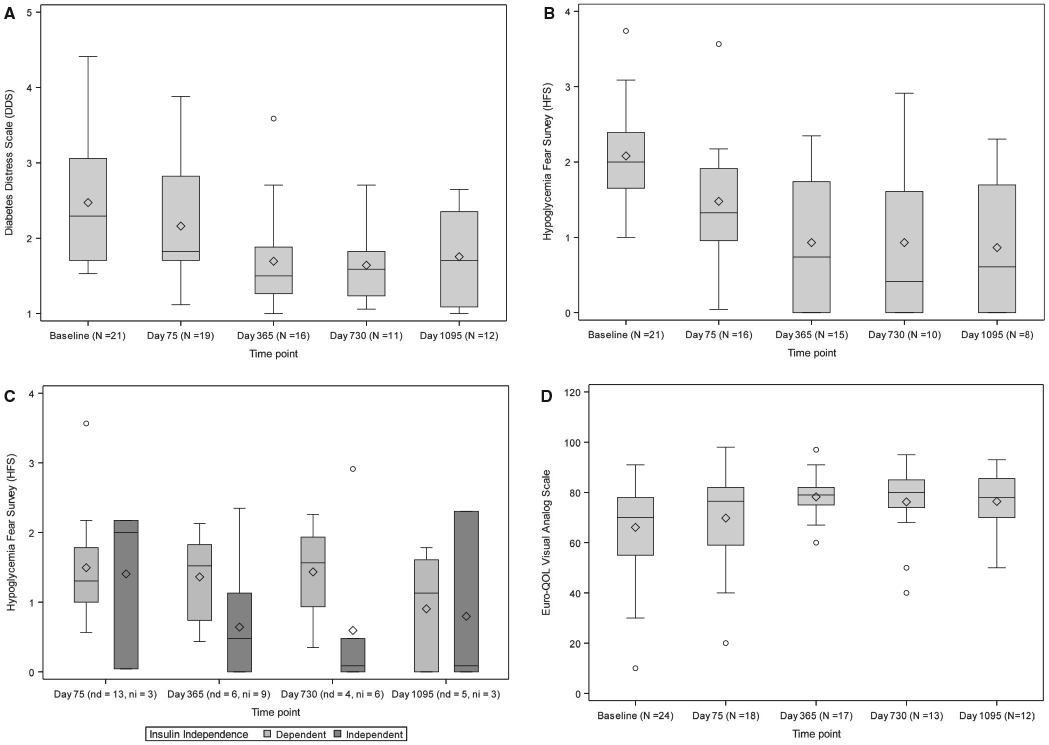
A, Diabetes Distress Scale (DDS) scores. The Wilcoxon signed rank test for paired outcomes was used to compare DDS from baseline and day 75, day 365, day 730, and day 1095 following initial purified human pancreatic islets (PHPI) product transplant. The Benjamini-Hochberg (BH) method was used to adjust the level of significance to preserve the overall false discovery rate (FDR) of 10%. The upper BH boundary was 0.0229 and the P values for the 2-sided Wilcoxon signed rank test were, respectively, P = .0020, P = .0062, P = .0195 and P = .0078. B, Overall Hypoglycemia Fear Survey (HFS) scores. The Wilcoxon signed rank test for paired outcomes was used to compare HFS from baseline to day 75, day 365, day 730, and day 1095 following initial PHPI product transplant. The BH method was used to adjust the level of significance to preserve the overall FDR of 10%. The upper BH boundary was 0.0229 and the P values for the 2-sided Wilcoxon signed rank test were, respectively, P = .0005, P = .0024, P = .0391, and P = .0469. C, Hypoglycemia Fear Survey (HFS) score as a function of insulin independence. The sample sizes are recorded as (nd = number of insulin dependent, ni = number of insulin independent) at day 75, day 365, day 730, and day 1095 following initial PHPI product transplantation. The BH method was used to adjust the level of significance to preserve the overall FDR of 10%. The upper BH boundary was 0.0229. Pairwise Wilcoxon P values comparing HFS scores among those who met insulin independence vs those who did not for day 75, day 365, day 730, and day 1095 were, respectively, P = .7250, P = .0783, P = .0171 and P = 1.0. D, Overall visual analog scale (VAS) Scores. The Wilcoxon signed rank test for paired outcomes was used to compare EuroQOL VAS from baseline to day 75, day 365, day 730, and day 1095 following initial PHPI product transplant. The BH method was used to adjust the level of significance to preserve the overall FDR of 10%. The upper BH boundary was 0.0229 and the P values for the 2-sided Wilcoxon signed rank test were, respectively, P = .1061, P = .0002, P = .0952 and P = .0327

Comment in

References

    1. Hering BJ, Clarke WR, Bridges ND, et al. Phase 3 trial of transplantation of human islets in type 1 diabetes complicated by severe hypoglycemia. Diabetes Care. 2016;39:1230–1240. - PMC - PubMed
    1. Ricordi C, Goldstein JS, Balamurugan AN, et al. National Institutes of Health-sponsored Clinical Islet Transplantation Consortium phase 3 trial: manufacture of a complex cellular product at eight processing facilities. Diabetes. 2016;65:3418–3428. - PMC - PubMed
    1. Choudhary P, Rickels MR, Senior PA, et al. Evidence-informed clinical practice recommendations for treatment of type 1 diabetes complicated by problematic hypoglycemia. Diabetes Care. 2015;38:1016–1029. - PMC - PubMed
    1. US Food and Drug Administration. Guidance for industry: considerations for allogeneic pancreatic islet cell products (article online). 2009; Available from https://www.fda.gov/media/77497/download. Accessed 20 October 2015
    1. Tiwari JL, Schneider B, Barton F, Anderson SA. Islet cell transplantation in type 1 diabetes: an analysis of efficacy outcomes and considerations for trial designs. Am J Transplant. 2012;12(7):1898–1907. - PubMed

Publication types

Grants and funding