Review
. 2020 Jul 1;12(7):1748.
doi: 10.3390/cancers12071748.

Reactive Oxygen Species and Antitumor Immunity-From Surveillance to Evasion

Affiliations
Review

Reactive Oxygen Species and Antitumor Immunity-From Surveillance to Evasion

Andromachi Kotsafti et al. Cancers (Basel). .

Abstract

The immune system is a crucial regulator of tumor biology with the capacity to support or inhibit cancer development, growth, invasion and metastasis. Emerging evidence show that reactive oxygen species (ROS) are not only mediators of oxidative stress but also players of immune regulation in tumor development. This review intends to discuss the mechanism by which ROS can affect the anti-tumor immune response, with particular emphasis on their role on cancer antigenicity, immunogenicity and shaping of the tumor immune microenvironment. Given the complex role that ROS play in the dynamics of cancer-immune cell interaction, further investigation is needed for the development of effective strategies combining ROS manipulation and immunotherapies for cancer treatment.

Keywords: cancer; immunity; inflammation; oxidative stress; reactive oxygen species.


Conflict of interest statement

The authors declare no conflict of interest.

Figures
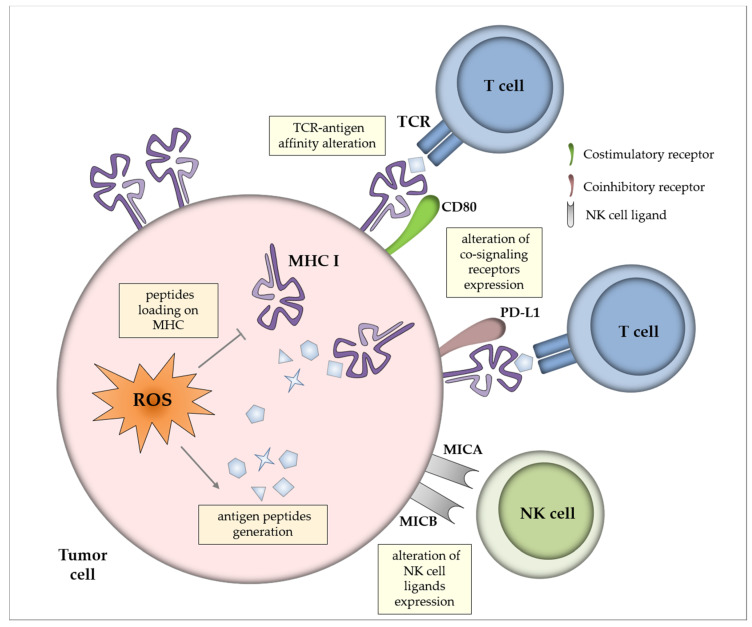
Figure 1
Figure 1
Impact of reactive oxygen species (ROS) on tumor antigenicity and immunogenicity. Oxidative stress in the tumor cells can induce the generation of antigenic peptides, which is counterbalanced by limited loading on major histocompatibility complex (MHC) molecules. Post-translational modification of proteins by ROS may alter antigenicity and modify T cell receptor (TCR) affinity to antigens. In addition, ROS may regulate the expression of co-signaling receptors for T cells (i.e., CD80 costimulatory molecule and PD-L1 coinhibitory molecule) and of NK cell ligands (i.e., MHC class I chain-related protein A and B MICA and MICB).
Figure 2
Figure 2
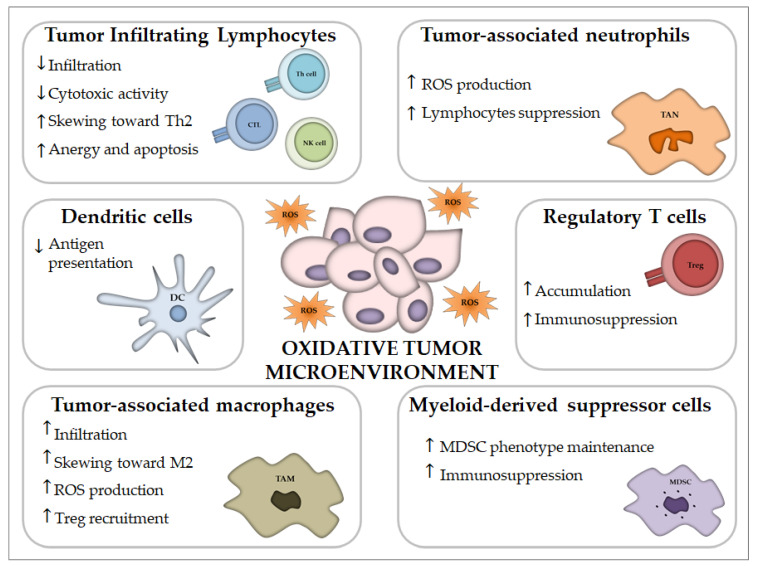
Impact of oxidative stress on immune cells of the tumor microenvironment. Oxidative stress in the tumor microenvironment promote immune suppression. It can reduce the infiltration of lymphocytes and favor the recruitment and accumulation of regulatory T cells and M2 tumor-associated macrophages. Antigen presentation by dendritic cells results impaired and tumor infiltrating lymphocytes are dysfunctional. Myeloid-derived suppressor cells and tumor-associated neutrophils inhibit lymphocytes functions through ROS production.

References

    1. Emanuele S., D’Anneo A., Calvaruso G., Cernigliaro C., Giuliano M., Lauricella M. The Double-Edged Sword Profile of Redox Signaling: Oxidative Events as Molecular Switches in the Balance between Cell Physiology and Cancer. Chem. Res. Toxicol. 2018;31:201–210. doi: 10.1021/acs.chemrestox.7b00311. - DOI - PubMed
    1. Hegedűs C., Kovács K., Polgár Z., Regdon Z., Szabó É., Robaszkiewicz A., Forman H.J., Martner A., Virág L. Redox control of cancer cell destruction. Redox Biol. 2018;16:59–74. doi: 10.1016/j.redox.2018.01.015. - DOI - PMC - PubMed
    1. Mullen L., Mengozzi M., Hanschmann E.-M., Alberts B., Ghezzi P. How the redox state regulates immunity. Free. Radic. Biol. Med. 2019 doi: 10.1016/j.freeradbiomed.2019.12.022. - DOI - PubMed
    1. Lorenzen I., Mullen L., Bekeschus S., Hanschmann E.-M. Redox Regulation of Inflammatory Processes Is Enzymatically Controlled. Oxidative Med. Cell. Longev. 2017;2017:8459402. doi: 10.1155/2017/8459402. - DOI - PMC - PubMed
    1. Smyth M.J., Dunn G.P., Schreiber R.D. Cancer immunosurveillance and immunoediting: The roles of immunity in suppressing tumor development and shaping tumor immunogenicity. Adv. Immunol. 2006;90:1–50. doi: 10.1016/S0065-2776(06)90001-7. - DOI - PubMed

LinkOut - more resources