. 2020 Jun 25;17(12):4569.
doi: 10.3390/ijerph17124569.

Shoes and Insoles: The Influence on Motor Tasks Related to Walking Gait Variability and Stability

Affiliations

Shoes and Insoles: The Influence on Motor Tasks Related to Walking Gait Variability and Stability

Luca Russo et al. Int J Environ Res Public Health. .

Abstract

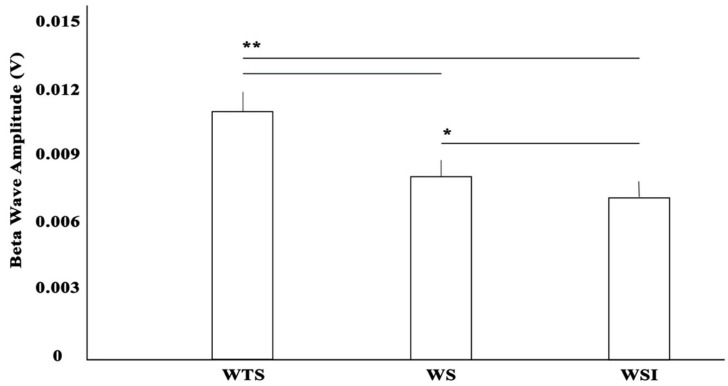
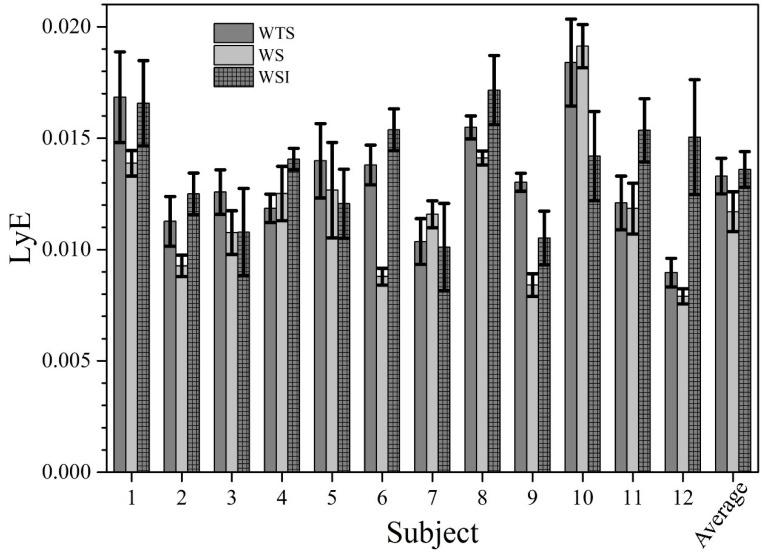
The rhythmic control of the lower limb muscles influences the cycle-to-cycle variability during a walking task. The benefits of insoles, commonly used to improve the walking gait, have been little studied. Therefore, the aim of this study was to assess the walking gait variability and stability on different walking conditions (without shoes, WTS, with shoes, WS, with shoes and insoles, WSI) related to brain activity. Twelve participants randomly (WTS/WS/WSI) walked on a treadmill at 4 km/h for 10 min. Kinematic analysis (i.e., footstep and gait variability), brain activation (beta wave signal), rating of perceived exertion (RPE, CR-10 scale), and time domain measures of walking variability were assessed. The maximum Lyapunov exponent (LyE) on the stride cycle period's datasets was also calculated. Stride length and cycle calculated for all walking conditions were 61.59 ± 2.53/63.38 ± 1.43/64.09 ± 2.40 cm and 1.11 ± 0.03/1.14 ± 0.03/1.15 ± 0.04 s (F1,10 = 4.941/p = 0.01, F1,10 = 4.938/p = 0.012) for WTS, WS, WSI, respectively. Beta wave (F1,10 = 564.201/p = 0.0001) was higher in WTS compared to WS and WSI. Analysis of variance's (ANOVA) LyE showed a F1,10 = 3.209/p = 0.056, while post hoc analysis showed a significant effect between WS and WSI with p = 0.023, and nonsignificant effects between WTS and WS/WSI (p = 0.070/0.607), respectively. Small perturbations of the foot can influence the control of gait rhythmicity by increasing the variability in a dissipative deterministic regimen.

Keywords: Lyapunov exponent; barefoot; electroencephalogram (EEG); foot; motor control.


Conflict of interest statement

The authors declare no conflict of interest.

Figures
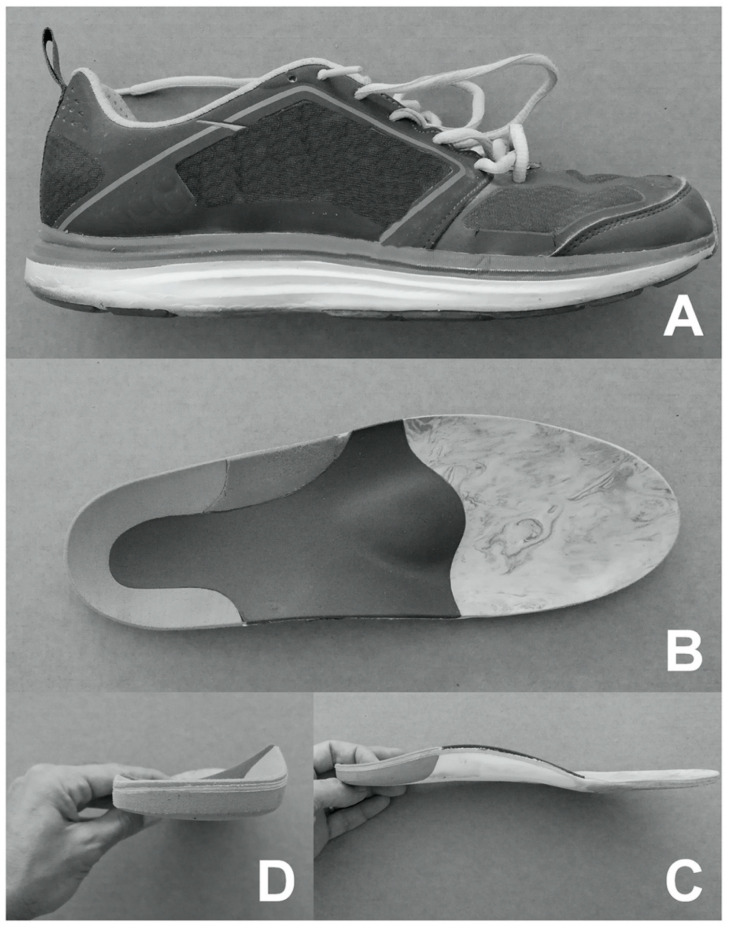
Figure 1
Figure 1
Shoes and insoles. (A) Lateral view of experimental shoe. The insoles were produced with an anatomical and ergonomic shape. Insoles had three-density Ethylene-Vinyl Acetate (EVA) full length, stabilization of the rear foot, support of the mid foot, and cushioning of the fore foot (B), physiological medial heel wedge (C), and physiological arch support (D).
Figure 2
Figure 2
Beta wave amplitude signal in (* and ** for p < 0.05 and 0.01, respectively) different walking conditions (without shoes WTS, with shoes WS, with shoes and insoles WSI).
Figure 3
Figure 3
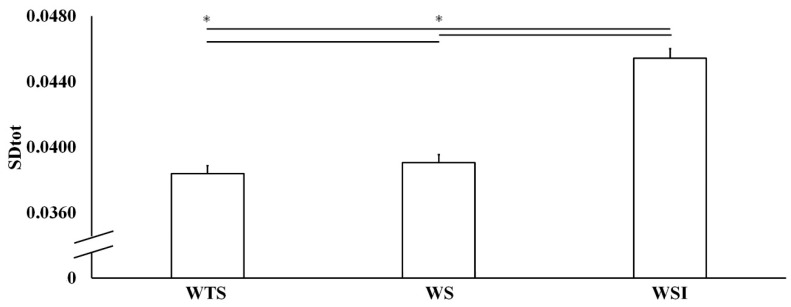
Standard deviation of cycle-to-cycle intervals (SDtot) on WTS (without shoes), WS (with shoes), WSI (with shoes and insoles). Statistical significance is denoted as “*” p < 0.001 between the two walking conditions.
Figure 4
Figure 4
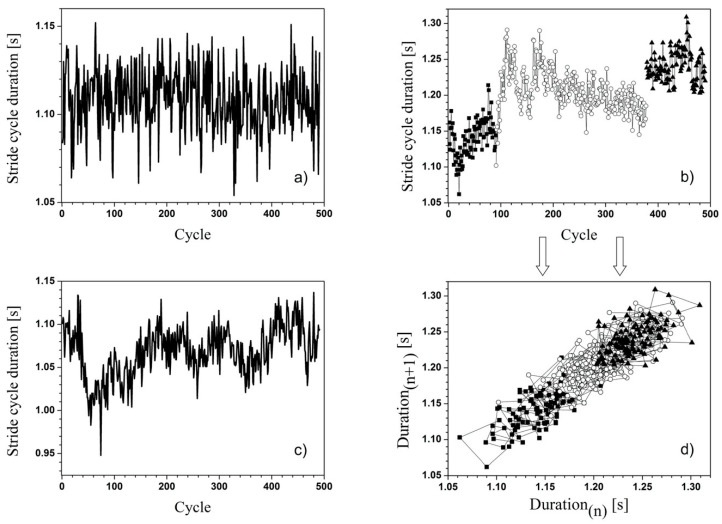
Some representative plots of the stride cycle duration during an entire walking test. All the displayed data are in WTS condition: (a) Very regular walking over the whole range; (b) a walking dataset clearly characterized by sharp “transitions” from a walking regime to another. Different regimes have been highlighted by using different point stiles (also to produce a clearer output for the plot in panel d)); (c) an intermediate situation between the two previous ones, characterizing most subjects; (d) 2D-projection of reconstructed trajectories in the phase-space produced by the data of panel b): the different symbols highlight the presence of local attractors for the orbits.
Figure 5
Figure 5
Maximum Lyapunov exponents (LyEs) calculated for each subject in each investigated walking condition. LyE values are measured in (stride cycles) −1.

References

    1. Marchena-Rodriguez A., Ortega-Avila A.B., Cervera-Garvi P., Cabello-Manrique D., Gijon-Nogueron G. Review of Terms and Definitions Used in Descriptions of Running Shoes. Int. J. Environ. Res. Public Health. 2020;17:3562. doi: 10.3390/ijerph17103562. - DOI - PMC - PubMed
    1. Al-Trinkaus E., Shang H. Anatomical evidence for the antiquity of human footwear: Tianyuan and Sunghir. J. Archaeol. Sci. 2008;35:1928–1933. doi: 10.1016/j.jas.2007.12.002. - DOI
    1. Franklin S., Grey M.J., Heneghan N., Bowen L., Li F.X. Barefoot vs common footwear: A systematic review of the kinematic, kinetic and muscle activity differences during walking. Gait Posture. 2015;42:230–239. doi: 10.1016/j.gaitpost.2015.05.019. - DOI - PubMed
    1. Al-Abdulwahab S., Al-Dosry R.D. Hallux Valgus and Preferred Shoe Types Among Young Healthy Saudi Arabian Females. Ann. Saudi. Med. 2000;20:319–321. doi: 10.5144/0256-4947.2000.319. - DOI - PubMed
    1. Csapo R., Maganaris C.N., Seynnes O.R., Narici M.V. On muscle, tendon and high heels. J. Exp. Biol. 2010;213:2582–2588. doi: 10.1242/jeb.044271. - DOI - PubMed

LinkOut - more resources