Review
. 2020 Jun 25;10(6):958.
doi: 10.3390/biom10060958.

The Hyperoxic-Hypoxic Paradox

Affiliations
Review

The Hyperoxic-Hypoxic Paradox

Amir Hadanny et al. Biomolecules. .

Abstract

Effective metabolism is highly dependent on a narrow therapeutic range of oxygen. Accordingly, low levels of oxygen, or hypoxia, are one of the most powerful inducers of gene expression, metabolic changes, and regenerative processes, including angiogenesis and stimulation of stem cell proliferation, migration, and differentiation. The sensing of decreased oxygen levels (hypoxia) or increased oxygen levels (hyperoxia), occurs through specialized chemoreceptor cells and metabolic changes at the cellular level, which regulate the response. Interestingly, fluctuations in the free oxygen concentration rather than the absolute level of oxygen can be interpreted at the cellular level as a lack of oxygen. Thus, repeated intermittent hyperoxia can induce many of the mediators and cellular mechanisms that are usually induced during hypoxia. This is called the hyperoxic-hypoxic paradox (HHP). This article reviews oxygen physiology, the main cellular processes triggered by hypoxia, and the cascade of events triggered by the HHP.

Keywords: biogenesis; hyperbaric oxygen; hyperoxia; hyperoxic-hypoxic paradox; hypoxia; hypoxia-inducible factor (HIF).


Conflict of interest statement

AH works for AVIV Scientific LTD. ES is a shareholder in AVIV Scientific LTD. Aviv Scientific LTD had no role in the design, execution, interpretation or writing of the study.

Figures
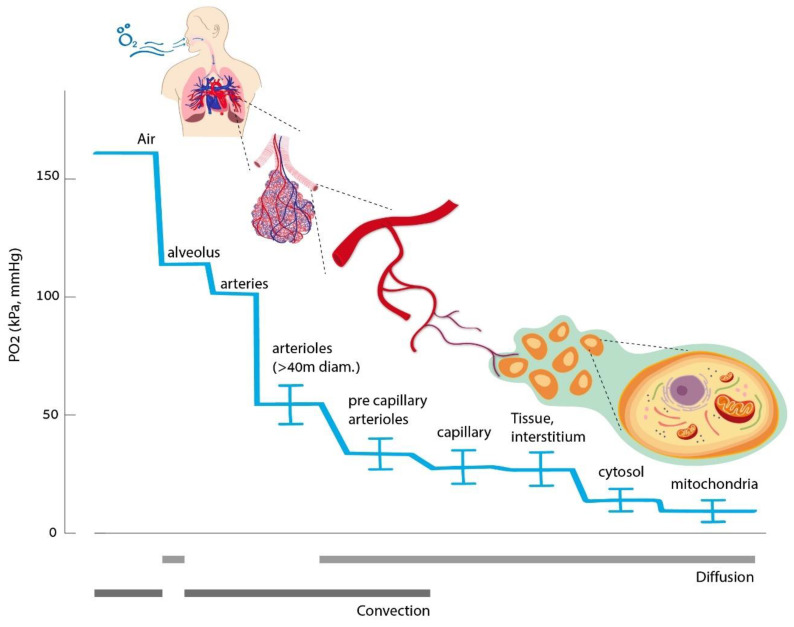
Figure 1
Figure 1
Oxygen delivery chain.
Figure 2
Figure 2
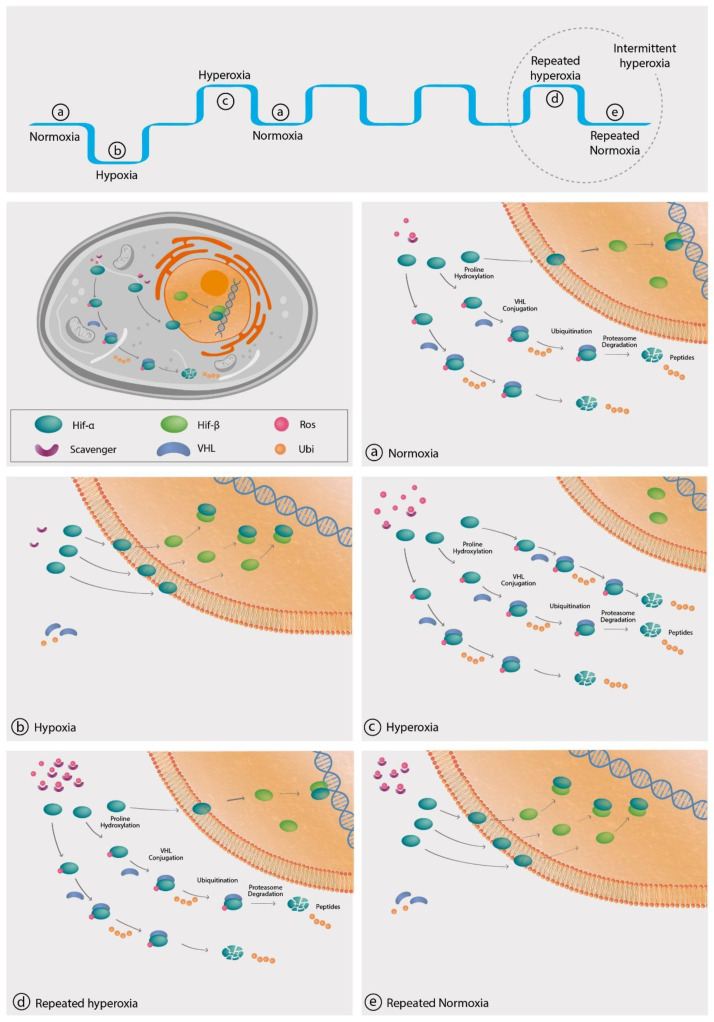
The intracellular cascade of HIF-1 alpha. Legend: HIF-1 is a heterodimer composed of cytoplasmatic HIF-1α and the nuclear HIF-1β subunits. (a) Under normal oxygen environments, the ratio of ROS/scavenger is high and the free ROS molecules initiate HIF-1α hydroxylation, HIF-1α subunits become a target for VHLp (von Hippel–Lindau protein) protein which facilitates HIF-1α subunits ubiquitination and degradation. (b) Under hypoxic conditions, less oxygen and ROS molecules are available, HIF-1α subunits are not hydrolyzed, and more HIF-1α subunits penetrate the nucleus to conjugate with HIF-1β subunits and generate the active HIF transcription factor. (c) At the hyperoxic environment, more ROS and oxygen are available; thus more HIF-1α subunits are hydrolyzed and degraded. (d) The adaptive response to repeated hyperoxia includes increases in the production of scavengers that adjust to the increased ROS generation. Thus, the ROS/scavenger ratio gradually becomes similar to the ratio under normal oxygen environment prior to initiating repeated hyperoxic exposures. (e) Upon return to normoxia, following repeated hyperoxic exposures, the ratio of ROS/scavenger is low due to the fact scavengers elimination half-life (T1/2) is significantly longer than the T1/2 of ROS. Accordingly, less HIF-1α subunits are hydroxylated, and more of them penetrate the nucleus, conjugate with HIF-1β to generate the active HIF, similar to the hypoxic state.
Figure 3
Figure 3
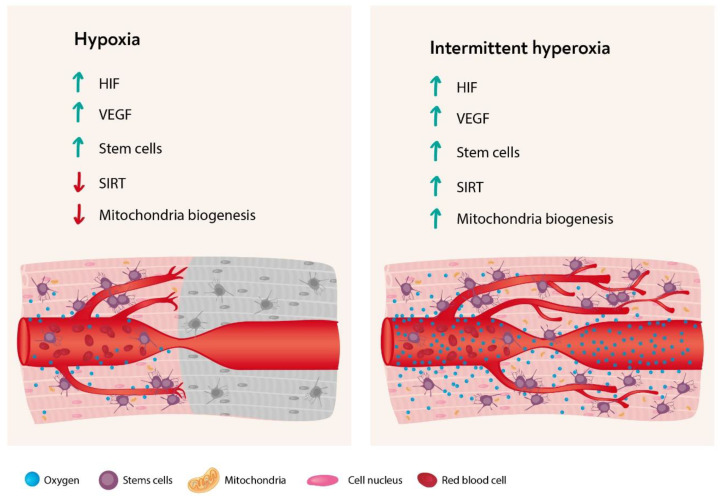
The major cellular response cascade initiated by hypoxia and by intermittent hyperoxia. Legends: HIF: Hypoxic induce factor; VEGF: Vascular endothelial growth factor; SIRT: Sirtuin.

References

    1. Berner R.A. Atmospheric oxygen over Phanerozoic time. Proc. Natl. Acad. Sci. USA. 1999;96:10955–10957. doi: 10.1073/pnas.96.20.10955. - DOI - PMC - PubMed
    1. Butterfield N.J. Oxygen, animals and oceanic ventilation: An alternative view. Geobiology. 2009;7:1–7. doi: 10.1111/j.1472-4669.2009.00188.x. - DOI - PubMed
    1. Trayhurn P. Oxygen-A Critical, but Overlooked, Nutrient. Front. Nutr. 2019;6:10. doi: 10.3389/fnut.2019.00010. - DOI - PMC - PubMed
    1. Collins J.A., Rudenski A., Gibson J., Howard L., O’Driscoll R. Relating oxygen partial pressure, saturation and content: The haemoglobin-oxygen dissociation curve. Breathe (Sheff) 2015;11:194–201. doi: 10.1183/20734735.001415. - DOI - PMC - PubMed
    1. Echevarria M., Munoz-Cabello A.M., Sanchez-Silva R., Toledo-Aral J.J., Lopez-Barneo J. Development of cytosolic hypoxia and hypoxia-inducible factor stabilization are facilitated by aquaporin-1 expression. J. Biol. Chem. 2007;282:30207–30215. doi: 10.1074/jbc.M702639200. - DOI - PubMed

Publication types

LinkOut - more resources