


Review
doi: 10.3390/polym12071481.
New Variants of Nitroxide Mediated Polymerization
Affiliations
- PMID: 32630664
- PMCID: PMC7408045
- DOI: 10.3390/polym12071481
Item in Clipboard
Review
New Variants of Nitroxide Mediated Polymerization
Polymers (Basel).
.
Abstract
Nitroxide-mediated polymerization is now a mature technique, at 35 years of age. During this time, several variants have been developed: electron spin capture polymerization (ESCP), photoNMP (NMP2), chemically initiated NMP (CI-NMP), spin label NMP (SL-NMP), and plasmon-initiated NMP (PI-NMP). This mini-review is devoted to the features and applications of these variants.
Keywords: CI-NMP; ESCP; NMP2; PI-NMP; SLNMP; nitroxide mediated polymerization.
Conflict of interest statement
The authors declare no conflict of interest. The funders had no role in the writing of the manuscript and in the decision to publish the results.
Figures
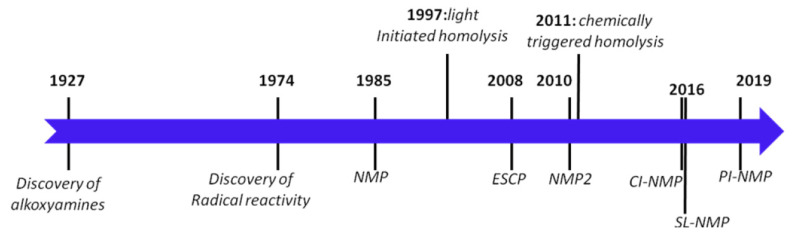
Timeline of the discoveries of the variants of NMP
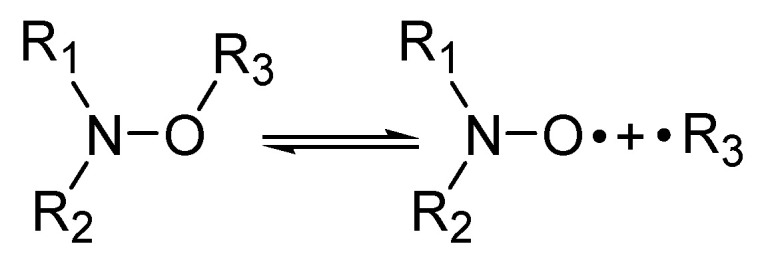
Reversible C—ON bond homolysis in alkoxyamines.
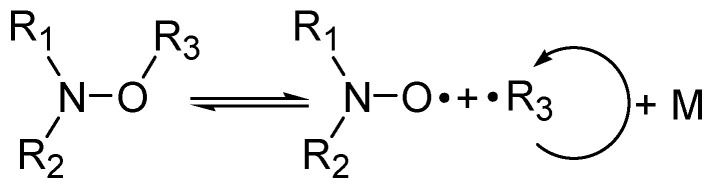
Oversimplified scheme of nitroxide-mediated polymerization (NMP) [4].
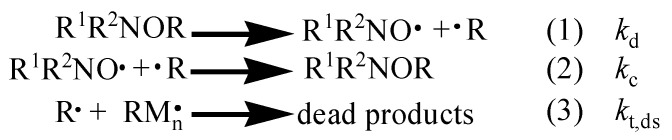
Elementary reactions involved in the alkoxyamine decomposition.
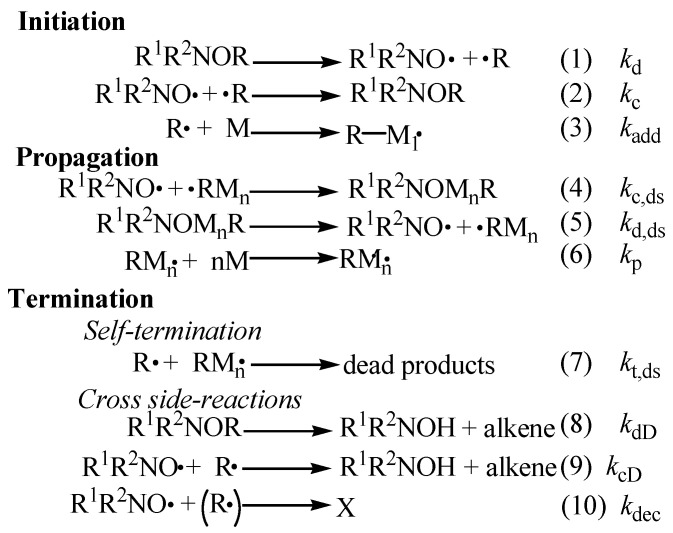
Kinetics of NMP: kd is the rate constant for the homolysis of initiator, kc for the re-formation of initiator, kadd for the addition of initiating alkyl radical onto monomer, kc,ds for the re-formation reaction of dormant species (ds = macro-initiator), kd,ds for the homolysis of dormant species, kp for the propagation of the polymer chain, kt,ds for the self-termination reactions of the propagating radicals, kdD for the side-reactions occurring during the homolysis, kcD for the side-reactions occurring during the re-formation reaction, and kdec for the decay of nitroxide.
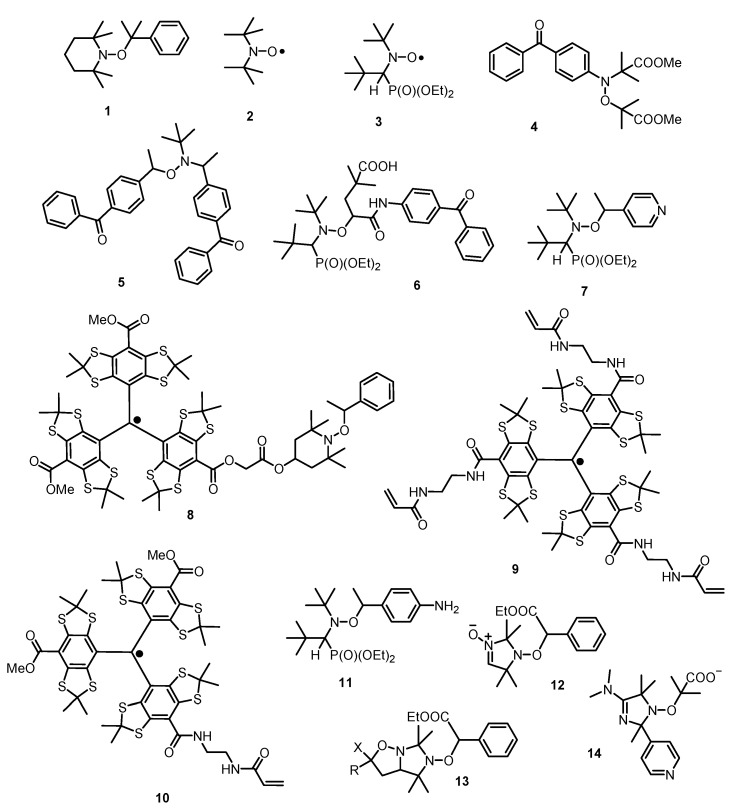
Alkoxyamines used to exemplify the variants of NMP
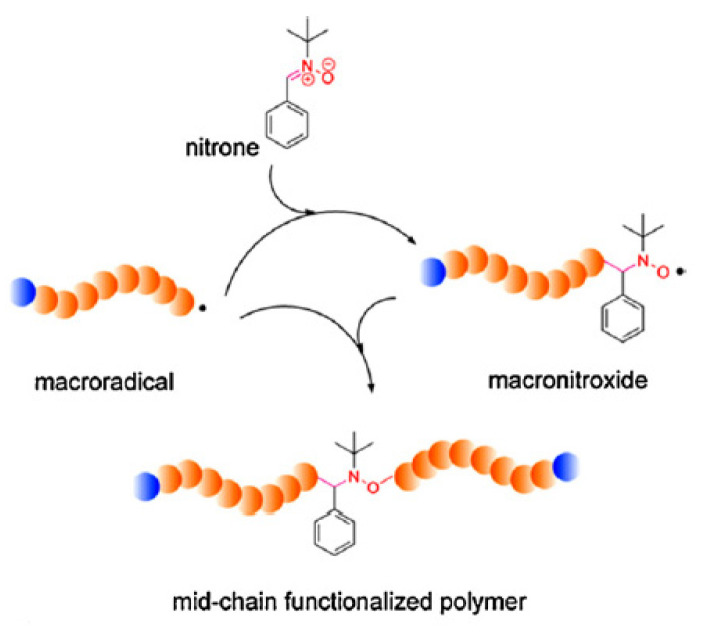
Scheme of electron spin capture polymerization (ESCP). Reprinted with the permission of Royal Society of Chemistry (RSC) from ref. [43].
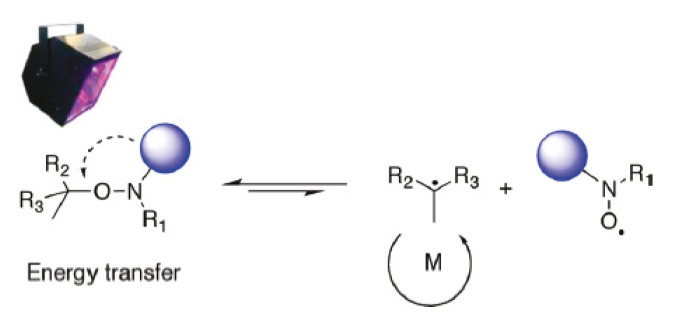
NMP2 concept. Reprinted with permission from (Guillaneuf, Y.; Bertin, D.; Gigmes, D.; Versace, D.-L.; Lalevée, J.; Fouassier, J.P. Toward Nitroxide-Mediated Photopolymerization. Macromolecules
2010, 43, 2204–2212). Copyright (2010) American Chemical Society.
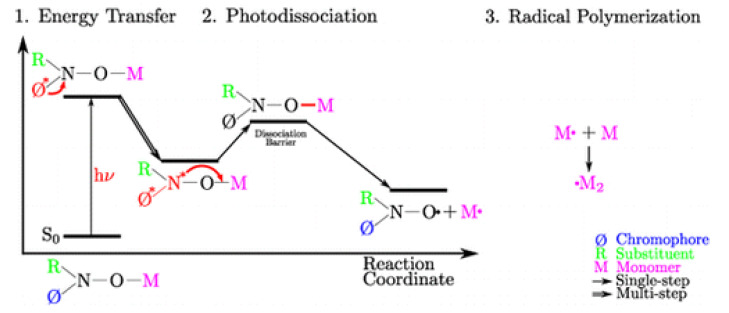
General scheme of the photochemically induced NMP2 initiation mechanism. The red part of the structure indicates the localization of the excitation energy in the structure. Reprinted with permission from (Huix-Rotllant, M.; Ferré, N. Theoretical Study of the Photochemical Initiation in Nitroxide-Mediated Photopolymerization. J. Phys. Chem. A
2014, 118, 4464–4470). Copyright (2014) American Chemical Society.".

The two different polymerization modes that could be used with 5 and 6. An amine is used as co-initiator for UV-induced polymerization with 6. Reprinted with the permission of RSC from ref. [56]
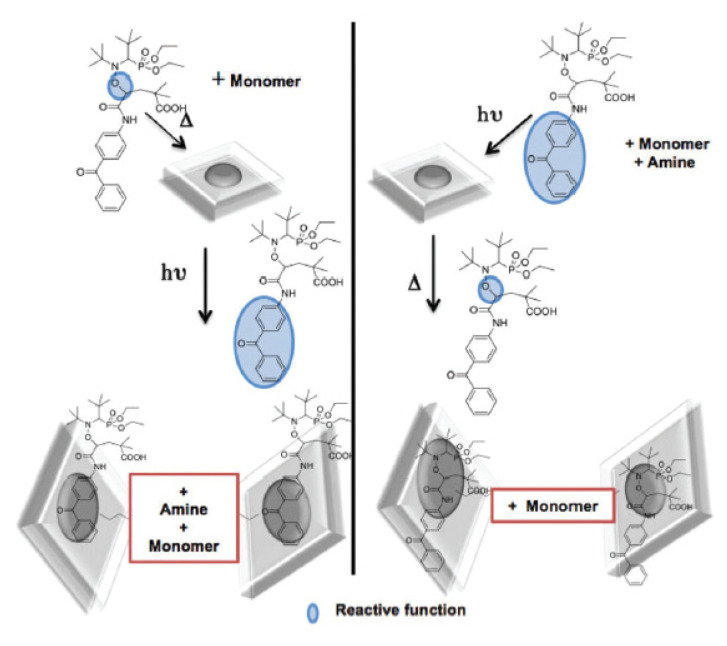
Use of a dual photoinitiator for the linkage of two polymer films by combining UV and thermal polymerization in laminate. Reprinted with the permission of RSC from ref. [56]
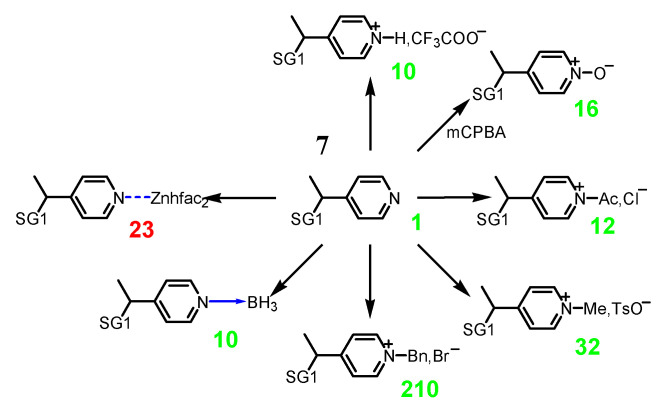
Various modes of activation of 7. Bold (green for normal activation, red values for unexpected values for the coordination by Lewis acid) numbers are for relative kd values.
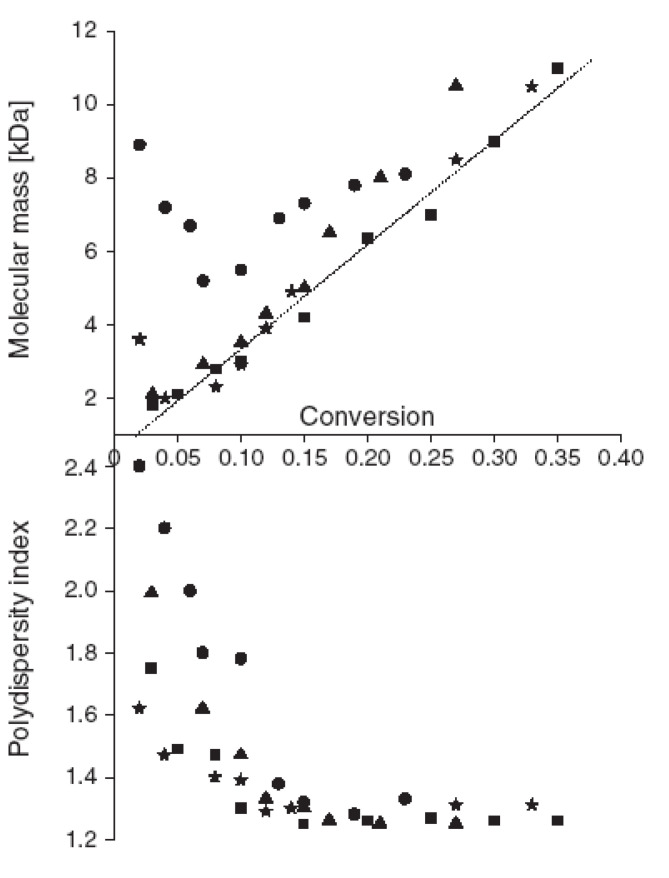
Plots of Mn versus conversion, Ð versus conversion, and ln([M]/[M0]) versus time for the polymerization of styrene at 90 °C initiated with RS/SR-7 (●); RS/SR-7Zn(hfac)2 (■); in situ RS/SR-7Zn(hfac)2 (RS/SR-7 + 0.5 equiv. Zn(hfac)2) (★); RS/SR-7 + 10 equiv. Zn(hfac)2 (▲), the monomer-to-initiator ratio is 250 : 1. Reprinted with the permission of CSIRO from ref. [65]
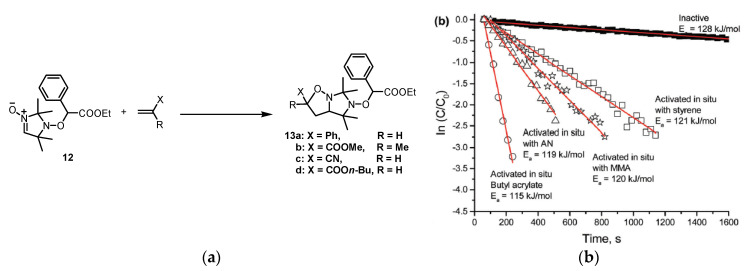
(a) Huysgen reaction between 12 and various alkenes; (b) Ea for activation in situ by the Huysgen reaction using various alkenes. Reprinted with permission from ref. [66]. Copyright 2019 Royal Society of Chemistry.
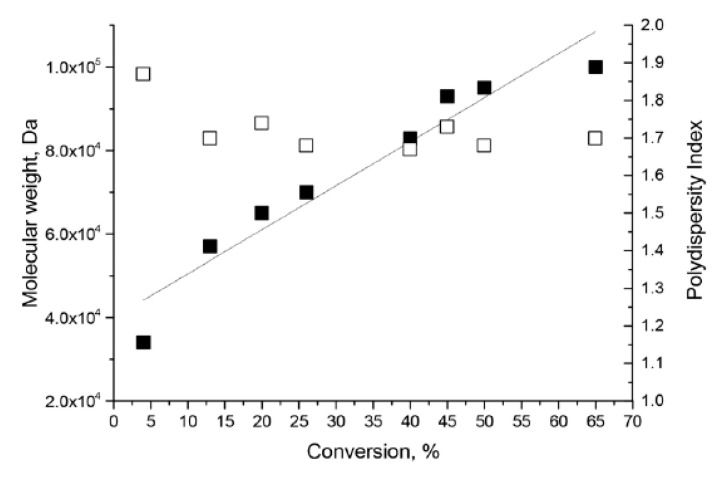
Molecular weight (left axis, filled squares) and polydispersity index (right axis, open squares) evolution vs. conversion plot for bulk polymerization of styrene initiated with alkoxyamine 8 at 130 °C with styrene/8 ratio 5000:1. Dotted line for the theoretical evolution of Mn. Audran, G.; Bagryanskaya, E.; Bagryanskaya, I.; Brémond, P.; Edeleva, M.; Marque, S.R.A.; Parkhomenko, D.; Rogozhnikova, O.Yu.;. Tormyshev, V.M.; Tretyakov, E.V.; Trukhin, D.V.; Zhivetyeva, S. Trityl-based Alkoxyamines as NMP Controlers and Spin-labels. Polym. Chem.
2016, 7, 6490–6499. Published by The Royal Society of Chemistry.
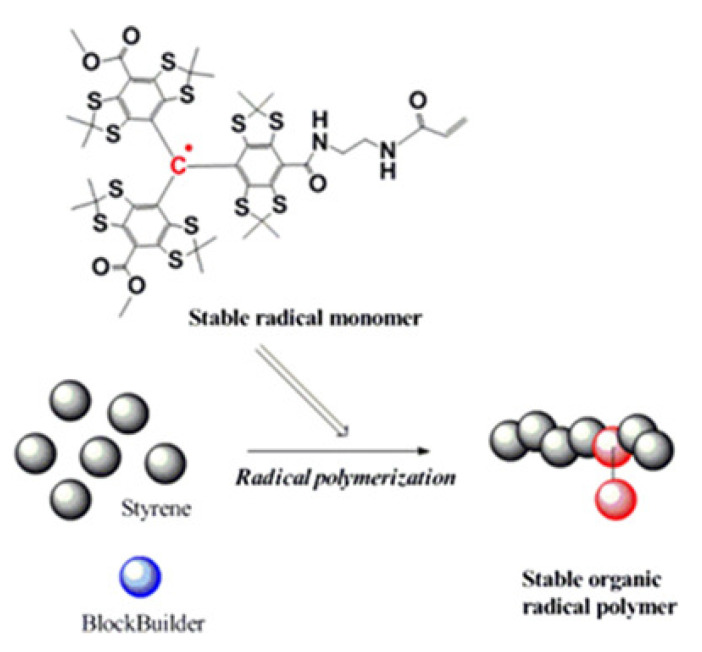
Preparation of stable organic radical polymer (SORP) using conventional radical polymerization and NMP. Reprinted with the permission of Wiley from ref. [78].
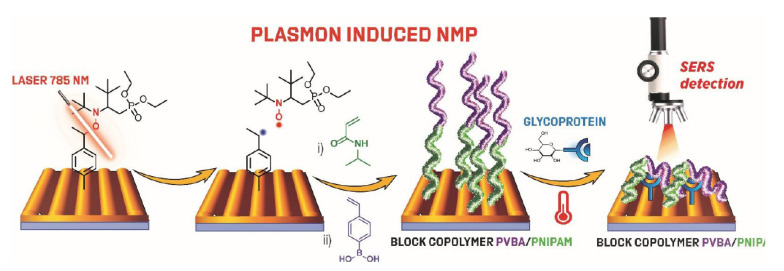
Scheme for plasmon-initiated NMP (PI-NMP). Reprinted with the permission of RSC from ref. [102].
References
-
- Jones L.W., Major R.T. Substituted O-alkyl hydroxylamines chemically related to medicinally valuable amines. J. Am. Chem. Soc. 1927;49:1527–1540. doi: 10.1021/ja01405a021. - DOI
-
- Kovtun G.A., Aleksandrov A.L., Golubev V.A. Interaction of Peroxide Radicals with Esters of Hydroxylamines. Russ. Chem. Bull. 1974;23:2115–2121. doi: 10.1007/BF00921266. Izv. Akad. Nauk SSSR, Ser. Khim.1974, 2197–2203. - DOI
-
- Solomon D.H., Rizzardo E., Cacioli P. Polymerization Process and Polymers Produced Thereby. 4,581,429. U.S. Patent. 1986 Aug 4
-
- Matyjaszewski K. Controlled Radical Polymerization. Current Opin. Solid State Materials Sci. 1996;1996. 1:769–776. doi: 10.1016/S1359-0286(96)80101-X. - DOI
Publication types
Grants and funding
LinkOut - more resources
Full Text Sources
Research Materials
Miscellaneous
