


Epidemiological trends of head and neck Cancer survivors in Alberta: towards improved understanding of the burden of disease
- PMID: 32631452
- PMCID: PMC7339434
- DOI: 10.1186/s40463-020-00443-4
Epidemiological trends of head and neck Cancer survivors in Alberta: towards improved understanding of the burden of disease
Abstract
Background: With an increase in the incidence of human papillomavirus (HPV)-associated oropharyngeal squamous cell carcinoma (OPSCC) and more favourable survival outcomes, there is now a population of head and neck cancer survivors that are different from preceding decades. In addition, their long-term survivorship issues have become increasing research interests. This study was undertaken to determine the changing epidemiological trends of head and neck cancer survivors in Alberta to better anticipate future demands on healthcare services.
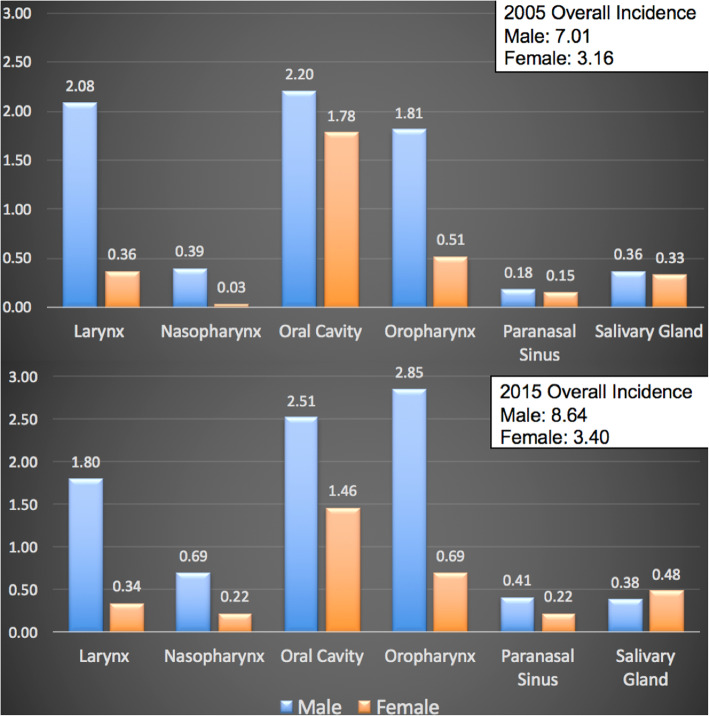
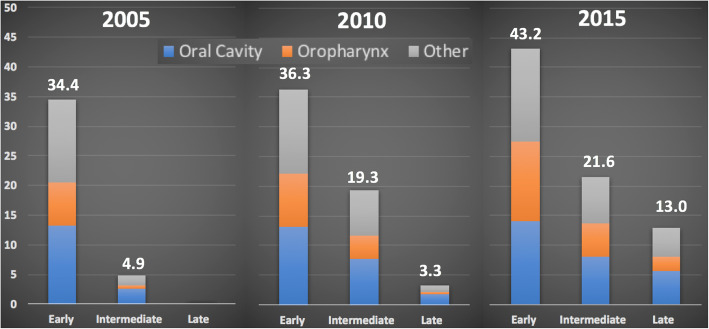
Methods: The Alberta Cancer Registry was queried for adult (aged > 18 years), head and neck cancer (HNC) patients who were at least 1-year post-treatment completion between 1997 to 2016. Cutaneous head and neck and thyroid cancer patients were excluded. Extracted data was then used to calculate the incidence and prevalence of early (< 5 years from treatment), intermediate (5 to < 10 years from treatment), and late (> 10 years from treatment) survivors of head and neck cancer. Point prevalence of HNC survivors in 2005, 2010, and 2015 were then further stratified by gender, sub-site and age.
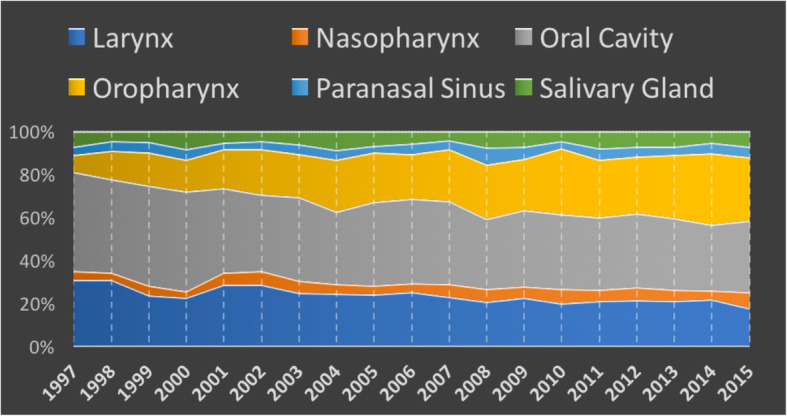
Results: Over this time period, head and neck cancer survivors tended to be younger (64.0 vs. 62.1, p = 0.046) and male (M:F 2.45:1 vs 2.54:1). In 1997, the predominant subsites were the oral cavity and larynx at 45.8% and 30.9%, respectively. In 2015 the predominant subsites were the oral cavity and oropharynx at 33.0% and 29.4%, respectively. Within the cohort, the prevalence of late HNC survivors increased to 13.3 per 100,000 people in 2015.
Conclusions: There is a significant population of head and neck survivors who are younger, male, and more than 10 years post-treatment. While oral cavity cancers have shown stable disease prevalence in recent decades, the number of OPSCC survivors have increased. With an improved understanding of the distribution and characteristics of HNC survivors, a more guided healthcare support network can be fostered for these patients.
Keywords: Alberta; Canada; Demographics; Epidemiology; Head and neck Cancer; Survivors; Survivorship.
Conflict of interest statement
None of the authors have any conflicts of interest to declare.
Figures
References
-
- Habbous S, Chu KP, Qiu X, La Delfa A, Harland LT, Fadhel E, et al. The changing incidence of human papillomavirus-associated oropharyngeal cancer using multiple imputation from 2000 to 2010 at a comprehensive Cancer Centre. Cancer Epidemiol. 2013;37:820–829. doi: 10.1016/j.canep.2013.09.011. - DOI - PubMed
-
- Global Burden of Disease Cancer Collaboration. Fitzmaurice C, Allen C, Barber RM, Barregard L, Bhutta ZA, et al. Global, Regional, and National Cancer Incidence, Mortality, Years of Life Lost, Years Lived With Disability, and Disability-Adjusted Life-years for 32 Cancer Groups, 1990 to 2015: A Systematic Analysis for the Global Burden of Disease Study. JAMA Oncol. 2017;3:524–548. doi: 10.1001/jamaoncol.2016.5688. - DOI - PMC - PubMed
MeSH terms
LinkOut - more resources
Full Text Sources
Medical
