


Concerns for low-resource countries, with under-prepared intensive care units, facing the COVID-19 pandemic
- PMID: 32631682
- PMCID: PMC7274573
- DOI: 10.1016/j.idh.2020.05.008
Concerns for low-resource countries, with under-prepared intensive care units, facing the COVID-19 pandemic
Abstract
Background: Low-resource countries with fragile healthcare systems lack trained healthcare professionals and specialized resources for COVID-19 patient hospitalization, including mechanical ventilators. Additional socio-economic complications such as civil war and financial crisis in Libya and other low-resource countries further complicate healthcare delivery.
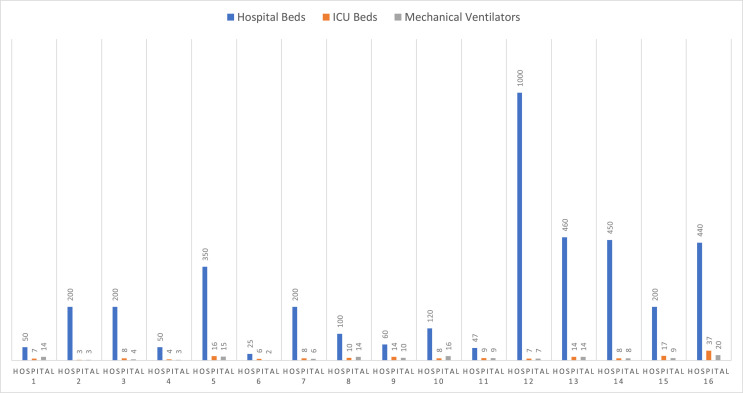
Methods: A cross-sectional survey evaluating hospital and intensive care unit's capacity and readiness was performed from 16 leading Libyan hospitals in March 2020. In addition, a survey was conducted among 400 doctors who worked in these hospitals to evaluate the status of personal protective equipment.
Results: Out of 16 hospitals, the highest hospital capacity was 1000 in-patient beds, while the lowest was 25 beds with a median of 200 (IQR 52-417, range 25-1000) hospital beds. However, a median of only eight (IQR 6-14, range 3-37) available functioning ICU beds were reported in these hospitals. Only 9 (IQR 4.5-14, range 2-20) mechanical ventilators were reported and none of the hospitals had a reverse transcription-polymerase chain reaction machine for COVID-19 testing. Moreover, they relied on one of two central laboratories located in major cities. Our PPE survey revealed that 56.7% hospitals lacked PPE and 53% of healthcare workers reported that they did not receive proper PPE training. In addition, 70% reported that they were buying the PPE themselves as hospitals did not provide them.
Conclusion: This study provides an alarming overview of the unpreparedness of Libyan hospitals for detecting and treating patients with COVID-19 and limiting the spread of the pandemic.
Keywords: COVID-19; Intensive care units; Outbreak; Pandemic; Personal protective equipment; SARS-CoV-2.
Copyright © 2020 Australasian College for Infection Prevention and Control. Published by Elsevier B.V. All rights reserved.
Figures
References
-
- Organization WH . WHO; 2020. Director-General's remarks at the media briefing on 2019-nCoV on 11 February 2020.
MeSH terms
LinkOut - more resources
Full Text Sources
Miscellaneous
