. 2020 Jul 21;117(29):16824-16830.
doi: 10.1073/pnas.2002918117. Epub 2020 Jul 6.

Calibrating the coevolution of Ediacaran life and environment

Affiliations

Calibrating the coevolution of Ediacaran life and environment

Alan D Rooney et al. Proc Natl Acad Sci U S A. .

Abstract

The rise of animals occurred during an interval of Earth history that witnessed dynamic marine redox conditions, potentially rapid plate motions, and uniquely large perturbations to global biogeochemical cycles. The largest of these perturbations, the Shuram carbon isotope excursion, has been invoked as a driving mechanism for Ediacaran environmental change, possibly linked with evolutionary innovation or extinction. However, there are a number of controversies surrounding the Shuram, including its timing, duration, and role in the concomitant biological and biogeochemical upheavals. Here we present radioisotopic dates bracketing the Shuram on two separate paleocontinents; our results are consistent with a global and synchronous event between 574.0 ± 4.7 and 567.3 ± 3.0 Ma. These dates support the interpretation that the Shuram is a primary and synchronous event postdating the Gaskiers glaciation. In addition, our Re-Os ages suggest that the appearance of Ediacaran macrofossils in northwestern Canada is identical, within uncertainty, to similar macrofossils from the Conception Group of Newfoundland, highlighting the coeval appearance of macroscopic metazoans across two paleocontinents. Our temporal framework for the terminal Proterozoic is a critical step for testing hypotheses related to extreme carbon isotope excursions and their role in the evolution of complex life.

Keywords: Ediacaran; Neoproterozoic; Re-Os geochronology; Shuram; carbon isotopes.


Conflict of interest statement

The authors declare no competing interest.

Figures
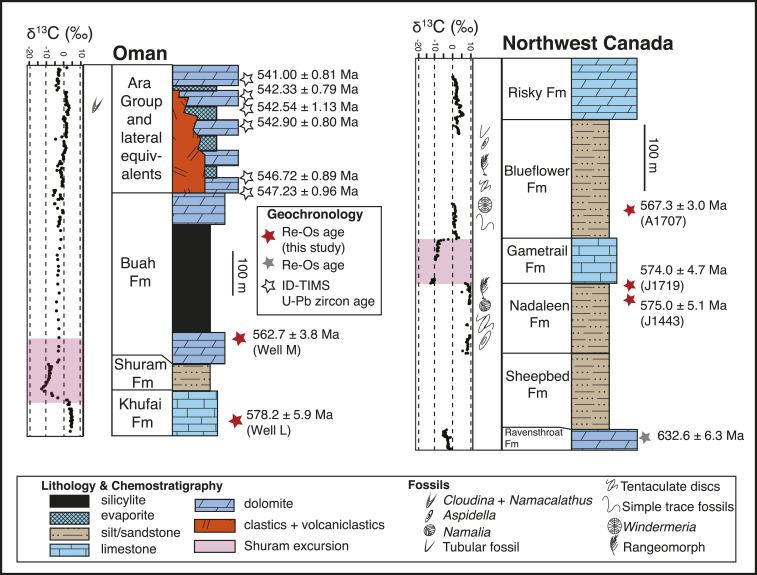
Fig. 1.
Fig. 1.
Simplified stratigraphy and chemostratigraphy of Ediacaran sedimentary rocks in northwestern Canada and Oman. Sampled horizons indicated with stars and compilation of carbon isotope data are in SI Appendix, Table S1. Previously published geochronological constraints are from U-Pb zircon ages on ash beds (21) and Re-Os ages on organic-rich sedimentary rocks (22). Fm, Formation.
Fig. 2.
Fig. 2.
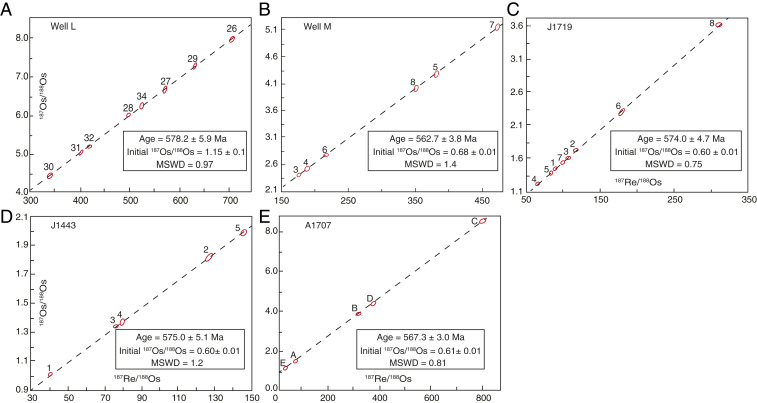
Re-Os isochron diagrams for dated horizons. (A) Well L: Khufai Formation, Oman. (B) Well M: Buah Formation, Oman. (C) J1719: Nadaleen Formation, Wernecke Mountains, Yukon. (D) J1443: Nadaleen Formation, Wernecke Mountains, Yukon. (E) A1707: unit PH4, Ogilvie Mountains, Yukon. All isotopic composition and elemental abundance data are presented in SI Appendix, Table S2.
Fig. 3.
Fig. 3.
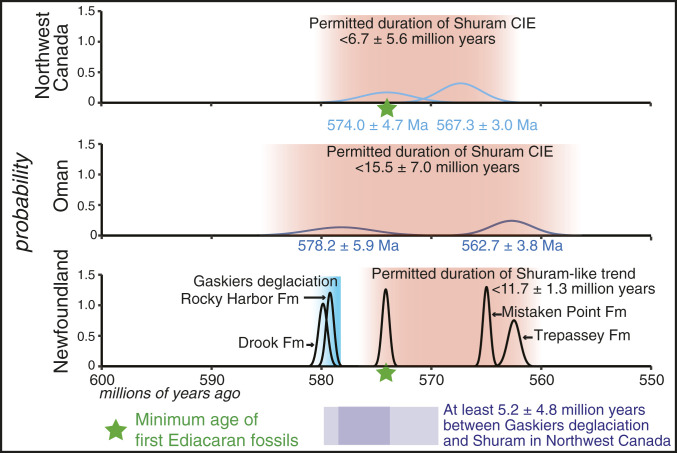
Probability distributions of ages from this study and others (17, 51, 52) (note use of age from ref. for the Pizza Disc ash bed used both as 1) the minimum age of the first Ediacara biota preserved in Newfoundland and 2) the maximum age of the Shuram-like isotope trend described by ref. 51). The minimum duration of the Shuram CIE or Shuram-like isotope trend in each location is shown. Assuming a synchronous global Shuram CIE, the preonset age (574.0 ± 4.7 Ma) from northwestern Canada suggests at least 5.2 ± 4.8 My between Gaskiers deglaciation and the onset of the CIE. This is supported by a recently observed isotope trend in siliciclastic-hosted carbonate in Newfoundland (51), which may be correlative to the Shuram CIE and is stratigraphically and geochronologically distinct from the Gaskiers deglaciation. An ash in the Trepassey Formation (Fm) above this trend constrains it to >562.5 ± 1.1 Ma (51); an ash within the Mistaken Point Fm, associated with negative values, is dated to 565.00 ± 0.64 Ma (52). Ages in blue are Re-Os ages from organic-rich rocks (this study); all others are chemical abrasion–isotope dilution–thermal ionization mass spectrometry U-Pb ages measured on zircon (17, 51, 52).
Fig. 4.
Fig. 4.
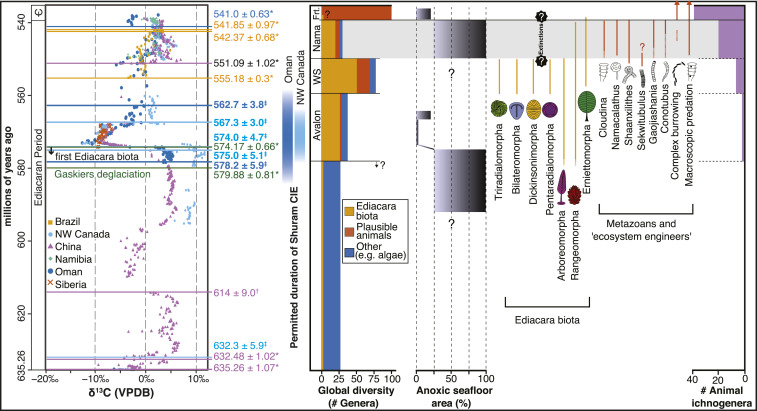
Composite carbon isotope curve, age constraints, and fossil occurrences for the Ediacaran Period. References used for carbon isotope curve and age model are listed in the SI Appendix. *, U-Pb TIMS zircon date; †, U-Pb SHRIMP zircon date; ‡ indicates Re-Os date. The same color is used to plot both ages and chemostratigraphic data from the same location; dark green ages are from Newfoundland. Dates in bold are Re-Os ages from this study; bolded dark blue ages are from Oman, and bolded light blue ages are from northwestern Canada. Global diversity, ranges of Ediacara biota constituents, and animal ichnogenera follow (18). Percent anoxic seafloor area derived from mass balance modeling of Mo and U isotopic data are from refs. , . WS, White Sea; Frt., Fortunian; £, Cambrian.

References

    1. Erwin D. H. et al., The Cambrian conundrum: Early divergence and later ecological success in the early history of animals. Science 334, 1091–1097 (2011). - PubMed
    1. Hoffman P. F. et al., Snowball Earth climate dynamics and Cryogenian geology-geobiology. Sci. Adv. 3, e1600983 (2017). - PMC - PubMed
    1. Fike D. A., Grotzinger J. P., Pratt L. M., Summons R. E., Oxidation of the Ediacaran ocean. Nature 444, 744–747 (2006). - PubMed
    1. Sahoo S. K. et al., Oceanic oxygenation events in the anoxic Ediacaran ocean. Geobiology 14, 457–468 (2016). - PubMed
    1. McFadden K. A. et al., Pulsed oxidation and biological evolution in the Ediacaran Doushantuo Formation. Proc. Natl. Acad. Sci. U.S.A. 105, 3197–3202 (2008). - PMC - PubMed

Publication types

LinkOut - more resources