


How frequency hopping suppresses pulse-echo ambiguity in bat biosonar
- PMID: 32632013
- PMCID: PMC7382275
- DOI: 10.1073/pnas.2001105117
How frequency hopping suppresses pulse-echo ambiguity in bat biosonar
Abstract
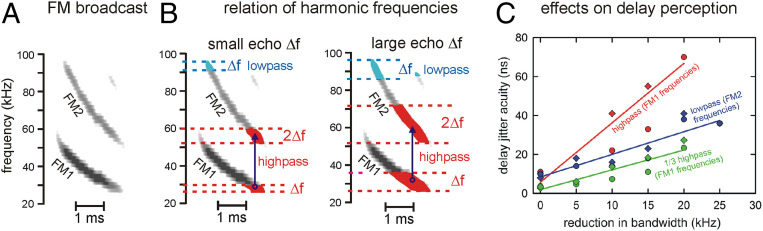
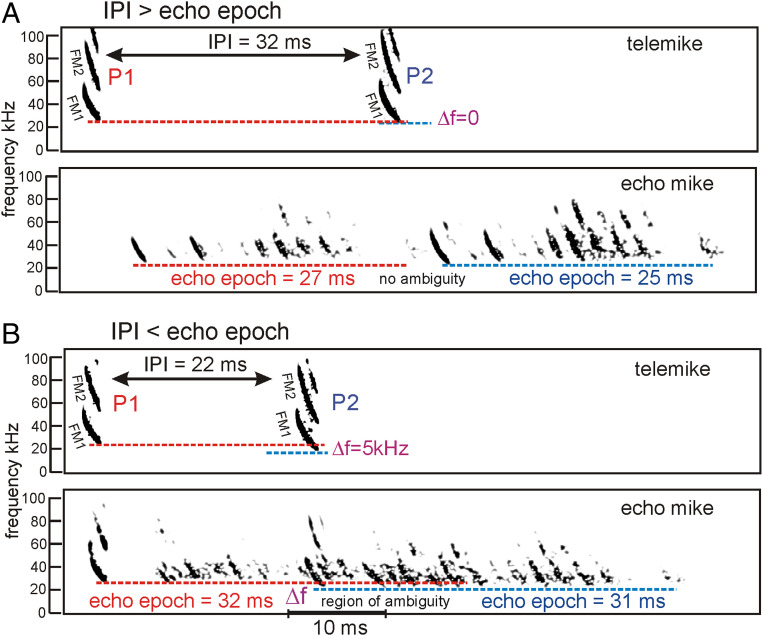
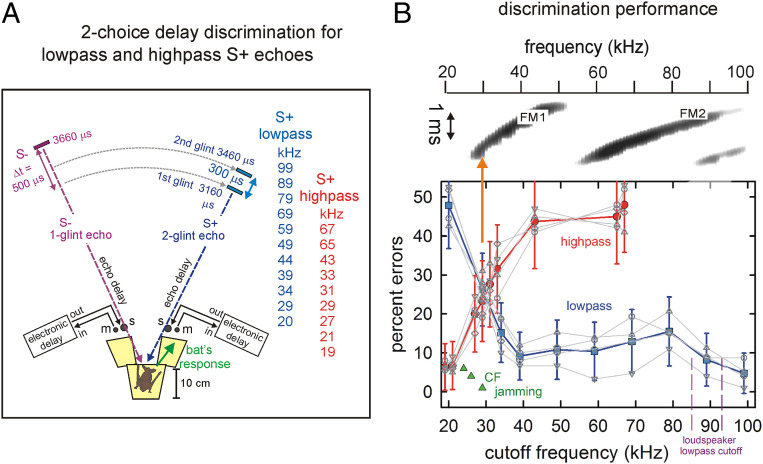
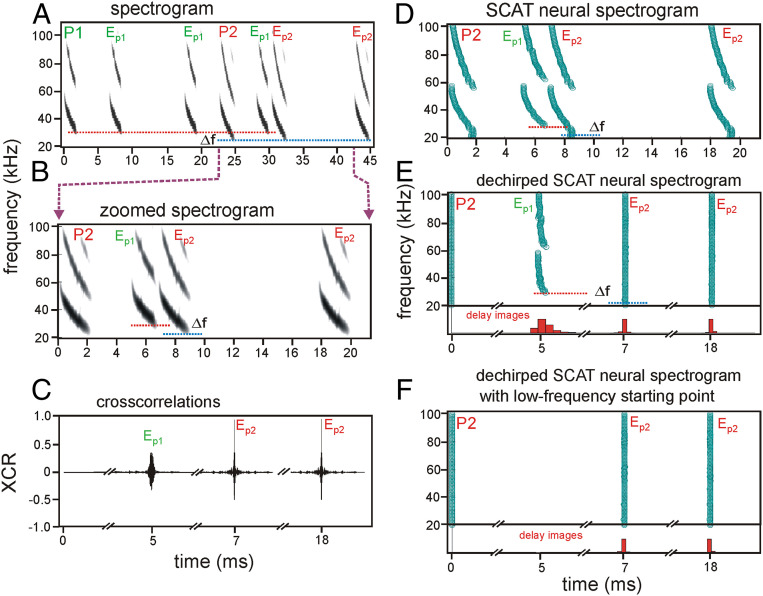
Big brown bats transmit wideband FM biosonar sounds that sweep from 55 to 25 kHz (first harmonic, FM1) and from 110 to 50 kHz (second harmonic, FM2). FM1 is required to perceive echo delay for target ranging; FM2 contributes only if corresponding FM1 frequencies are present. We show that echoes need only the lowest FM1 broadcast frequencies of 25 to 30 kHz for delay perception. If these frequencies are removed, no delay is perceived. Bats begin echo processing at the lowest frequencies and accumulate perceptual acuity over successively higher frequencies, but they cannot proceed without the low-frequency starting point in their broadcasts. This reveals a solution to pulse-echo ambiguity, a serious problem for radar or sonar. In dense, extended biosonar scenes, bats have to emit sounds rapidly to avoid collisions with near objects. But if a new broadcast is emitted when echoes of the previous broadcast still are arriving, echoes from both broadcasts intermingle, creating ambiguity about which echo corresponds to which broadcast. Frequency hopping by several kilohertz from one broadcast to the next can segregate overlapping narrowband echo streams, but wideband FM echoes ordinarily do not segregate because their spectra still overlap. By starting echo processing at the lowest frequencies in frequency-hopped broadcasts, echoes of the higher hopped broadcast are prevented from being accepted by lower hopped broadcasts, and ambiguity is avoided. The bat-inspired spectrogram correlation and transformation (SCAT) model also begins at the lowest frequencies; echoes that lack them are eliminated from processing of delay and no longer cause ambiguity.
Keywords: bat biosonar; clutter suppression; echo ambiguity; echolocation; sonar image.
Copyright © 2020 the Author(s). Published by PNAS.
Conflict of interest statement
The authors declare no competing interest.
Figures
References
-
- Kurta A., Baker R. H., Eptesicus fuscus. Mamm. Species 356, 1–10 (1990).
-
- Griffin D. R., Listening in the Dark, (Yale University Press, New Haven, CT, 1958).
-
- Neuweiler G., Biology of Bats, (Oxford University Press, Oxford, UK, 2000).
-
- Fenton M. B., Grinnell A. D., Popper A. N., Eds., Bat Bioacoustics, (Springer, New York, 2016).
-
- Clare E. L., Symondson W. O. C., Fenton M. B., An inordinate fondness for beatles? Variation in seasonal dietary preferences of night-roosting big brown bats (Eptesicus fuscus). Mol. Ecol. 23, 3633–3647 (2014). - PubMed
Publication types
MeSH terms
LinkOut - more resources
Full Text Sources
