


Association of Statin Use With All-Cause and Cardiovascular Mortality in US Veterans 75 Years and Older
- PMID: 32633800
- PMCID: PMC7341181
- DOI: 10.1001/jama.2020.7848
Association of Statin Use With All-Cause and Cardiovascular Mortality in US Veterans 75 Years and Older
Erratum in
-
Incorrect Information in Text and Table Heading.JAMA. 2020 Oct 13;324(14):1468. doi: 10.1001/jama.2020.18585. JAMA. 2020. PMID: 33048140 Free PMC article. No abstract available.
Abstract
Importance: Data are limited regarding statin therapy for primary prevention of atherosclerotic cardiovascular disease (ASCVD) in adults 75 years and older.
Objective: To evaluate the role of statin use for mortality and primary prevention of ASCVD in veterans 75 years and older.
Design, setting, and participants: Retrospective cohort study that used Veterans Health Administration (VHA) data on adults 75 years and older, free of ASCVD, and with a clinical visit in 2002-2012. Follow-up continued through December 31, 2016. All data were linked to Medicare and Medicaid claims and pharmaceutical data. A new-user design was used, excluding those with any prior statin use. Cox proportional hazards models were fit to evaluate the association of statin use with outcomes. Analyses were conducted using propensity score overlap weighting to balance baseline characteristics.
Exposures: Any new statin prescription.
Main outcomes and measures: The primary outcomes were all-cause and cardiovascular mortality. Secondary outcomes included a composite of ASCVD events (myocardial infarction, ischemic stroke, and revascularization with coronary artery bypass graft surgery or percutaneous coronary intervention).
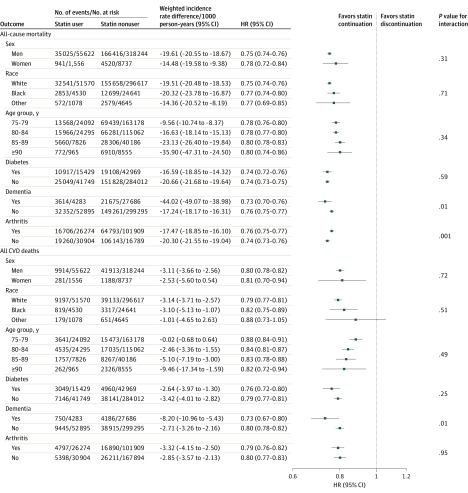
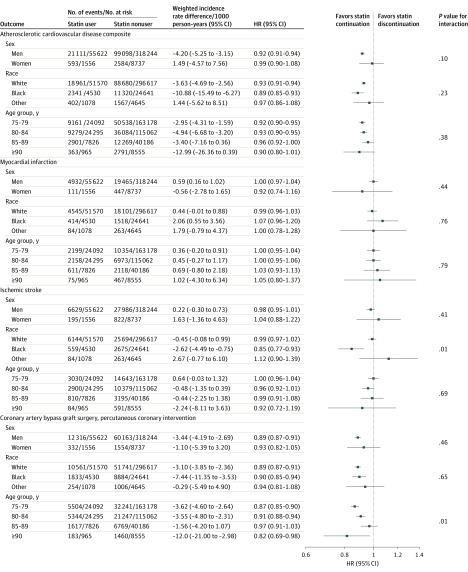
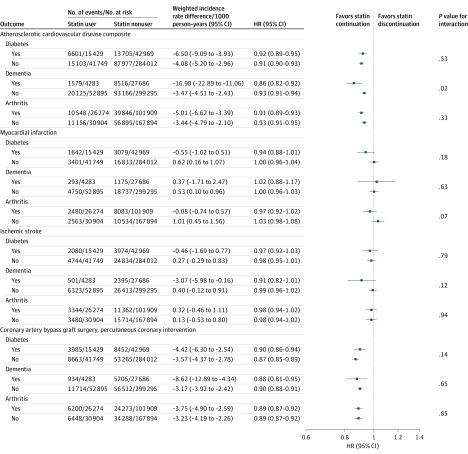
Results: Of 326 981 eligible veterans (mean [SD] age, 81.1 [4.1] years; 97% men; 91% white), 57 178 (17.5%) newly initiated statins during the study period. During a mean follow-up of 6.8 (SD, 3.9) years, a total 206 902 deaths occurred including 53 296 cardiovascular deaths, with 78.7 and 98.2 total deaths/1000 person-years among statin users and nonusers, respectively (weighted incidence rate difference [IRD]/1000 person-years, -19.5 [95% CI, -20.4 to -18.5]). There were 22.6 and 25.7 cardiovascular deaths per 1000 person-years among statin users and nonusers, respectively (weighted IRD/1000 person-years, -3.1 [95 CI, -3.6 to -2.6]). For the composite ASCVD outcome there were 123 379 events, with 66.3 and 70.4 events/1000 person-years among statin users and nonusers, respectively (weighted IRD/1000 person-years, -4.1 [95% CI, -5.1 to -3.0]). After propensity score overlap weighting was applied, the hazard ratio was 0.75 (95% CI, 0.74-0.76) for all-cause mortality, 0.80 (95% CI, 0.78-0.81) for cardiovascular mortality, and 0.92 (95% CI, 0.91-0.94) for a composite of ASCVD events when comparing statin users with nonusers.
Conclusions and relevance: Among US veterans 75 years and older and free of ASCVD at baseline, new statin use was significantly associated with a lower risk of all-cause and cardiovascular mortality. Further research, including from randomized clinical trials, is needed to more definitively determine the role of statin therapy in older adults for primary prevention of ASCVD.
Conflict of interest statement
Figures
Comment in
-
Statins for Primary Prevention in the Elderly: The Importance of Rigorous Evidence.JAMA. 2020 Jul 7;324(1):45-46. doi: 10.1001/jama.2020.8390. JAMA. 2020. PMID: 32633787 No abstract available.
-
Statine nutzen auch gesunden Alten : Kardiovaskuläres Risiko.MMW Fortschr Med. 2020 Sep;162(15):27. doi: 10.1007/s15006-020-4350-7. MMW Fortschr Med. 2020. PMID: 32895819 Review. German. No abstract available.
-
New Statin Use and Mortality in Older Veterans.JAMA. 2020 Nov 10;324(18):1907. doi: 10.1001/jama.2020.19009. JAMA. 2020. PMID: 33170234 No abstract available.
-
New Statin Use and Mortality in Older Veterans.JAMA. 2020 Nov 10;324(18):1907-1908. doi: 10.1001/jama.2020.19012. JAMA. 2020. PMID: 33170235 No abstract available.
-
New Statin Use and Mortality in Older Veterans.JAMA. 2020 Nov 10;324(18):1908. doi: 10.1001/jama.2020.19015. JAMA. 2020. PMID: 33170236 No abstract available.
References
-
- Ortman JM, Velkoff VA, Hoga H An Aging Nation: The Older Population in the United States: Population Estimates and Projections. Published May 2014. Accessed March 30, 2020. https://www.census.gov/prod/2014pubs/p25-1140.pdf
-
- Benjamin EJ, Blaha MJ, Chiuve SE, et al. ; American Heart Association Statistics Committee and Stroke Statistics Subcommittee . Heart disease and stroke statistics—2017 update: a report from the American Heart Association. Circulation. 2017;135(10):e146-e603. doi:10.1161/CIR.0000000000000485 - DOI - PMC - PubMed
-
- Alexander KP, Newby LK, Cannon CP, et al. ; American Heart Association Council on Clinical Cardiology; Society of Geriatric Cardiology . Acute coronary care in the elderly, part I: non-ST-segment-elevation acute coronary syndromes: a scientific statement for healthcare professionals from the American Heart Association Council on Clinical Cardiology: in collaboration with the Society of Geriatric Cardiology. Circulation. 2007;115(19):2549-2569. doi:10.1161/CIRCULATIONAHA.107.182615 - DOI - PubMed
-
- Arnett DK, Blumenthal RS, Albert MA, et al. . 2019 ACC/AHA guideline on the primary prevention of cardiovascular disease: a report of the American College of Cardiology/American Heart Association Task Force on Clinical Practice Guidelines. Circulation. 2019;140(11):e596-e646. doi:10.1161/CIR.0000000000000678 - DOI - PMC - PubMed
Publication types
MeSH terms
Substances
Grants and funding
LinkOut - more resources
Full Text Sources
Other Literature Sources
Medical
