


Age-Specific Acute Changes in Carotid-Femoral Pulse Wave Velocity With Head-up Tilt
- PMID: 32634245
- PMCID: PMC7814224
- DOI: 10.1093/ajh/hpaa101
Age-Specific Acute Changes in Carotid-Femoral Pulse Wave Velocity With Head-up Tilt
Abstract
Background: Aortic stiffness as measured by carotid-femoral pulse wave velocity (cfPWV) is known to depend on blood pressure (BP), and this dependency may change with age. Therefore, the hydrostatic BP gradient resulting from a change in body posture may elicit a cfPWV change that is age-dependent. We aimed to analyze the relationship between BP gradient-induced by head-up body tilting-and related changes in cfPWV in individuals of varying age.
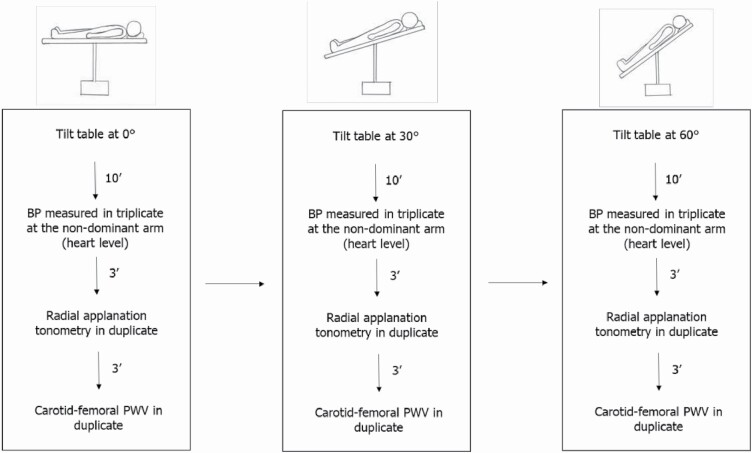
Methods: cfPWV and other hemodynamic parameters were measured in 30 healthy individuals at a head-up tilt of 0° (supine), 30°, and 60°. At each angle, the PWV gradient and resulting cfPWV were also estimated (predicted) by assuming a global nonlinear, exponential, pressure-diameter relationship characterized by a constant β0, and taking into account that (diastolic) foot-to-foot cfPWV acutely depends on diastolic BP.
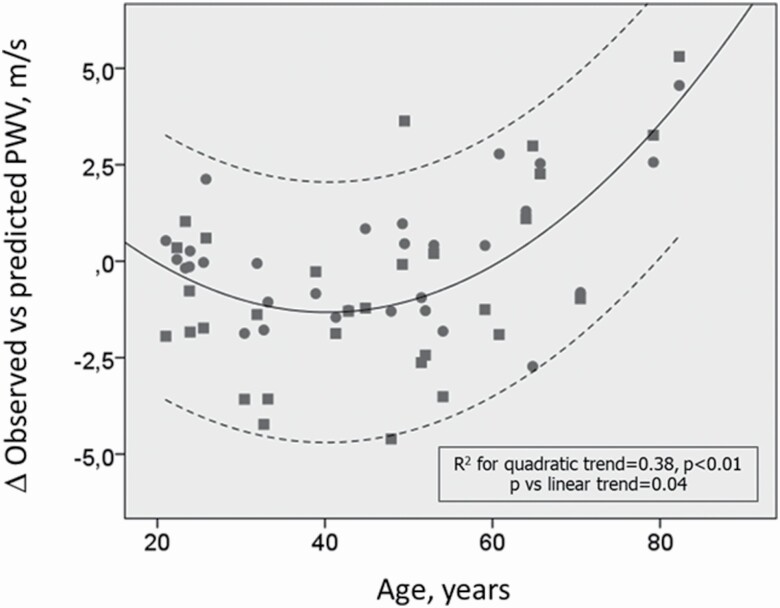
Results: cfPWV significantly increased upon body tilting (8.0 ± 2.0 m/s supine, 9.1 ± 2.6 m/s at 30°, 9.5 ± 3.2 m/s at 60°, P for trend <0.01); a positive trend was also observed for heart rate (HR; P < 0.01). When the observed, tilt-induced cfPWV change measured by applanation tonometry was compared with that predicted from the estimated BP hydrostatic gradient, the difference in observed-vs.-predicted PWV change increased nonlinearly as a function of age (R2 for quadratic trend = 0.38, P < 0.01, P vs. linear = 0.04). This result was unaffected by HR tilt-related variations (R2 for quadratic trend = 0.37, P < 0.01, P vs. linear = 0.04).
Conclusions: Under a hydrostatic pressure gradient, the pulse wave traveling along the aorta undergoes an age-related, nonlinear PWV increase exceeding the increase predicted from BP dependency.
Keywords: arterial function; arterial stiffness; blood pressure; early vascular aging; hypertension; pressure dependence.
© The Author(s) 2020. Published by Oxford University Press on behalf of American Journal of Hypertension, Ltd.
Figures

Comment in
-
Dynamic Pulse Wave Velocity Response to Hydrostatic Blood Pressure Gradient: A Pressure-Independent Marker of Vascular Aging?Am J Hypertens. 2020 Dec 31;33(12):1075-1077. doi: 10.1093/ajh/hpaa127. Am J Hypertens. 2020. PMID: 32750109 No abstract available.
References
-
- O’Rourke MF, Hashimoto J. Mechanical factors in arterial aging: a clinical perspective. J Am Coll Cardiol 2007; 50:1–13. - PubMed
-
- Spronck B, Heusinkveld MH, Donders WP, de Lepper AG, Op’t Roodt J, Kroon AA, Delhaas T, Reesink KD. A constitutive modeling interpretation of the relationship among carotid artery stiffness, blood pressure, and age in hypertensive subjects. Am J Physiol Heart Circ Physiol 2015; 308:H568–H582. - PubMed
-
- Hayashi K, Handa H, Nagasawa S, Okumura A, Moritake K. Stiffness and elastic behavior of human intracranial and extracranial arteries. J Biomech 1980; 13:175–184. - PubMed
-
- Kawasaki T, Sasayama S, Yagi S, Asakawa T, Hirai T. Non-invasive assessment of the age related changes in stiffness of major branches of the human arteries. Cardiovasc Res 1987; 21:678–687. - PubMed
-
- Shirai K, Utino J, Otsuka K, Takata M. A novel blood pressure-independent arterial wall stiffness parameter; cardio-ankle vascular index (CAVI). J Atheroscler Thromb 2006; 13:101–107. - PubMed
Publication types
MeSH terms
LinkOut - more resources
Full Text Sources
Medical
