. 2020 Jul 3;11(7):744.
doi: 10.3390/genes11070744.

Genomic Comparison of Insect Gut Symbionts from Divergent Burkholderia Subclades

Affiliations

Genomic Comparison of Insect Gut Symbionts from Divergent Burkholderia Subclades

Kazutaka Takeshita et al. Genes (Basel). .

Abstract

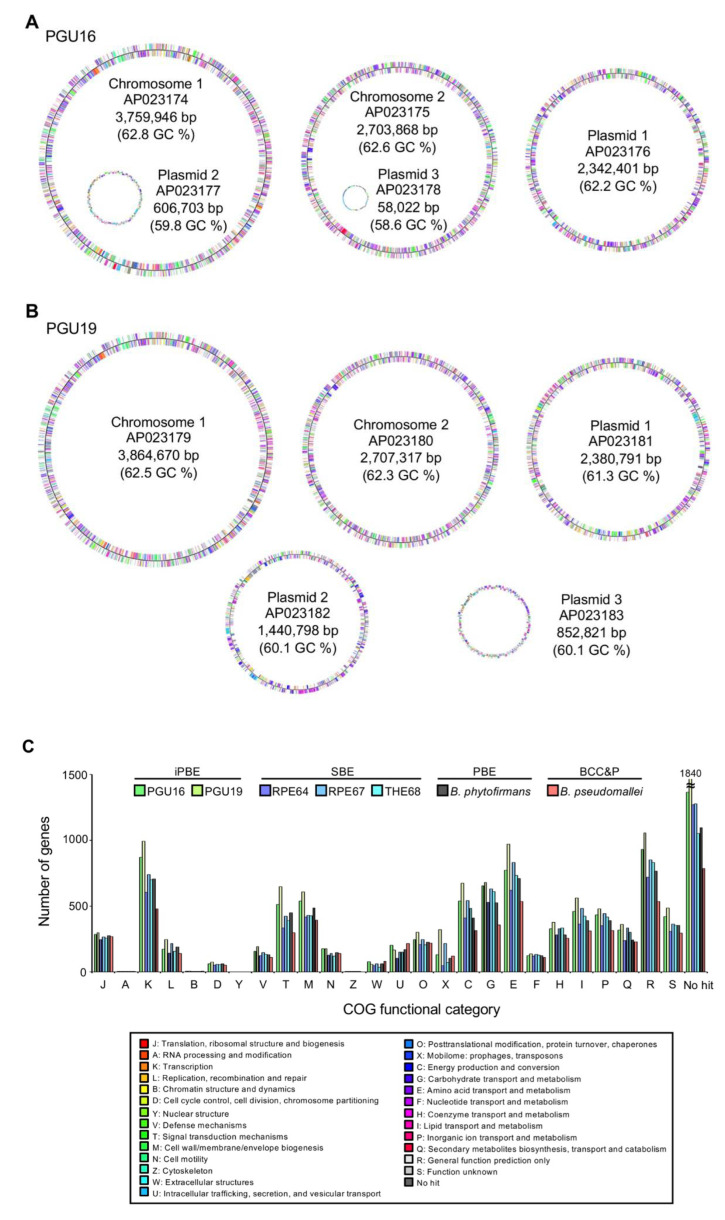
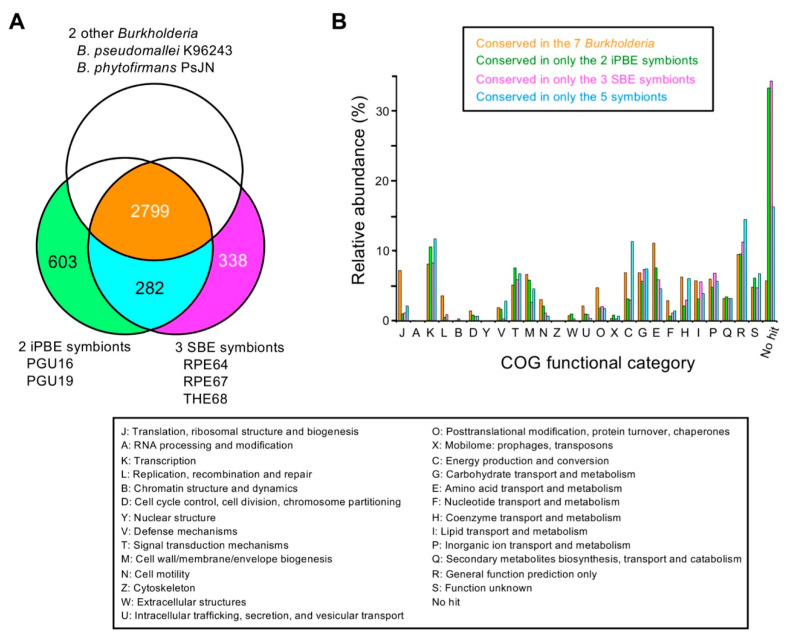
Stink bugs of the superfamilies Coreoidea and Lygaeoidea establish gut symbioses with environmentally acquired bacteria of the genus Burkholderia sensu lato. In the genus Burkholderia, the stink bug-associated strains form a monophyletic clade, named stink bug-associated beneficial and environmental (SBE) clade (or Caballeronia). Recently, we revealed that members of the family Largidae of the superfamily Pyrrhocoroidea are associated with Burkholderia but not specifically with the SBE Burkholderia; largid bugs harbor symbionts that belong to a clade of plant-associated group of Burkholderia, called plant-associated beneficial and environmental (PBE) clade (or Paraburkholderia). To understand the genomic features of Burkholderia symbionts of stink bugs, we isolated two symbiotic Burkholderia strains from a bordered plant bug Physopellta gutta (Pyrrhocoroidea: Largidae) and determined their complete genomes. The genome sizes of the insect-associated PBE (iPBE) are 9.5 Mb and 11.2 Mb, both of which are larger than the genomes of the SBE Burkholderia symbionts. A whole-genome comparison between two iPBE symbionts and three SBE symbionts highlighted that all previously reported symbiosis factors are shared and that 282 genes are specifically conserved in the five stink bug symbionts, over one-third of which have unknown function. Among the symbiont-specific genes, about 40 genes formed a cluster in all five symbionts; this suggests a "symbiotic island" in the genome of stink bug-associated Burkholderia.

Keywords: Burkholderia; bordered plant bugs; comparative genomics; environmental acquisition; evolution; gut symbiosis; insect-microbe interaction; stink bugs.


Conflict of interest statement

The authors declare no conflict of interest.

Figures
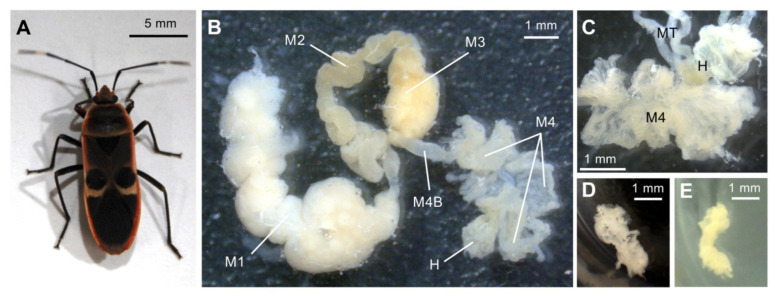
Figure 1
Figure 1
The symbiont-harboring midgut crypts of Physopelta gutta. (A) An adult female P. gutta. (B) The dissected midgut of an adult female P. gutta. The Burkholderia symbiont is specifically localized in the 4th section of the crypt-bearing midgut [31]. (C) An enlarged image of the M4 section. (D,E) Pre-culture of the midgut crypts in yeast-glucose medium. The midgut crypts before pre-culture (D) and after two days of pre-culture (E). After pre-culture, the crypts became cloudy due to the bacterial growth inside the crypts. Bacterial growth was also observed outside the crypts. M1, midgut 1st section; M2, midgut 2nd section; M3, midgut 3rd section; M4, midgut 4th section; M4B, M4 bulb; MT, malpighian tubule; H, hindgut.
Figure 2
Figure 2
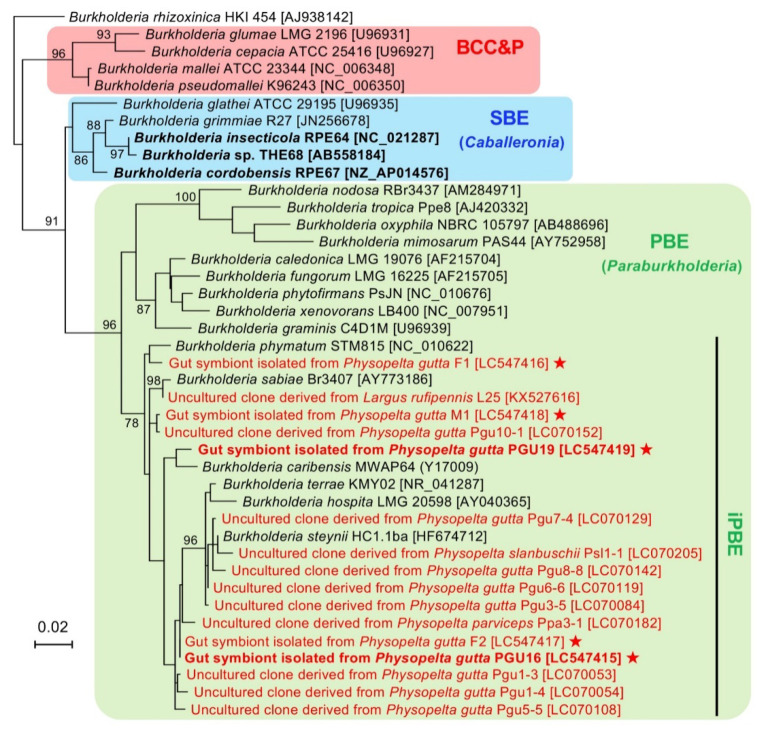
Molecular phylogeny of the Burkholderia symbionts isolated from P. gutta based on 16S rRNA gene. The tree shows an ML phylogeny of the five isolates and related species/clones of the genus Burkholderia sensu lato. The multiple sequence alignment of 1320 nucleotide sites of the bacterial 16S rRNA gene was analyzed. Accession numbers in the DDBJ/EMBL/GenBank DNA database are shown in square brackets. The isolates and uncultured clones of symbiotic Burkholderia derived from largid stink bugs are shown in red. Stars indicate the isolates reported in this study. Bold indicates the Burkholderia symbionts of stink bugs with complete genome sequences. Bootstrap support values higher than 70% are shown on the internal branches. BCC&P, Burkholderia cepacia complex and Burkholderia pseudomallei clade; SBE, stink bug-associated beneficial and environmental clade; PBE, plant-associated beneficial and environmental clade; iPBE, insect-associated PBE clade.
Figure 3
Figure 3
Complete genomes of the isolated iPBE Burkholderia symbionts. Circular visualization of the genomes of Burkholderia sp. strain PGU16 (A) and Burkholderia sp. strain PGU19 (B). Colors indicate the Clusters of Orthologous Group (COG) functional categories of the genes on the genomes. (C) The number of genes classified into each COG functional category in the five symbionts of stink bugs, Burkholderia phytofirmans PsJN and B. pseudomallei K96243. A gene may be classified into two or more categories; therefore, the sum of numbers here might be different from the total number of genes in a genome. The description of each COG category is shown in the bottom. “No hit” indicates no homologous sequence was detected in the COG database with blastp.
Figure 4
Figure 4
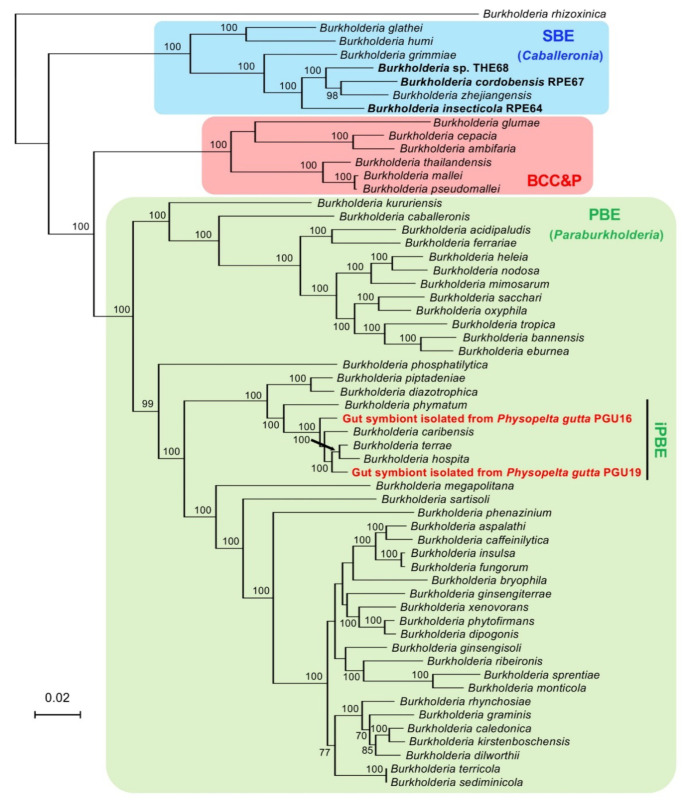
Genome-based molecular phylogeny of the Burkholderia symbionts isolated from P. gutta. The tree shows an ML phylogeny of the two isolates and related species of the genus Burkholderia sensu lato. The multiple sequence alignment of 22,112 amino acids of the 70 UBCGs was analyzed. Accession numbers in the DDBJ/EMBL/GenBank DNA database are shown in Table S2. Isolates of the symbiotic Burkholderia derived from the largid stink bug are shown in red. Bold indicates the Burkholderia symbionts of stink bugs. Bootstrap support values higher than 70% are shown on the internal branches. BCC&P, B. cepacia complex and B. pseudomallei clade; SBE, stink bug-associated beneficial and environmental clade; PBE, plant-associated beneficial and environmental clade; iPBE, insect-associated PBE clade.
Figure 5
Figure 5
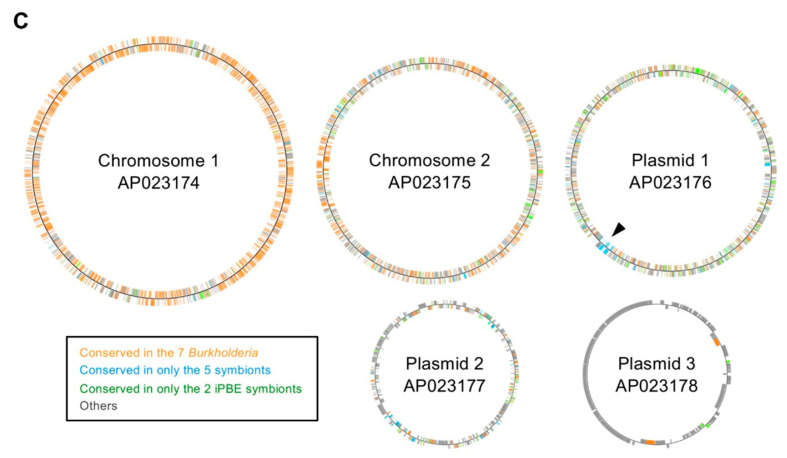
Comparative genomics for highlighting conserved genes among the five Burkholderia symbionts of stink bugs. (A) Venn diagram for the comparison between the five symbionts and the other two Burkholderia. The number of orthogroups is shown. One orthogroup may include two or more genes from a genome. (B) Relative abundance of the conserved orthogroups classified into each COG functional category. Since one orthogroup may be classified into two or more categories, the sum of relative abundance can be over 1. The description of each COG category is shown below the panels A and B. (C). The distribution of the conserved genes on the genome of the iPBE symbiont PGU16. The arrowhead indicates the region that contains the cluster of conserved genes in the five symbionts.
Figure 5
Figure 5
Comparative genomics for highlighting conserved genes among the five Burkholderia symbionts of stink bugs. (A) Venn diagram for the comparison between the five symbionts and the other two Burkholderia. The number of orthogroups is shown. One orthogroup may include two or more genes from a genome. (B) Relative abundance of the conserved orthogroups classified into each COG functional category. Since one orthogroup may be classified into two or more categories, the sum of relative abundance can be over 1. The description of each COG category is shown below the panels A and B. (C). The distribution of the conserved genes on the genome of the iPBE symbiont PGU16. The arrowhead indicates the region that contains the cluster of conserved genes in the five symbionts.

References

    1. Buchner P. Endosymbiosis of Animals With Plant Microorganisms. Interscience Publishers; New York, NY, USA: 1965.
    1. Bourtzis K., Miller T.A. In: Insect Symbiosis. Bourtzis K., Miller T.A., editors. CRC Press; Boca Raton, FL, USA: 2003.
    1. Engel P., Moran N.A. The gut microbiota of insects—Diversity in structure and function. FEMS Microbiol. Rev. 2013;37:699–735. doi: 10.1111/1574-6976.12025. - DOI - PubMed
    1. Douglas A.E. Multiorganismal insects: Diversity and function of resident microorganisms. Annu. Rev. Entomol. 2015;60:17–34. doi: 10.1146/annurev-ento-010814-020822. - DOI - PMC - PubMed
    1. Janson E.M., Stireman J.O., Singer M.S., Abbot P. Phytophagous insect–microbe mutualisms and adaptive evolutionary diversification. Evolution. 2008;62:997–1012. doi: 10.1111/j.1558-5646.2008.00348.x. - DOI - PubMed

Publication types

LinkOut - more resources