


Stroke mimics in patients clinically diagnosed with stroke at a tertiary teaching hospital in Tanzania: a prospective cohort study
- PMID: 32635888
- PMCID: PMC7339381
- DOI: 10.1186/s12883-020-01853-7
Stroke mimics in patients clinically diagnosed with stroke at a tertiary teaching hospital in Tanzania: a prospective cohort study
Abstract
Background: Stroke mimics account for up to one-third of acute stroke admissions and are a heterogeneous entity which pose diagnostic challenges. Diagnosing such patients is however crucial to avoid delays in treatment and potentially harmful medication prescription. We aimed at describing the magnitude, clinical characteristics and short-term outcomes of stroke mimics in patients clinically diagnosed with a stroke.
Methods: This prospective study enrolled patients admitted with a World Health Organization clinical criteria for stroke at a tertiary hospital in Tanzania. Baseline data was collected and the simplified version of the FABS scale was used to determine its usefulness in predicting stroke mimics. The National Institute of Health Stroke Scale and Modified Rankin Scale were used to assess for admission stroke severity and outcomes respectively.
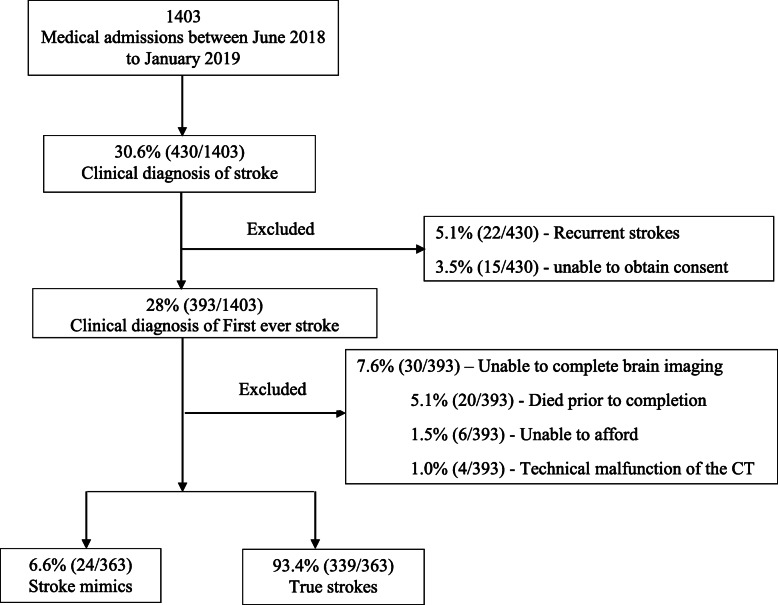
Results: Among 363 patients with suspected stroke on admission, the final diagnosis was stroke mimics in 24 (6.6%) who had a mean age of 65.8 ± 15 years. Patients with stroke mimics were less likely to have cardiovascular risk factors for stroke including premorbid hypertension (7 (29.2%) vs 263 (77.6%), p < 0.001) and increased waist-hip ratio (9 (37.5%) vs 270 (79.6%) p < 0.001) for mimics and true strokes respectively. Clinical findings such as hypertension and the presence of cortical features in neurological examination occurred less in patients with stroke mimics. The simplified FABS score of ≥3 could identify patients with stroke mimics with a sensitivity and specificity of 38 and 80% respectively. The most common causes of mimics were brain tumors 6 (25%), meningoencephalitis 4 (16.7%) and epileptic seizures 3 (12.5%). The majority of patients with stroke mimics had severe disease on admission and the 30-day mortality in these patients was 54.5%.
Conclusions: In the present study, the proportion of stroke mimics among patients clinically diagnosed with stroke was 6.6% and brain tumors was a common etiology. Stroke mimics were less likely to have cardiovascular risk factors and cortical signs during evaluation. We recommend further studies that can help develop clinical scales used for predicting stroke mimics in an African population.
Keywords: Magnitude; Mimics; Mortality; Outcomes; Stroke.
Conflict of interest statement
The authors declare that they have no competing interests.
Figures

References
-
- WHO Noncommunicable Diseases and Mental Health . The WHO STEPwise approach to stroke surveillance report. 2005.
-
- Onwuekwe IO, Ezeala-Adikaibe BA, Ohaegbulam SC, Chikani MC, Amuta J, Uloh HN. Stroke mimics - study of CT images in Nigerian African stroke patients. J Neurol Sci. 2008;25(3):143–149.
MeSH terms
LinkOut - more resources
Full Text Sources
Medical
