. 2020 Jul 7;5(4):e00039-20.
doi: 10.1128/mSystems.00039-20.

Abundant and Diverse RNA Viruses in Insects Revealed by RNA-Seq Analysis: Ecological and Evolutionary Implications

Affiliations

Abundant and Diverse RNA Viruses in Insects Revealed by RNA-Seq Analysis: Ecological and Evolutionary Implications

Haoming Wu et al. mSystems. .

Abstract

Increasing data indicate that insects serve as major reservoirs and vectors of viruses, which account for the continuously increasing ecological burden and infectious disease outbreaks. Uncovering the hidden diversity of viruses in insects will further the understanding of the ecological and evolutionary perspectives in the emergence of insect-associated virus diseases. In this study, we queried transcriptome sequencing (RNA-Seq) data from more than 600 species across 32 insect orders dwelling in different ecological habitats and recovered more than 1,213 RNA viruses that were recapitulated in 40 families, 2 unclassified genera, and many unspecified viral groups. These novel viruses included the well-known insect-associated viruses within Flaviviridae, Picornavirales, Bunyavirales, Mononegavirales, Nidovirales, Reoviridae, and Negevirus More appeared to form novel clusters within previously described taxa or could be resolved as paraphyletic, including the first astrovirus identified in insects, in which many were sufficiently divergent to warrant the establishment of new virus genera or families. Additionally, some viruses were closely related to the recognized plant-, fungus-, and vertebrate-specific species, implying the importance of relationships between insect behavior and virus spread. Comparative genome analyses also revealed high genomic variability with respect to the flexible gene pool and genome architecture of these newly described viruses, including the evidence for genome reshuffling first discovered in Dicistroviridae The data reflecting the genetically and ecologically diverse viral populations in insects greatly expand our understanding of RNA viruses in nature and highlight that the biodiversity of RNA viruses remains largely unexplored.IMPORTANCE Insects comprise the largest proportion of animals on earth and are frequently implicated in the transmission of vector-borne diseases. However, considerable attention has been paid to the phytophagous and hematophagous insects, with results that provide insufficient and biased information about the viruses in insects. Here, we have delivered compelling evidence for the exceptional abundance and genetic diversity of RNA viruses in a wide range of insects. Novel viruses were found to cover major categories of RNA viruses, and many formed novel clusters divergent from the previously described taxa, dramatically broadening the range of known RNA viruses in insects. These newly characterized RNA viruses exhibited high levels of genomic plasticity in genome size, open reading frame (ORF) number, intergenic structure, and gene rearrangement and segmentation. This work provides comprehensive insight into the origin, spread, and evolution of RNA viruses. Of course, a large-scale virome project involving more organisms would provide more-detailed information about the virus infections in insects.

Keywords: RNA virus; ecology; insect; virome; virus evolution.


Figures

FIG 1
FIG 1
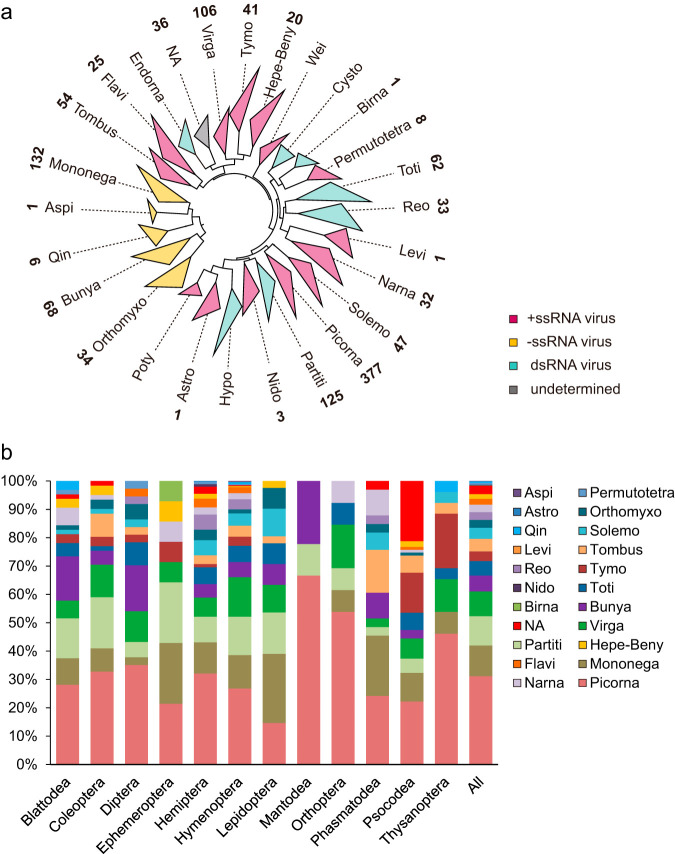
Taxonomic diversity and distribution of RNA viruses in insects. (a) Taxonomic reassessment of the RNA viruses based on RdRp. For each phylogeny, branches are collapsed and are displayed as triangles filled with different colors (see legend). The name of each clade is abbreviated based on the collapsed viral families or orders. The number of viral contigs assigned to each clade is indicated by the Arabic numerals next to the clade name. (b) Percent relative abundance of RNA viruses across each insect order. Those insect orders with too few samples (<10 samples) analyzed in our data set are not listed individually. Astro, Astroviridae; Aspi, Aspiviridae; Hepe-Beny, Benyviridae, Hepeviridae, Alphatetraviridae, Togaviridae, Bastrovirus; Birna, Birnavirdae; Bunya, Bunyavirales, Arenaviridae; Cysto, Cystoviridae; Endorna, Endornaviridae; Flavi, Flaviviridae; Hypo, Hypoviridae; Levi, Leviviridae; Mononega, Mononegavirales, Jingchuvirales; Narna, Narnaviridae, Botourmiaviridae; Nido, Nidovirales; Partiti, Partitiviridae, Amalgaviridae, Picobirnaviridae; Orthomyxo, Orthomyxoviridae; Permutotetra, Permutotetraviridae; Poty, Potyviridae; Picorna, Picornavirales, Solinviviridaes, Caliciviridae, Marnaviridae; Qin, Qinviridae; Solemo, Solemoviridae, Luteoviridae, Barnaviridae, Alvernaviridae; Reo, Reoviridae; Tombus, Tombusviridae, Nodaviridae, Sinaivirus, Carmotetraviridae, Luteoviridae; Toti, Totiviridae, Chrysoviridae, Megabirnaviridae, Quadriviridae, Botybirnavirus; Tymo, Tymovirales; Virga, Virgaviridae, Togaviridae, Bromoviridae, Closteroviridae, Idaeovirus; Wei, Weivirus; NA, unclassified.
FIG 2
FIG 2
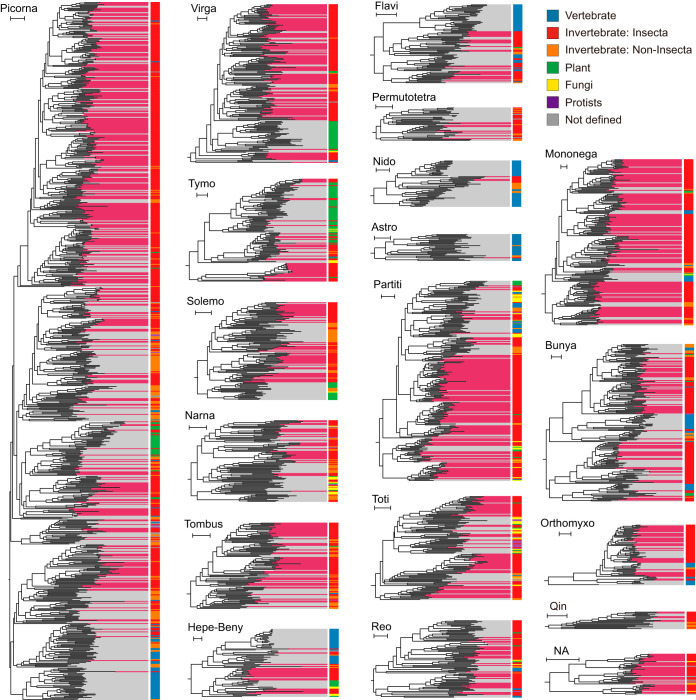
Genetic diversity of RNA viruses in insects. The illustrated phylogenetic trees, which 19 major groups of RNA viruses, were inferred based on RdRp data using the maximum likelihood method and rerooted at midpoint. As indicated, a branch background in red shading represents viruses identified in this study, and a branch background in shading represents those described previously. Host groups are indicated by differently colored bars (see legend). Scale bars represent 0.5 amino acid substitutions per site. Detailed phylogenies are available in Fig. S2 to S6.
FIG 3
FIG 3
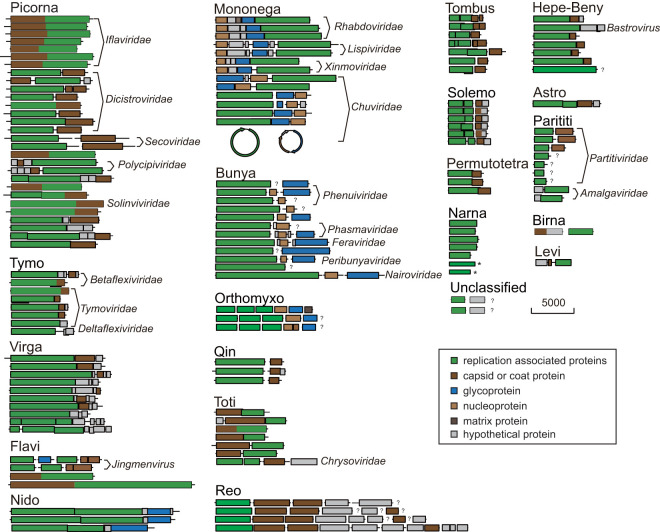
Genome architectures and comparison of representative viruses within major viral clades. The genomes are drawn as boxes and lines approximately to scale, representing open reading frames (ORFs) and noncoding regions, respectively. The predicted homologous genes are shown in colored boxes (see legend). The question marks (?) represent the missing genomic segments, and each asterisk (*) represents a novel hypothetical ORF on the minus strand of the virus genome.

References

    1. Suttle CA. 2007. Marine viruses–major players in the global ecosystem. Nat Rev Microbiol 5:801–812. doi: 10.1038/nrmicro1750. - DOI - PubMed
    1. Paez-Espino D, Eloe-Fadrosh EA, Pavlopoulos GA, Thomas AD, Huntemann M, Mikhailova N, Rubin E, Ivanova NN, Kyrpides NC. 2016. Uncovering Earth's virome. Nature 536:425–430. doi: 10.1038/nature19094. - DOI - PubMed
    1. Thurber RV, Haynes M, Breitbart M, Wegley L, Rohwer F. 2009. Laboratory procedures to generate viral metagenomes. Nat Protoc 4:470–483. doi: 10.1038/nprot.2009.10. - DOI - PubMed
    1. López-Bueno A, Tamames J, Velázquez D, Moya A, Quesada A, Alcamí A. 2009. High diversity of the viral community from an Antarctic lake. Science 326:858–861. doi: 10.1126/science.1179287. - DOI - PubMed
    1. Gilbert KB, Holcomb EE, Allscheid RL, Carrington JC. 2019. Hiding in plain sight: new virus genomes discovered via a systematic analysis of fungal public transcriptomes. PLoS One 14:e0219207. doi: 10.1371/journal.pone.0219207. - DOI - PMC - PubMed

LinkOut - more resources