. 2020 Jul 7;10(1):11168.
doi: 10.1038/s41598-020-68030-1.

Inhibition of interaction between Staphylococcus aureus α-hemolysin and erythrocytes membrane by hydrolysable tannins: structure-related activity study

Affiliations

Inhibition of interaction between Staphylococcus aureus α-hemolysin and erythrocytes membrane by hydrolysable tannins: structure-related activity study

Ewa Olchowik-Grabarek et al. Sci Rep. .

Abstract

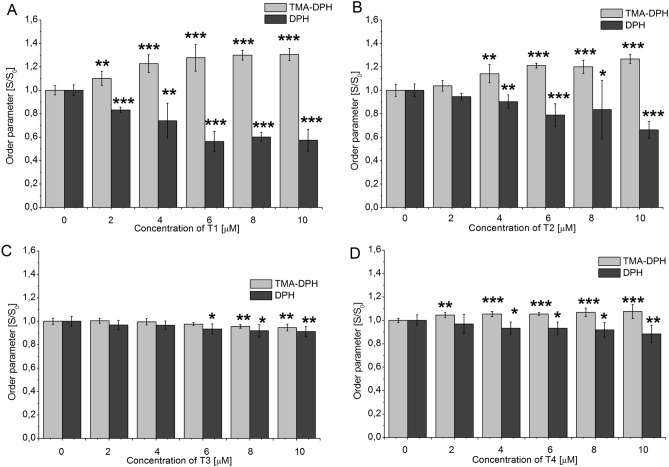
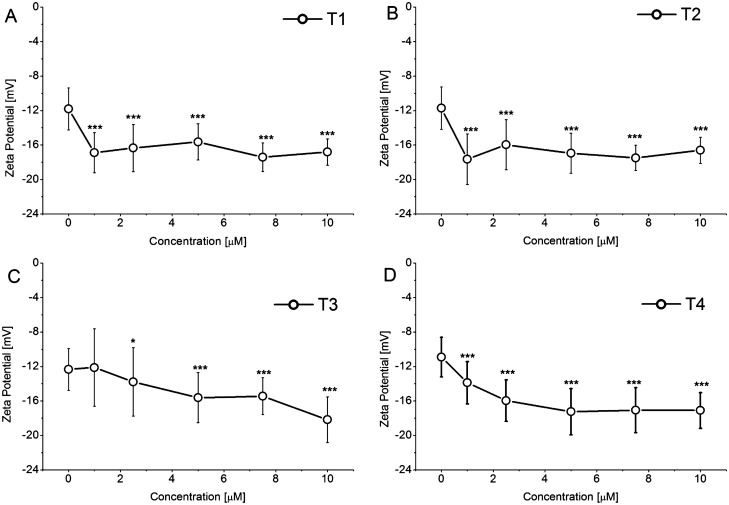
The objective of the study was a comparative analysis of the antihemolytic activity against two Staphylococcus aureus strains (8325-4 and NCTC 5655) as well as α-hemolysin and of the membrane modifying action of four hydrolysable tannins with different molecular mass and flexibility: 3,6-bis-O-di-O-galloyl-1,2,4-tri-O-galloyl-β-D-glucose (T1), 1,2,3,4,5-penta-O-galloyl-β-D-glucose (T2), 3-O-galloyl-1,2-valoneoyl-β-D-glucose (T3) and 1,2-di-O-galloyl-4,6-valoneoyl-β-D-glucose (T4). We showed that all the compounds studied manifested antihemolytic effects in the range of 5-50 µM concentrations. However, the degree of the reduction of hemolysis by the investigated tannins was not uniform. A valoneoyl group-containing compounds (T3 and T4) were less active. Inhibition of the hemolysis induced by α-hemolysin was also noticed on preincubated with the tannins and subsequently washed erythrocytes. In this case the efficiency again depended on the tannin structure and could be represented by the following order: T1 > T2 > T4 > T3. We also found a relationship between the degree of antihemolytic activity of the tannins studied and their capacity to increase the ordering parameter of the erythrocyte membrane outer layer and to change zeta potential. Overall, our study showed a potential of the T1 and T2 tannins as anti-virulence agents. The results of this study using tannins with different combinations of molecular mass and flexibility shed additional light on the role of tannin structure in activity manifestation.


Conflict of interest statement

The authors declare no competing interests.

Figures

Figure 1
Figure 1
Mechanisms of polyphenols protective action against bacterial activity on three different levels: (1) direct affecting bacterial cell biology (bacteria level), (2) modifying properties of secreted toxins (toxin level), (3) increasing target cells resistance (target cell level).
Figure 2
Figure 2
Chemical structure of 3,6-bis-O-di-O-galloyl-1,2,4-tri-O-galloyl-β-d-glucose (T1) (a), 1,2,3,4,5-penta-O-galloyl-β-d-glucose (PGG) (T2) (b), 3-O-galloyl-1,2-valoneoyl-β-d-glucose (T3) (c), and 1,2-di-O-galloyl-4,6-valoneoyl-β-d-glucose (T4) (d).
Figure 3
Figure 3
Percentage of hemolysis of sheep erythrocytes in presence studied tannins at the concentration of 50 μM (T1, T2, T3 and T4).
Figure 4
Figure 4
Protective effect of tannins (T1, T2, T3, and T4) against hemolysis induced by incubation of sheep erythrocytes with S. aureus NCTC 5655 (A) and S. aureus 8325-4 (B). The data presented are the means ± SD, n = 6. Lines represent best fit of logistic equation to the data. The effects of the tannins were statistically significant according to one-way ANOVA test, * < 0.05, **p < 0.01, ***p < 0.001.
Figure 5
Figure 5
Effects of tannins against hemolysis of sheep erythrocytes induced by α-hemolysin at different incubation conditions. (A) Erythrocytes were preincubated with tannins and tannins were also present during incubation with α-hemolysin. (B) Erythrocytes were first preincubated with tannins and then washed and thus were absent in the incubation media containing α-hemolysin. The data presented are the means ± SD, n = 6. Lines represent best fit of logistic equation to the data. The effects of the tannins were statistically significant according to one-way ANOVA test, * < 0.05, **p < 0.01, ***p < 0.001.
Figure 6
Figure 6
Changes of the order parameter S/S0 of erythrocytes membrane in the presence of tannins. S is sample with tannin, So is sample without tannin. The data presented are the means ± SD (n = 6). The effects of the tannins were statistically significant according to one-way ANOVA test, * < 0.05, **p < 0.01, ***p < 0.001.
Figure 7
Figure 7
Changes of erythrocytes Zeta potential in the presence of tannins. The data presented are the means ± SD (n = 6). The effects of the tannins were statistically significant according to one-way ANOVA test, * < 0.05, **p < 0.01, ***p < 0.001.

References

    1. Daglia M. Polyphenols as antimicrobial agents. Curr. Opin. Biotechnol. 2012;23:174–181. - PubMed
    1. Wink M, Ashour ML, El-Readi MZ. Secondary metabolites from plants inhibiting ABC transporters and reversing resistance of cancer cells and microbes to cytotoxic and antimicrobial agents. Front. Microbiol. 2012 doi: 10.3389/fmicb.2012.00130. - DOI - PMC - PubMed
    1. Redondo LM, Chacana PA, Dominguez JE, Miyakawa MEF. Perspectives in the use of tannins as alternative to antimicrobial growth promoter factors in poultry. Front. Microbiol. 2014 doi: 10.3389/fmicb.2014.00118. - DOI - PMC - PubMed
    1. Krueger E, Brown AC. Inhibition of bacterial toxin recognition of membrane components as an anti-virulence strategy. J Biol Eng. 2019 doi: 10.1186/s13036-018-0138-z. - DOI - PMC - PubMed
    1. Funatogawa K, et al. Antibacterial activity of hydrolyzable tannins derived from medicinal plants against Helicobacter pylori. Microbiol. Immunol. 2004;48:251–261. - PubMed

LinkOut - more resources