. 2020 Jun 24;6(26):eaba3231.
doi: 10.1126/sciadv.aba3231. eCollection 2020 Jun.

XAF1 as a modifier of p53 function and cancer susceptibility

Emilia M Pinto  1 Bonald C Figueiredo  2 Wenan Chen  3 Henrique C R Galvao  4 Maria Nirvana Formiga  5 Maria Candida B V Fragoso  6 Patricia Ashton-Prolla  7 Enilze M S F Ribeiro  8 Gabriela Felix  9 Tatiana E B Costa  10 Sharon A Savage  11 Meredith Yeager  11 Edenir I Palmero  4 Sahlua Volc  4 Hector Salvador  12 Jose Luis Fuster-Soler  13 Cinzia Lavarino  12 Guillermo Chantada  14 Dominique Vaur  15 Vicente Odone-Filho  16 Laurence Brugières  17 Tobias Else  18 Elena M Stoffel  18 Kara N Maxwell  19 Maria Isabel Achatz  20 Luis Kowalski  5 Kelvin C de Andrade  11 Alberto Pappo  21 Eric Letouze  22 Ana Claudia Latronico  6 Berenice B Mendonca  6 Madson Q Almeida  6 Vania B Brondani  6 Camila M Bittar  7 Emerson W S Soares  23 Carolina Mathias  8 Cintia R N Ramos  4 Moara Machado  11 Weiyin Zhou  11 Kristine Jones  11 Aurelie Vogt  11 Payal P Klincha  11 Karina M Santiago  5 Heloisa Komechen  2 Mariana M Paraizo  2 Ivy Z S Parise  2 Kayla V Hamilton  21 Jinling Wang  1 Evadnie Rampersaud  3 Michael R Clay  1 Andrew J Murphy  24 Enzo Lalli  25 Kim E Nichols  21 Raul C Ribeiro  21 Carlos Rodriguez-Galindo  14 Marta Korbonits  26 Jinghui Zhang  3 Mark G Thomas  27 Jon P Connelly  28 Shondra Pruett-Miller  28 Yoan Diekmann  27 Geoffrey Neale  29 Gang Wu  3 Gerard P Zambetti  1
Affiliations

XAF1 as a modifier of p53 function and cancer susceptibility

Emilia M Pinto et al. Sci Adv. .

Abstract

Cancer risk is highly variable in carriers of the common TP53-R337H founder allele, possibly due to the influence of modifier genes. Whole-genome sequencing identified a variant in the tumor suppressor XAF1 (E134*/Glu134Ter/rs146752602) in a subset of R337H carriers. Haplotype-defining variants were verified in 203 patients with cancer, 582 relatives, and 42,438 newborns. The compound mutant haplotype was enriched in patients with cancer, conferring risk for sarcoma (P = 0.003) and subsequent malignancies (P = 0.006). Functional analyses demonstrated that wild-type XAF1 enhances transactivation of wild-type and hypomorphic TP53 variants, whereas XAF1-E134* is markedly attenuated in this activity. We propose that cosegregation of XAF1-E134* and TP53-R337H mutations leads to a more aggressive cancer phenotype than TP53-R337H alone, with implications for genetic counseling and clinical management of hypomorphic TP53 mutant carriers.


Figures

Fig. 1
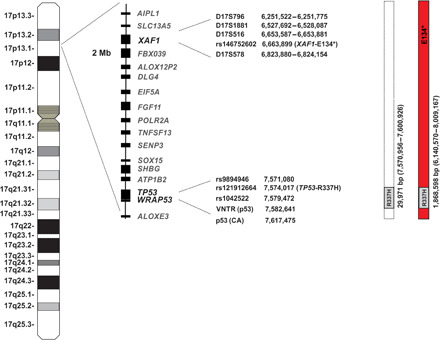
Fig. 1. Schematic diagram of chromosome 17p13 spanning 2-Mb region encompassing TP53-R337H and XAF1-E134* variants.
Identification and location of genes in this region as well as the genotyped SNPs and microsatellite markers are shown. Positions are given relative to build GRCh37/hg19. R337H-only and extended (TP53-R337H + XAF1-E134*) haplotypes observed in the population cohort study are represented.
Fig. 2
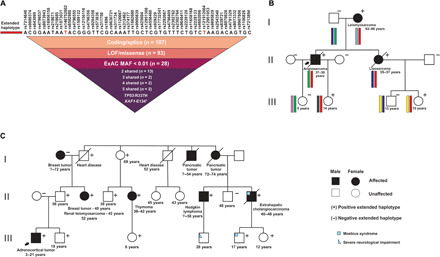
Fig. 2. Risk haplotype and representative pedigrees associated with the extended haplotype as determined by phasing.
(A) Common SNPs from the Axiom array spanning 2-Mb region in the chromosome 17p13 (see Fig. 1). Of the rare variants falling within haplotype boundaries, only TP53-R337H and XAF1-E134* variants remained after filtering for pathogenicity. ExAC: Exome Aggregation Consortium; MAF: Minor Allele Frequency. (B) Brazilian family (proband no. 108; table S2) diagnosed with angiosarcoma and their relatives. SNPs were used to phase the haplotypes. The risk haplotype harboring both mutant alleles (TP53-R337H and XAF1-E134*) is represented in red bars. The remaining haplotype is represented by different colors as segregating in family members. (C) Spanish family (proband no. 50; table S2). Age at diagnosis and present age or age at death are indicated in each pedigree. ExAC, Exome Aggregation Consortium; MAF, Minor Allele Frequency.
Fig. 3
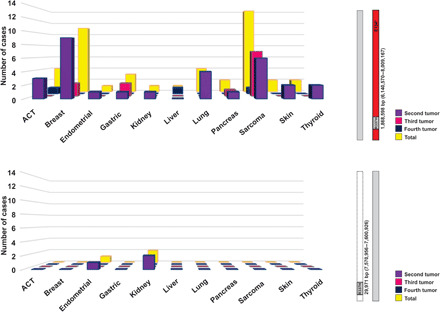
Fig. 3. Distribution of tumor types as a second, third, or fourth malignancy among patients with the R337H-only and extended haplotypes.
Thirty-three probands (29 females and 4 males) developed multiple primary malignancies. Multiple primary tumors in probands with the extended haplotype (n = 30) are visualized in the upper panel. Multiple primary tumors in probands with the R337H-only haplotype (n = 3) are visualized in the lower panel.
Fig. 4
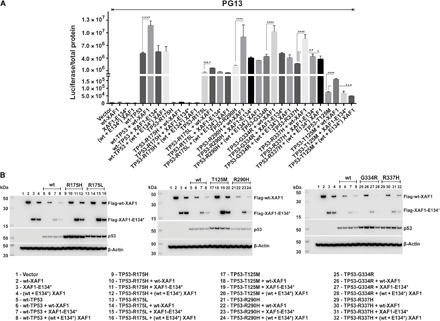
Fig. 4. XAF1 increases the transcriptional activity of hypomorphic TP53 variants.
Saos-2 cells were transiently transfected with p53-responsive promoter-luciferase reporters with or without p53 and XAF1 expression vectors, as described in the Supplementary Materials. PG13 promoter-reporter luciferase assay. Wild-type XAF1, but not XAF1-E134*, stimulated the transactivation function of wild-type p53 and other hypomorphic p53 variants such as T125M, R175L, R290H, and G334R. (A) Western blot analysis of p53 and XAF1 in the transfected cell lysates. (B) The columns represent the mean of three independent experiments (±SD), each performed in duplicate. Error bars indicate SDs. Asterisks indicate statistical significance, as determined by one-way analysis of variance (ANOVA) *P < 0.005; **P = 0.0096; ***P = 0.0009; ****P = <0.0001.
Fig. 5
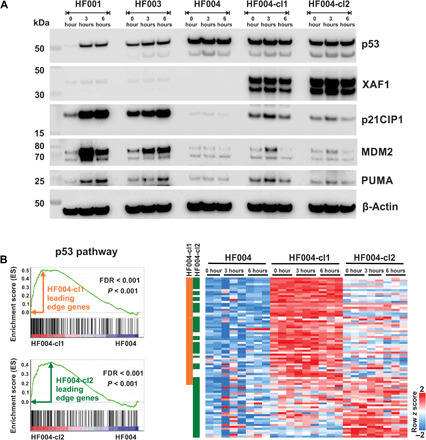
Fig. 5. Correction of the XAF1-E134* mutation using CRISPR-Cas9 in human low-passage fibroblasts restores full-length XAF1 and partial p53 responsiveness.
(A) Western blot analysis of MDM2, XAF1, p21CIP1, PUMA, and p53 expression in untreated and irradiated (5 Gy) low-passage fibroblasts. HF001 (wild-type XAF1 and TP53), HF003 (heterozygous XAF1- E134*; TP53-R337H), HF004 (homozygous XAF1-E134*; TP53-R337H), and derived HF004 clones with CRISPR-Cas9–corrected E134*(HF004cl1 and HF004cl2). (B) Gene set enrichment analysis (GSEA) showing the enrichment of p53 pathway signature in edited clones and heat map showing the expression levels in each cell line before and after IR treatment. Color scale represents SDs from the mean (z-score; range, −2 to 2). FDR, false discovery rate.

References

    1. McBride K. A., Ballinger M. L., Killick E., Kirk J., Tattersall M. H., Eeles R. A., Thomas D. M., Mitchell G., Li-Fraumeni syndrome: Cancer risk assessment and clinical management. Nat. Rev. Clin. Oncol. 11, 260–271 (2014). - PubMed
    1. Ribeiro R. C., Sandrini F., Figueiredo B., Zambetti G. P., Michalkiewicz E., Lafferty A. R., DeLacerda L., Rabin M., Cadwell C., Sampaio G., Cat I., Stratakis C. A., Sandrini R., An inherited p53 mutation that contributes in a tissue-specific manner to pediatric adrenal cortical carcinoma. Proc. Natl. Acad. Sci. U.S.A. 98, 9330–9335 (2001). - PMC - PubMed
    1. Latronico A. C., Pinto E. M., Domenice S., Fragoso M. C. B. V., Martin R. M., Zerbini M. C., Lucon A. M., Mendonca B. B., An inherited mutation outside the highly conserved DNA-binding domain of the p53 tumor suppressor protein in children and adults with sporadic adrenocortical tumors. J. Clin. Endocrinol. Metab. 86, 4970–4973 (2001). - PubMed
    1. Pinto E. M., Billerbeck A. E. C., Fragoso M. C. B. V., Domenice S., Mendonca B. B., Latronico A. C., Founder effect for the highly prevalent R337H mutation of tumor suppressor p53 in Brazilian patients with adrenocortical tumors. Arq. Bras. Endocrinol. Metabol. 48, 647–650 (2004). - PubMed
    1. Cury N. M., Ferraz V. E., Silva W. A. Jr., TP53 p.R337H prevalence in a series of Brazilian hereditary breast cancer families. Hered. Cancer Clin. Pract. 12, 8 (2014). - PMC - PubMed

Publication types