Molecular atlas of the adult mouse brain
- PMID: 32637622
- PMCID: PMC7319762
- DOI: 10.1126/sciadv.abb3446
Molecular atlas of the adult mouse brain
Abstract
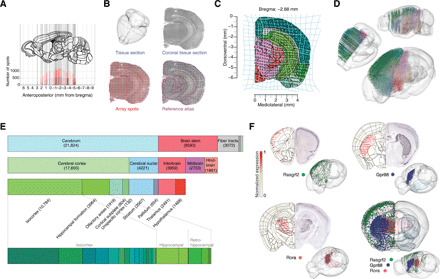
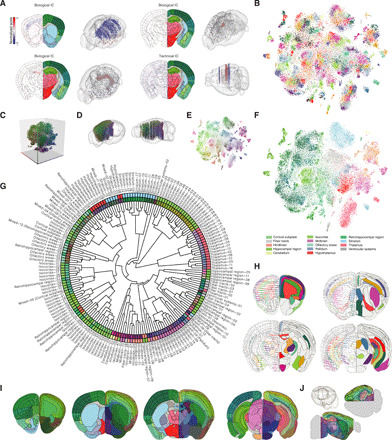
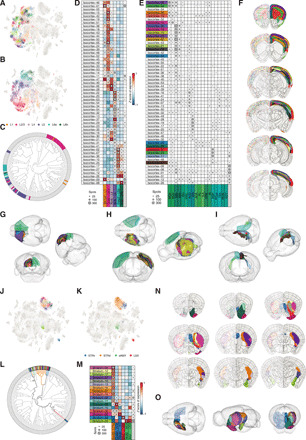
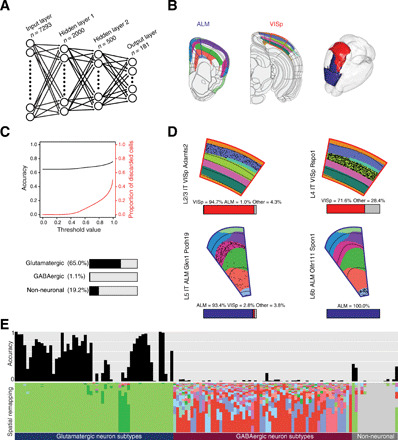
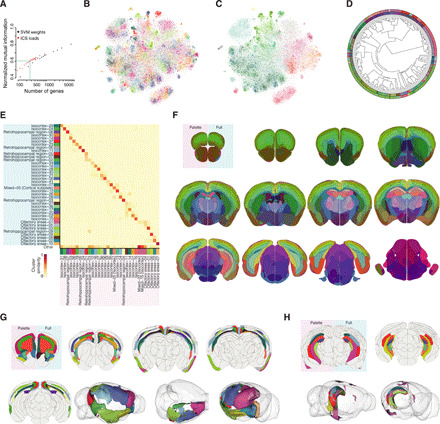
Brain maps are essential for integrating information and interpreting the structure-function relationship of circuits and behavior. We aimed to generate a systematic classification of the adult mouse brain based purely on the unbiased identification of spatially defining features by employing whole-brain spatial transcriptomics. We found that the molecular information was sufficient to deduce the complex and detailed neuroanatomical organization of the brain. The unsupervised (non-expert, data-driven) classification revealed new area- and layer-specific subregions, for example in isocortex and hippocampus, and new subdivisions of striatum. The molecular atlas further supports the characterization of the spatial identity of neurons from their single-cell RNA profile, and provides a resource for annotating the brain using a minimal gene set-a brain palette. In summary, we have established a molecular atlas to formally define the spatial organization of brain regions, including the molecular code for mapping and targeting of discrete neuroanatomical domains.
Copyright © 2020 The Authors, some rights reserved; exclusive licensee American Association for the Advancement of Science. No claim to original U.S. Government Works. Distributed under a Creative Commons Attribution NonCommercial License 4.0 (CC BY-NC).
Figures
References
-
- Crick F., Jones E., Backwardness of human neuroanatomy. Nature 361, 109–110 (1993). - PubMed
-
- Denk W., Briggman K. L., Helmstaedter M., Structural neurobiology: Missing link to a mechanistic understanding of neural computation. Nat. Rev. Neurosci. 13, 351–358 (2012). - PubMed
-
- Swanson L. W., Lichtman J. W., From Cajal to Connectome and beyond. Annu. Rev. Neurosci. 39, 197–216 (2016). - PubMed
-
- L. W. Swanson, A history of neuroanatomical mapping, in Brain Mapping: The Systems, A. W. Toga, J. C. Mazziotta, Eds. (Academic Press, 2000), pp. 77–109.
Publication types
MeSH terms
LinkOut - more resources
Full Text Sources
Molecular Biology Databases