


Levosimendan Efficacy and Safety: 20 Years of SIMDAX in Clinical Use
- PMID: 32639325
- PMCID: PMC7340234
- DOI: 10.1097/FJC.0000000000000859
Levosimendan Efficacy and Safety: 20 Years of SIMDAX in Clinical Use
Abstract
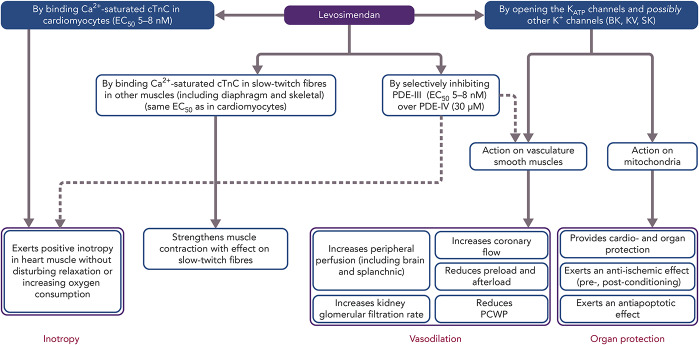
Levosimendan was first approved for clinical use in 2000, when authorization was granted by Swedish regulatory authorities for the hemodynamic stabilization of patients with acutely decompensated chronic heart failure (HF). In the ensuing 20 years, this distinctive inodilator, which enhances cardiac contractility through calcium sensitization and promotes vasodilatation through the opening of adenosine triphosphate-dependent potassium channels on vascular smooth muscle cells, has been approved in more than 60 jurisdictions, including most of the countries of the European Union and Latin America. Areas of clinical application have expanded considerably and now include cardiogenic shock, takotsubo cardiomyopathy, advanced HF, right ventricular failure, pulmonary hypertension, cardiac surgery, critical care, and emergency medicine. Levosimendan is currently in active clinical evaluation in the United States. Levosimendan in IV formulation is being used as a research tool in the exploration of a wide range of cardiac and noncardiac disease states. A levosimendan oral form is at present under evaluation in the management of amyotrophic lateral sclerosis. To mark the 20 years since the advent of levosimendan in clinical use, 51 experts from 23 European countries (Austria, Belgium, Croatia, Cyprus, Czech Republic, Estonia, Finland, France, Germany, Greece, Hungary, Italy, the Netherlands, Norway, Poland, Portugal, Russia, Slovenia, Spain, Sweden, Switzerland, the United Kingdom, and Ukraine) contributed to this essay, which evaluates one of the relatively few drugs to have been successfully introduced into the acute HF arena in recent times and charts a possible development trajectory for the next 20 years.
Conflict of interest statement
P. Pollesello, T. Sarapohja, and M. Kivikko are full-time or part-time employees of Orion Pharma. In the past 5 years, all other authors have received honoraria from Orion Pharma for educational lectures and/or unrestricted grants for investigator-initiated studies.
Figures
Comment in
-
Levosimendan Comes of Age: 20 Years of Clinical Use.J Cardiovasc Pharmacol. 2020 Jul;76(1):1-3. doi: 10.1097/FJC.0000000000000850. J Cardiovasc Pharmacol. 2020. PMID: 32433361 No abstract available.
References
-
- Fabiato A, Fabiato F. Calcium and cardiac excitation-contraction coupling. Ann Rev Physiol. 1979;41:473–484. - PubMed
-
- Wohlfart B, Noble MI. The cardiac excitation-contraction cycle. Pharmacol Ther. 1982;16:1–43. - PubMed
-
- Colucci WS, Wright RF, Braunwald E. New positive inotropic agents in the treatment of congestive heart failure. Mechanisms of action and recent clinical developments. 1. N Engl J Med. 1986;314:290–299. - PubMed
-
- Maskin CS, Sinoway L, Chadwick B, et al. Sustained hemodynamic and clinical effects of a new cardiotonic agent, WIN 47203, in patients with severe congestive heart failure. Circulation. 1983;67:1065–1070. - PubMed
Publication types
MeSH terms
Substances
LinkOut - more resources
Full Text Sources
Medical
Research Materials
Miscellaneous
