Review
. 2020 Jul 6;21(13):4782.
doi: 10.3390/ijms21134782.

Immunopathology of SARS-CoV-2 Infection: Immune Cells and Mediators, Prognostic Factors, and Immune-Therapeutic Implications

Affiliations
Review

Immunopathology of SARS-CoV-2 Infection: Immune Cells and Mediators, Prognostic Factors, and Immune-Therapeutic Implications

Alessandro Allegra et al. Int J Mol Sci. .

Abstract

The present is a comprehensive review of the immunopathology of Covid-19. The immune reaction to SARS-CoV-2 infection is characterized by differentiation and proliferation of a variety of immune cells with immune mediator production and release, and activation of other pathogen resistance mechanisms. We fully address the humoral and cellular immune changes induced by the virus, with particular emphasis on the role of the "cytokine storm" in the evolution of the disease. Moreover, we also propose some immune alterations (i.e., inflammatory parameters, cytokines, leukocytes and lymphocyte subpopulations) as prognostic markers of the disease. Furthermore, we discuss how immune modifying drugs, such as tocilizumab, chloroquine, glucocorticoids and immunoglobulins, and blood purification therapy, can constitute a fundamental moment in the therapy of the infection. Finally, we made a critical analysis of a number of substances, not yet utilized, but potentially useful in SARS-CoV-2 patients, such as IFN lambda, TNF blockers, ulinastatin, siponimod, tacrolimus, mesenchymal stem cells, inhibitors of mononuclear macrophage recruitment, IL-1 family antagonists, JAK-2 or STAT-3 inhibitors.

Keywords: IL-6; SARS-CoV-2; T lymphocyte; cytokine storm; immune response; prognostic factor.


Conflict of interest statement

The authors declare no conflict of interest.

Figures
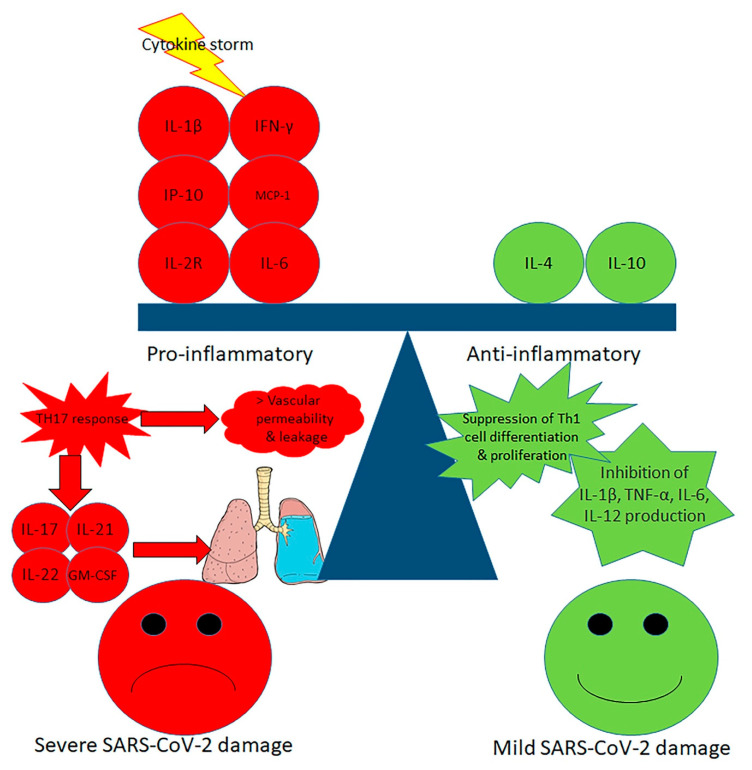
Figure 1
Figure 1
Mechanisms of cytokine storm in severe SARS-CoV-2 infection. In severe Severe Acute Respiratory Syndrome Coronavirus 2 (SARS-CoV-2), a pro-inflammatory cascade is prevalent, with T-helper type 1 (Th1) and T-helper type 17 (Th17) cytokine upregulation leading to increased vascular permeability and leakage with severe lung damage. In mild SARS-CoV-2, an anti-inflammatory behavior is prevalent, featuring the suppression of Th1 cell differentiation and proliferation with inhibition of IL-1β, TNF-α, IL-6 and IL-12 production.
Figure 2
Figure 2
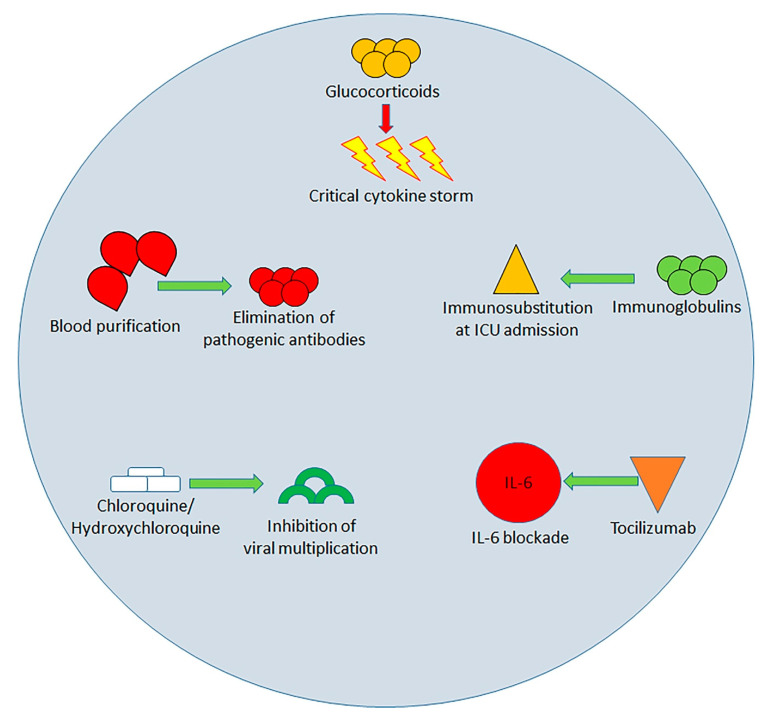
Possible treatment methods for SARS-CoV-2 until present (red arrows indicate inhibition, green arrows indicate promotion/enhancement of the related mechanism). Glucocorticoids limit the production and damaging effects of cytokines so avoiding acute lung injury induced by the cytokine storm; the blood purification removes pathogenic antibodies; Intravenous administration of immunoglobulins (IVIG) has the dual actions of immune substitution and immunomodulation, which are particularly useful during early phase of the cytokine storm; Chloroquine and hydroxychloroquine inhibit viral multiplication and restore the CD8+ cytotoxic viral response; Tocilizumab blocks IL-6; the preliminary results of clinical trials all demonstrate its clinical efficacy.

References

    1. Magrone T., Magrone M., Jirillo E. Focus on Receptors for Coronaviruses with Special Reference to Angiotensin-converting Enzyme 2 as a Potential Drug Target—A Perspective. Endocr. Metab. Immune Disord. Drug Targets. 2020 doi: 10.2174/1871530320666200427112902. [Epub ahead of print, 27 April 2020] - DOI - PubMed
    1. Li F. Structure, function, and evolution of coronavirus spike proteins. Annu. Rev. Virol. 2016;3:237–261. doi: 10.1146/annurev-virology-110615-042301. - DOI - PMC - PubMed
    1. Nelemans T., Kikkert M. Viral innate immune evasion and the pathogenesis of emerging RNA virus infections. Viruses. 2019;11:961. doi: 10.3390/v11100961. - DOI - PMC - PubMed
    1. Fehr A.R., Channappanavar R., Perlman S. Middle East respiratory syndrome: Emergence of a pathogenic human coronavirus. Annu. Rev. Med. 2017;68:387–399. doi: 10.1146/annurev-med-051215-031152. - DOI - PMC - PubMed
    1. Rognan D., Zimmermann N., Jung G., Folkers G. Molecular dynamics study of a complex between the human histocompatibility antigen HLA-A2 and the IMP58-66 nonapeptide from influenza virus matrix protein. Eur. J. Biochem. 1992;208:101–113. doi: 10.1111/j.1432-1033.1992.tb17163.x. - DOI - PubMed

MeSH terms

LinkOut - more resources